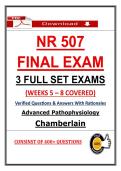
NR 507
FINAL EXAM
3 FULL SET EXAMS
(WEEKS 5 – 8 COVERED)
Verified Questions & Answers With Rationales
Advanced Pathophysiology
Chamberlain
CONSINST OF 400+ QUESTIONS
, NR 507 Final Exam - 3 Full Sets
PREVIEW PAGES BELOW
Get the Complete PDF After Purchase
ORIGINAL QUESTION LAYOUT TABLE OF CONTENTS KEPT
Need More Help?
If you require further clarification or
are in need of any study resources,
feel free to Message me.
Preview first. Complete document follows.
Question pages below are preserved from the original PDF.
,Table of Contents
NR 507 — FINAL EXAM SET 1 ........................................ 2
NR 507 — FINAL EXAM SET 2 ..................................... 56
NR 507 — FINAL EXAM SET 3 ..................................... 80
NR 507 — FINAL EXAM SET 1
1. A 52-year-old patient reports chronic heartburn that worsens when lying flat and
is accompanied by a persistent cough and hoarseness. Which pathophysiological
mechanism best explains the patient's atypical symptoms?
A. Increased gastric acid secretion due to Zollinger-Ellison syndrome
B. Impaired lower esophageal sphincter tone allowing reflux into the larynx
C. Delayed gastric emptying causing intestinal distention
D. Esophageal strictures causing mechanical obstruction
Correct Answer: B
Expert Rationale:
Atypical GERD symptoms such as chronic cough and hoarseness occur when gastric
contents reflux beyond the esophagus into the larynx and respiratory tract. This is most
commonly caused by decreased lower esophageal sphincter tone, allowing repeated
exposure of upper airway tissues to acid.
2. A patient with long-standing GERD has progressive dysphagia. Which complication
is the NP most concerned about based on GERD pathophysiology?
A. Esophageal varices
B. Esophageal stricture formation
C. Gastric outlet obstruction
D. Acute pancreatitis
Correct Answer: B
, Expert Rationale:
Chronic acid exposure leads to esophagitis and fibrosis, increasing the risk of
esophageal strictures, which present with progressive dysphagia. This is a known
complication of untreated GERD.
3. A patient with GERD continues to have symptoms despite lifestyle modifications
and H2 blockers. Which medication directly targets the underlying mechanism of
acid-mediated mucosal injury?
A. Metoclopramide
B. Sucralfate
C. Omeprazole
D. Aluminum hydroxide
Correct Answer: C
Expert Rationale:
Proton pump inhibitors such as omeprazole inhibit gastric acid secretion at the proton
pump, providing the most effective acid suppression and addressing the core
mechanism of GERD-related mucosal injury.
4. A patient presents with periumbilical pain that later localizes to the right lower
quadrant, fever, and nausea. Which underlying mechanism explains this progression
of pain?
A. Local ischemia of the colon
B. Visceral to parietal peritoneal inflammation
C. Compression of the ileocecal valve
D. Referred pain from the liver
Correct Answer: B
Expert Rationale:
Early appendicitis causes visceral pain perceived near the umbilicus. As inflammation
spreads to the parietal peritoneum, pain localizes to the RLQ, particularly at McBurney's
point.
5. Which laboratory finding best supports the diagnosis of acute appendicitis while
helping rule out alternative diagnoses?
A. Elevated liver enzymes
B. Positive H. pylori testing
C. Elevated WBC count with CRP
D. Low hemoglobin
Correct Answer: C
, Expert Rationale:
An elevated WBC count and CRP indicate acute inflammation and support appendicitis,
while urinalysis and HCG testing help exclude urinary or gynecologic causes.
6. An adult patient expresses concern about long-term risks following appendectomy.
Which emerging association should the NP include in counseling?
A. Increased risk of colorectal cancer
B. Increased risk of liver disease
C. Reduced risk of Parkinson disease
D. Increased risk of Alzheimer's disease
Correct Answer: C
Expert Rationale:
Emerging evidence suggests appendectomy may reduce the risk of Parkinson disease,
possibly due to decreased α-synuclein propagation via the vagus nerve.
7. Which imbalance is central to the development of peptic ulcer disease?
A. Increased bile production and reduced pancreatic enzymes
B. Increased gastric motility and decreased absorption
C. Increased aggressive factors overwhelming protective mechanisms
D. Decreased mucosal blood flow due to hypotension
Correct Answer: C
Expert Rationale:
PUD develops when aggressive factors (acid, H. pylori, NSAIDs) overwhelm protective
mechanisms (mucus, bicarbonate, prostaglandins), leading to mucosal erosion.
8. A patient reports epigastric pain that improves with meals. Which ulcer type is
most consistent with this presentation?
A. Gastric ulcer
B. Duodenal ulcer
C. Stress ulcer
D. Malignant ulcer
Correct Answer: B
Expert Rationale:
Duodenal ulcers classically cause pain 2-3 hours after eating that is relieved by food or
antacids, due to buffering of gastric acid.
9. Which medication mechanism explains why NSAIDs increase the risk of PUD?
A. Increased gastric acid secretion
B. Direct bacterial colonization
, NR 507 — FINAL EXAM SET 2
1. Which of the following is true regarding a complicated urinary tract infection?
A. It occurs only in healthy non-pregnant women.
B. It can be caused by a structural urinary tract disorder.
C. It never extends beyond the bladder.
D. It always responds to a short course of antibiotics.
Correct Answer:
B. It can be caused by a structural urinary tract disorder.
Expert Rationale:
A complicated UTI is associated with structural or functional urinary tract abnormalities,
urinary obstruction, catheter use, pregnancy, diabetes, renal calculi, or extension beyond
the bladder.
2. Which of the following is a risk factor for the development of a urinary tract
infection (UTI)?
A. Pregnancy
B. High fluid intake
C. Long urethral length
D. Absence of sexual activity
Correct Answer:
A. Pregnancy
Expert Rationale:
Pregnancy increases UTI risk because hormonal and mechanical changes can promote
urinary stasis and bacterial growth.
3. A symptom of a lower urinary tract infection includes:
A. Flank pain
B. Costovertebral angle tenderness
C. Urgency
D. Shaking chills
Correct Answer:
C. Urgency
Expert Rationale:
,Lower UTIs commonly cause dysuria, urgency, frequency, and suprapubic discomfort. Flank
pain, fever, and chills suggest upper tract involvement.
4. Women are at a higher risk for the development of a UTI because of having a
shorter urethra.
A. True
B. False
Correct Answer:
A. True
Expert Rationale:
A shorter female urethra allows bacteria to ascend more easily from the perineal area into
the bladder.
5. Which of the following can help to prevent a UTI?
A. Decrease water consumption
B. Increase water consumption
C. Hold urine for long periods
D. Use hygiene sprays routinely
Correct Answer:
B. Increase water consumption
Expert Rationale:
Adequate hydration promotes urine flow, which helps flush bacteria from the urinary tract
and reduces urinary stasis.
6. Risk factors for a UTI
A. Pregnancy
B. Sexually active
C. Post-menopause
D. Estrogen-deficiency
E. Women with shorter urethra
F. Catheterization
G. High daily water intake
Correct Answer:
A, B, C, D, E, and F.
Expert Rationale:
UTI risk increases with pregnancy, sexual activity, estrogen deficiency after menopause,
female anatomy, and catheterization. High water intake is generally protective rather than a
risk factor.
, NR 507 — FINAL EXAM SET 3
1. Select all that apply: Which diseases are associated with Type 2 hypersensitivity?
A. Myasthenia Gravis
B. Systemic Lupus Erythematosis (SLE)
C. Hemolytic Anemia
D. Grave's Disease
E. Contact Dermatitis
Correct Answer:
A. Myasthenia Gravis C. Hemolytic Anemia D. Grave's Disease
Expert Rationale:
Type II hypersensitivity is antibody-mediated, usually involving IgG or IgM directed against
cell-surface antigens or receptors. Myasthenia gravis involves antibodies against
acetylcholine receptors, hemolytic anemia involves antibodies against red blood cells, and
Graves’ disease involves antibodies stimulating TSH receptors. SLE is mainly Type III, and
contact dermatitis is Type IV.
2. Select all that apply: Which findings are consistent with anaphylaxis?
A. Hypotension
B. Bronchoconstriction
C. Bradycardia
D. Urticaria
E. Increased mucus production
Correct Answer:
A. Hypotension B. Bronchoconstriction D. Urticaria E. Increased mucus production
Expert Rationale:
Anaphylaxis is a severe Type I hypersensitivity reaction caused by IgE-mediated mast cell
degranulation. Histamine and other mediators cause vasodilation, hypotension,
bronchoconstriction, urticaria, and increased mucus production. Bradycardia is not typical;
tachycardia is more commonly expected due to hypotension and sympathetic
compensation.
,3. Which best describes a Type 1 hypersensitivity reaction?
A. IgG-mediated cytotoxic reaction
B. Immune complex deposition in tissues
C. IgE-mediated immediate allergic reaction
D. Delayed T-cell-mediated response
Correct Answer:
C. IgE-mediated immediate allergic reaction
Expert Rationale:
Type I hypersensitivity reactions are immediate allergic reactions mediated by IgE
antibodies. Upon re-exposure to an allergen, IgE on mast cells triggers degranulation and
release of histamine, leukotrienes, and prostaglandins.
4. Select all that apply: Which are clinical manifestations of HIV?
A. Decreased CD4 count
B. Opportunistic Infections
C. Weight gain
D. Wasting syndrome
E. Night sweats
Correct Answer:
A. Decreased CD4 count B. Opportunistic Infections D. Wasting syndrome E. Night sweats
Expert Rationale:
HIV primarily targets CD4+ helper T cells, leading to immune suppression. As CD4 counts
decline, patients become vulnerable to opportunistic infections, chronic fever, night sweats,
weight loss, and wasting syndrome. Weight gain is not a typical manifestation of
progressive HIV disease.
5. Select all that apply: Which factors contribute to autoimmune disease
development?
A. Genetic Predisposition
B. Environmental triggers
C. Loss of self-tolerance
D. Decreased antibody production
E. Autoantibody formation
, NR 507
FINAL EXAM
3 FULL SET EXAMS
(WEEKS 5 – 8 COVERED)
Verified Questions & Answers With Rationales
Advanced Pathophysiology
Chamberlain
CONSINST OF 400+ QUESTIONS
FINAL EXAM
3 FULL SET EXAMS
(WEEKS 5 – 8 COVERED)
Verified Questions & Answers With Rationales
Advanced Pathophysiology
Chamberlain
CONSINST OF 400+ QUESTIONS
, NR 507 Final Exam - 3 Full Sets
PREVIEW PAGES BELOW
Get the Complete PDF After Purchase
ORIGINAL QUESTION LAYOUT TABLE OF CONTENTS KEPT
Need More Help?
If you require further clarification or
are in need of any study resources,
feel free to Message me.
Preview first. Complete document follows.
Question pages below are preserved from the original PDF.
,Table of Contents
NR 507 — FINAL EXAM SET 1 ........................................ 2
NR 507 — FINAL EXAM SET 2 ..................................... 56
NR 507 — FINAL EXAM SET 3 ..................................... 80
NR 507 — FINAL EXAM SET 1
1. A 52-year-old patient reports chronic heartburn that worsens when lying flat and
is accompanied by a persistent cough and hoarseness. Which pathophysiological
mechanism best explains the patient's atypical symptoms?
A. Increased gastric acid secretion due to Zollinger-Ellison syndrome
B. Impaired lower esophageal sphincter tone allowing reflux into the larynx
C. Delayed gastric emptying causing intestinal distention
D. Esophageal strictures causing mechanical obstruction
Correct Answer: B
Expert Rationale:
Atypical GERD symptoms such as chronic cough and hoarseness occur when gastric
contents reflux beyond the esophagus into the larynx and respiratory tract. This is most
commonly caused by decreased lower esophageal sphincter tone, allowing repeated
exposure of upper airway tissues to acid.
2. A patient with long-standing GERD has progressive dysphagia. Which complication
is the NP most concerned about based on GERD pathophysiology?
A. Esophageal varices
B. Esophageal stricture formation
C. Gastric outlet obstruction
D. Acute pancreatitis
Correct Answer: B
, Expert Rationale:
Chronic acid exposure leads to esophagitis and fibrosis, increasing the risk of
esophageal strictures, which present with progressive dysphagia. This is a known
complication of untreated GERD.
3. A patient with GERD continues to have symptoms despite lifestyle modifications
and H2 blockers. Which medication directly targets the underlying mechanism of
acid-mediated mucosal injury?
A. Metoclopramide
B. Sucralfate
C. Omeprazole
D. Aluminum hydroxide
Correct Answer: C
Expert Rationale:
Proton pump inhibitors such as omeprazole inhibit gastric acid secretion at the proton
pump, providing the most effective acid suppression and addressing the core
mechanism of GERD-related mucosal injury.
4. A patient presents with periumbilical pain that later localizes to the right lower
quadrant, fever, and nausea. Which underlying mechanism explains this progression
of pain?
A. Local ischemia of the colon
B. Visceral to parietal peritoneal inflammation
C. Compression of the ileocecal valve
D. Referred pain from the liver
Correct Answer: B
Expert Rationale:
Early appendicitis causes visceral pain perceived near the umbilicus. As inflammation
spreads to the parietal peritoneum, pain localizes to the RLQ, particularly at McBurney's
point.
5. Which laboratory finding best supports the diagnosis of acute appendicitis while
helping rule out alternative diagnoses?
A. Elevated liver enzymes
B. Positive H. pylori testing
C. Elevated WBC count with CRP
D. Low hemoglobin
Correct Answer: C
, Expert Rationale:
An elevated WBC count and CRP indicate acute inflammation and support appendicitis,
while urinalysis and HCG testing help exclude urinary or gynecologic causes.
6. An adult patient expresses concern about long-term risks following appendectomy.
Which emerging association should the NP include in counseling?
A. Increased risk of colorectal cancer
B. Increased risk of liver disease
C. Reduced risk of Parkinson disease
D. Increased risk of Alzheimer's disease
Correct Answer: C
Expert Rationale:
Emerging evidence suggests appendectomy may reduce the risk of Parkinson disease,
possibly due to decreased α-synuclein propagation via the vagus nerve.
7. Which imbalance is central to the development of peptic ulcer disease?
A. Increased bile production and reduced pancreatic enzymes
B. Increased gastric motility and decreased absorption
C. Increased aggressive factors overwhelming protective mechanisms
D. Decreased mucosal blood flow due to hypotension
Correct Answer: C
Expert Rationale:
PUD develops when aggressive factors (acid, H. pylori, NSAIDs) overwhelm protective
mechanisms (mucus, bicarbonate, prostaglandins), leading to mucosal erosion.
8. A patient reports epigastric pain that improves with meals. Which ulcer type is
most consistent with this presentation?
A. Gastric ulcer
B. Duodenal ulcer
C. Stress ulcer
D. Malignant ulcer
Correct Answer: B
Expert Rationale:
Duodenal ulcers classically cause pain 2-3 hours after eating that is relieved by food or
antacids, due to buffering of gastric acid.
9. Which medication mechanism explains why NSAIDs increase the risk of PUD?
A. Increased gastric acid secretion
B. Direct bacterial colonization
, NR 507 — FINAL EXAM SET 2
1. Which of the following is true regarding a complicated urinary tract infection?
A. It occurs only in healthy non-pregnant women.
B. It can be caused by a structural urinary tract disorder.
C. It never extends beyond the bladder.
D. It always responds to a short course of antibiotics.
Correct Answer:
B. It can be caused by a structural urinary tract disorder.
Expert Rationale:
A complicated UTI is associated with structural or functional urinary tract abnormalities,
urinary obstruction, catheter use, pregnancy, diabetes, renal calculi, or extension beyond
the bladder.
2. Which of the following is a risk factor for the development of a urinary tract
infection (UTI)?
A. Pregnancy
B. High fluid intake
C. Long urethral length
D. Absence of sexual activity
Correct Answer:
A. Pregnancy
Expert Rationale:
Pregnancy increases UTI risk because hormonal and mechanical changes can promote
urinary stasis and bacterial growth.
3. A symptom of a lower urinary tract infection includes:
A. Flank pain
B. Costovertebral angle tenderness
C. Urgency
D. Shaking chills
Correct Answer:
C. Urgency
Expert Rationale:
,Lower UTIs commonly cause dysuria, urgency, frequency, and suprapubic discomfort. Flank
pain, fever, and chills suggest upper tract involvement.
4. Women are at a higher risk for the development of a UTI because of having a
shorter urethra.
A. True
B. False
Correct Answer:
A. True
Expert Rationale:
A shorter female urethra allows bacteria to ascend more easily from the perineal area into
the bladder.
5. Which of the following can help to prevent a UTI?
A. Decrease water consumption
B. Increase water consumption
C. Hold urine for long periods
D. Use hygiene sprays routinely
Correct Answer:
B. Increase water consumption
Expert Rationale:
Adequate hydration promotes urine flow, which helps flush bacteria from the urinary tract
and reduces urinary stasis.
6. Risk factors for a UTI
A. Pregnancy
B. Sexually active
C. Post-menopause
D. Estrogen-deficiency
E. Women with shorter urethra
F. Catheterization
G. High daily water intake
Correct Answer:
A, B, C, D, E, and F.
Expert Rationale:
UTI risk increases with pregnancy, sexual activity, estrogen deficiency after menopause,
female anatomy, and catheterization. High water intake is generally protective rather than a
risk factor.
, NR 507 — FINAL EXAM SET 3
1. Select all that apply: Which diseases are associated with Type 2 hypersensitivity?
A. Myasthenia Gravis
B. Systemic Lupus Erythematosis (SLE)
C. Hemolytic Anemia
D. Grave's Disease
E. Contact Dermatitis
Correct Answer:
A. Myasthenia Gravis C. Hemolytic Anemia D. Grave's Disease
Expert Rationale:
Type II hypersensitivity is antibody-mediated, usually involving IgG or IgM directed against
cell-surface antigens or receptors. Myasthenia gravis involves antibodies against
acetylcholine receptors, hemolytic anemia involves antibodies against red blood cells, and
Graves’ disease involves antibodies stimulating TSH receptors. SLE is mainly Type III, and
contact dermatitis is Type IV.
2. Select all that apply: Which findings are consistent with anaphylaxis?
A. Hypotension
B. Bronchoconstriction
C. Bradycardia
D. Urticaria
E. Increased mucus production
Correct Answer:
A. Hypotension B. Bronchoconstriction D. Urticaria E. Increased mucus production
Expert Rationale:
Anaphylaxis is a severe Type I hypersensitivity reaction caused by IgE-mediated mast cell
degranulation. Histamine and other mediators cause vasodilation, hypotension,
bronchoconstriction, urticaria, and increased mucus production. Bradycardia is not typical;
tachycardia is more commonly expected due to hypotension and sympathetic
compensation.
,3. Which best describes a Type 1 hypersensitivity reaction?
A. IgG-mediated cytotoxic reaction
B. Immune complex deposition in tissues
C. IgE-mediated immediate allergic reaction
D. Delayed T-cell-mediated response
Correct Answer:
C. IgE-mediated immediate allergic reaction
Expert Rationale:
Type I hypersensitivity reactions are immediate allergic reactions mediated by IgE
antibodies. Upon re-exposure to an allergen, IgE on mast cells triggers degranulation and
release of histamine, leukotrienes, and prostaglandins.
4. Select all that apply: Which are clinical manifestations of HIV?
A. Decreased CD4 count
B. Opportunistic Infections
C. Weight gain
D. Wasting syndrome
E. Night sweats
Correct Answer:
A. Decreased CD4 count B. Opportunistic Infections D. Wasting syndrome E. Night sweats
Expert Rationale:
HIV primarily targets CD4+ helper T cells, leading to immune suppression. As CD4 counts
decline, patients become vulnerable to opportunistic infections, chronic fever, night sweats,
weight loss, and wasting syndrome. Weight gain is not a typical manifestation of
progressive HIV disease.
5. Select all that apply: Which factors contribute to autoimmune disease
development?
A. Genetic Predisposition
B. Environmental triggers
C. Loss of self-tolerance
D. Decreased antibody production
E. Autoantibody formation
, NR 507
FINAL EXAM
3 FULL SET EXAMS
(WEEKS 5 – 8 COVERED)
Verified Questions & Answers With Rationales
Advanced Pathophysiology
Chamberlain
CONSINST OF 400+ QUESTIONS