
C213 WGU, Key Points exam with all
solution
Terms in this set (51)
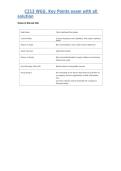
Debt Ratio Total Liabilities/Total Assets
Current Ratio Current Assets/Current Liabilities. Only need a balance
sheet.
Return on Sales Net Income/Sales. Only need income statement
Asset Turnover Sales/Total Assets
Return on Equity Net Income/Stockholder's equity. Balance and Income
Statements used.
Price-Earnings Ratio (PE) Market Value fo Shares/Net Income
Accounting is the recording of the day-to-day financial activities of
a company and the organization of that information
into
summary reports used to evaluate the company's
financial status.
, Bookeeping is the preservation of a systematic, quantitative
record of an activity. Without bookkeeping, good
business is impossible. An accounting system is
used by a business to handle routine bookkeeping
tasks and to structure the information so it can be
used to evaluate the performance and financial
status of the business. Accounting information is
intended to be useful in making decisions about the
future.
The focus of financial accounting is the three primary financial statements: the balance
sheet, the income statement, and the statement of
cash flows.
Financial accounting information is provided for, and used by, external users. Managerial
accounting is the name given to accounting systems
designed for internal users. The information provided
by financial
accounting is summarized in the financial statements:
The balance sheet reports a company's assets,
liabilities, and owners' equity.
The income statement reports the amount of net
income earned by a company during a period.
Net income is the excess of a company's
revenues over its expenses.
The statement of cash flows reports the amount of cash
collected and paid out by a company in the
following three types of activities: operating,
investing, and financing.
Among the users of financial lenders, investors, company management, suppliers,
accounting information are customers, employees, competitors, government
agencies, politicians, and the press.
Financial accounting information helps lenders evaluate the cash flows a business can be
expected to generate in the future in order to repay
loans. Investors use the same type of information to
assess the attractiveness of
companies as investments. Managers use financial
accounting data to formulate company goals, to
compute bonuses for
employees, and to illuminate company weaknesses.
Suppliers, customers, and employees use financial
statements to tell them about the long-run prospects
of a company.
Competitors use financial accounting information
to reveal strategic opportunities within their
industry. Government agencies and politicians
use financial statement data to
bolster political and regulatory positions for and
against companies. Reporters use financial
accounting data as
background information and to indicate which
companies are undergoing significant changes in
financial status.
solution
Terms in this set (51)
Debt Ratio Total Liabilities/Total Assets
Current Ratio Current Assets/Current Liabilities. Only need a balance
sheet.
Return on Sales Net Income/Sales. Only need income statement
Asset Turnover Sales/Total Assets
Return on Equity Net Income/Stockholder's equity. Balance and Income
Statements used.
Price-Earnings Ratio (PE) Market Value fo Shares/Net Income
Accounting is the recording of the day-to-day financial activities of
a company and the organization of that information
into
summary reports used to evaluate the company's
financial status.
, Bookeeping is the preservation of a systematic, quantitative
record of an activity. Without bookkeeping, good
business is impossible. An accounting system is
used by a business to handle routine bookkeeping
tasks and to structure the information so it can be
used to evaluate the performance and financial
status of the business. Accounting information is
intended to be useful in making decisions about the
future.
The focus of financial accounting is the three primary financial statements: the balance
sheet, the income statement, and the statement of
cash flows.
Financial accounting information is provided for, and used by, external users. Managerial
accounting is the name given to accounting systems
designed for internal users. The information provided
by financial
accounting is summarized in the financial statements:
The balance sheet reports a company's assets,
liabilities, and owners' equity.
The income statement reports the amount of net
income earned by a company during a period.
Net income is the excess of a company's
revenues over its expenses.
The statement of cash flows reports the amount of cash
collected and paid out by a company in the
following three types of activities: operating,
investing, and financing.
Among the users of financial lenders, investors, company management, suppliers,
accounting information are customers, employees, competitors, government
agencies, politicians, and the press.
Financial accounting information helps lenders evaluate the cash flows a business can be
expected to generate in the future in order to repay
loans. Investors use the same type of information to
assess the attractiveness of
companies as investments. Managers use financial
accounting data to formulate company goals, to
compute bonuses for
employees, and to illuminate company weaknesses.
Suppliers, customers, and employees use financial
statements to tell them about the long-run prospects
of a company.
Competitors use financial accounting information
to reveal strategic opportunities within their
industry. Government agencies and politicians
use financial statement data to
bolster political and regulatory positions for and
against companies. Reporters use financial
accounting data as
background information and to indicate which
companies are undergoing significant changes in
financial status.


