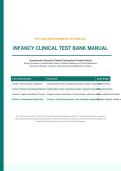
PSYC 290: DEVELOPMENTAL PSYCHOLOGY
INFANCY CLINICAL TEST BANK MANUAL
Comprehensive Postnatal & Pediatric Development Evaluation Manual
Directly Grounded in Verified Study Guides, Academic Modules, and Clinical Milestones.
Focusing on Physical, Cognitive, and Socioemotional Milestones in Infancy.
Core Clinical Domain Focus Area Exam Weight
Domain I: Physical Growth & Proportions Postnatal growth metrics, cephalocaudal length transitions, cardiac 25%
& sleep timelines
Domain II: Sensory & Neurological Milestones Cerebral lobes function, myelination insulation, neonatal sensory development
25% hierarchy
Domain III: Cognitive Development Theories Piagetian schemes, assimilation vs. accommodation, object permanence,
25% and Behaviorist models
Domain IV: Socioemotional & Attachment Primary vs. self-conscious emotions, infant cries/smiles, temperament
25%styles, Ainsworth / Bowlby mo
This manual is designed for nursing and developmental psychology educators. It features realistic case scenarios,
high-yield board-style multiple-choice questions, detailed rationales for distractors, key developmental concepts, and
common test-taking mistakes to foster critical clinical reasoning.
,PSYC 290: DEVELOPMENTAL PSYCHOLOGY INFANCY TEST BANK MANUAL
SECTION 1: PHYSICAL DEVELOPMENT: POSTNATAL GROWTH &
PROPORTIONS
QUESTION 1
Learning Objective: Analyze developmental changes in physical size, growth velocities, and cephalocaudal
head-to-body proportions during infancy.
A clinician is evaluating a healthy, full-term toddler at their 2-year well-child examination. Based on
developmental norms in North America, which physical growth metrics and head-to-body length proportions are
expected for this typical 2-year-old child?
A. Average weight of 26 to 32 pounds, average length of 32 to 35 inches, with the head accounting for
approximately 1/4th of total body length.
B. Average weight of 15 to 20 pounds, average length of 28 to 30 inches, with the head accounting for
approximately 1/3rd of total body length.
C. Average weight of 35 to 40 pounds, average length of 38 to 40 inches, with the head accounting for
approximately 1/8th of total body length.
D. Average weight of 20 to 25 pounds, average length of 30 to 32 inches, with the head accounting for
approximately 1/2 of total body length.
CORRECT ANSWER ■: A
ANSWER KEY
Detailed According to established developmental statistics, a typical full-term North American
Explanation: infant averages 20 inches in length and 7.6 pounds at birth. By the end of the second
year, weight increases to 26–32 pounds, and length increases to 32–35 inches.
Furthermore, cephalocaudal development alters proportions: the head accounts for 1/3rd
of body length at birth, is reduced to 1/4th by age 2, and reaches about 1/8th in
adulthood. Thus, Option A is correct. Option B describes neonatal or early infancy
metrics. Option C describes childhood/preschool proportions. Option D is mathematically
incorrect and physiologically impossible.
Key Concept: Head-to-body proportions transition cephalocaudally from 1/3rd of total length at birth to
1/4th by age 2, reflecting rapid trunk and limb growth relative to head size.
Common Mistake: Students commonly fail to recall the specific fractional reductions (1/3 to 1/4 to 1/8) or
confuse birth proportions with toddler/adult milestones.
Cognitive Level: Remembering (Knowledge) | MSC: Client Needs: Health Promotion and Maintenance
Grounded in Student Courseware & Verified Learning Objectives Page 2
, PSYC 290: DEVELOPMENTAL PSYCHOLOGY INFANCY TEST BANK MANUAL
SECTION 2: BRAIN DEVELOPMENT: CELEBRAL LOBES & MYELINATION
QUESTION 2
Learning Objective: Differentiate the distinct cognitive and sensory functions of the four cerebral lobes and
understand the role of myelination in neural efficiency.
An infant is observing a brightly colored mobile rotating above their crib. Which cerebral lobe is primarily
engaged in processing this complex visual stimulus, and what biological modification is responsible for
increasing the speed and efficiency of communication along these newly formed neural pathways?
A. Frontal lobe; synaptic pruning within the primary sensory cortex.
B. Temporal lobe; dendritic branching across the synaptic gap.
C. Occipital lobe; myelination of axonal pathways with a white, fatty substance.
D. Parietal lobe; neurotransmitter depletion within the visual cortex.
CORRECT ANSWER ■: C
ANSWER KEY
Detailed The occipital lobes contain the primary visual cortex, which processes visual stimuli such
Explanation: as the moving mobile. To make neural communication efficient, neurons develop myelin,
a white fatty substance that acts as an insulator, accelerating neurotransmission along
the axons. Frontal lobes control voluntary movement and higher-order reasoning.
Temporal lobes process auditory stimuli and language comprehension. Parietal lobes
process somatosensory information (touch). Therefore, Option C is correct.
Key Concept: Myelination is the developmental coating of axons with a fatty sheath that speeds up
nerve impulse conduction, facilitating rapid sensory-motor integration.
Common Mistake: Students often confuse the sensory domains of the lobes (e.g., misassociating vision with
the temporal or parietal lobes) or confuse myelin with dendrites.
Cognitive Level: Understanding (Comprehension) | MSC: Client Needs: Physiological Integrity: Physiological Adaptation
Grounded in Student Courseware & Verified Learning Objectives Page 3
INFANCY CLINICAL TEST BANK MANUAL
Comprehensive Postnatal & Pediatric Development Evaluation Manual
Directly Grounded in Verified Study Guides, Academic Modules, and Clinical Milestones.
Focusing on Physical, Cognitive, and Socioemotional Milestones in Infancy.
Core Clinical Domain Focus Area Exam Weight
Domain I: Physical Growth & Proportions Postnatal growth metrics, cephalocaudal length transitions, cardiac 25%
& sleep timelines
Domain II: Sensory & Neurological Milestones Cerebral lobes function, myelination insulation, neonatal sensory development
25% hierarchy
Domain III: Cognitive Development Theories Piagetian schemes, assimilation vs. accommodation, object permanence,
25% and Behaviorist models
Domain IV: Socioemotional & Attachment Primary vs. self-conscious emotions, infant cries/smiles, temperament
25%styles, Ainsworth / Bowlby mo
This manual is designed for nursing and developmental psychology educators. It features realistic case scenarios,
high-yield board-style multiple-choice questions, detailed rationales for distractors, key developmental concepts, and
common test-taking mistakes to foster critical clinical reasoning.
,PSYC 290: DEVELOPMENTAL PSYCHOLOGY INFANCY TEST BANK MANUAL
SECTION 1: PHYSICAL DEVELOPMENT: POSTNATAL GROWTH &
PROPORTIONS
QUESTION 1
Learning Objective: Analyze developmental changes in physical size, growth velocities, and cephalocaudal
head-to-body proportions during infancy.
A clinician is evaluating a healthy, full-term toddler at their 2-year well-child examination. Based on
developmental norms in North America, which physical growth metrics and head-to-body length proportions are
expected for this typical 2-year-old child?
A. Average weight of 26 to 32 pounds, average length of 32 to 35 inches, with the head accounting for
approximately 1/4th of total body length.
B. Average weight of 15 to 20 pounds, average length of 28 to 30 inches, with the head accounting for
approximately 1/3rd of total body length.
C. Average weight of 35 to 40 pounds, average length of 38 to 40 inches, with the head accounting for
approximately 1/8th of total body length.
D. Average weight of 20 to 25 pounds, average length of 30 to 32 inches, with the head accounting for
approximately 1/2 of total body length.
CORRECT ANSWER ■: A
ANSWER KEY
Detailed According to established developmental statistics, a typical full-term North American
Explanation: infant averages 20 inches in length and 7.6 pounds at birth. By the end of the second
year, weight increases to 26–32 pounds, and length increases to 32–35 inches.
Furthermore, cephalocaudal development alters proportions: the head accounts for 1/3rd
of body length at birth, is reduced to 1/4th by age 2, and reaches about 1/8th in
adulthood. Thus, Option A is correct. Option B describes neonatal or early infancy
metrics. Option C describes childhood/preschool proportions. Option D is mathematically
incorrect and physiologically impossible.
Key Concept: Head-to-body proportions transition cephalocaudally from 1/3rd of total length at birth to
1/4th by age 2, reflecting rapid trunk and limb growth relative to head size.
Common Mistake: Students commonly fail to recall the specific fractional reductions (1/3 to 1/4 to 1/8) or
confuse birth proportions with toddler/adult milestones.
Cognitive Level: Remembering (Knowledge) | MSC: Client Needs: Health Promotion and Maintenance
Grounded in Student Courseware & Verified Learning Objectives Page 2
, PSYC 290: DEVELOPMENTAL PSYCHOLOGY INFANCY TEST BANK MANUAL
SECTION 2: BRAIN DEVELOPMENT: CELEBRAL LOBES & MYELINATION
QUESTION 2
Learning Objective: Differentiate the distinct cognitive and sensory functions of the four cerebral lobes and
understand the role of myelination in neural efficiency.
An infant is observing a brightly colored mobile rotating above their crib. Which cerebral lobe is primarily
engaged in processing this complex visual stimulus, and what biological modification is responsible for
increasing the speed and efficiency of communication along these newly formed neural pathways?
A. Frontal lobe; synaptic pruning within the primary sensory cortex.
B. Temporal lobe; dendritic branching across the synaptic gap.
C. Occipital lobe; myelination of axonal pathways with a white, fatty substance.
D. Parietal lobe; neurotransmitter depletion within the visual cortex.
CORRECT ANSWER ■: C
ANSWER KEY
Detailed The occipital lobes contain the primary visual cortex, which processes visual stimuli such
Explanation: as the moving mobile. To make neural communication efficient, neurons develop myelin,
a white fatty substance that acts as an insulator, accelerating neurotransmission along
the axons. Frontal lobes control voluntary movement and higher-order reasoning.
Temporal lobes process auditory stimuli and language comprehension. Parietal lobes
process somatosensory information (touch). Therefore, Option C is correct.
Key Concept: Myelination is the developmental coating of axons with a fatty sheath that speeds up
nerve impulse conduction, facilitating rapid sensory-motor integration.
Common Mistake: Students often confuse the sensory domains of the lobes (e.g., misassociating vision with
the temporal or parietal lobes) or confuse myelin with dendrites.
Cognitive Level: Understanding (Comprehension) | MSC: Client Needs: Physiological Integrity: Physiological Adaptation
Grounded in Student Courseware & Verified Learning Objectives Page 3