Page 1 of 67
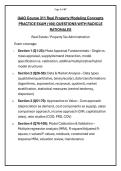
IAAO Course 311 Real Property Modeling Concepts
PRACTICE EXAM (100) QUESTIONS WITH RADICLE
RATIONALES
Real Estate / Property Tax Administration
Exam coverage:
I. Section 1 (Q1-25): Mass Appraisal Fundamentals – Single vs.
mass appraisal, supply/demand interaction, model
specification vs. calibration, additive/multiplicative/hybrid
model structures
II. Section 2 (Q26-50): Data & Market Analysis – Data types
(qualitative/quantitative, binary/scalar), data transformations
(logarithmic, exponential, reciprocal, quotient), market
stratification, statistical measures (central tendency,
dispersion)
III. Section 3 (Q51-75): Approaches to Value – Cost approach
(depreciation as demand, cost components as supply), sales
comparison approach, income approach (GIM, capitalization
rates), ratio studies (COD, PRD, COV)
IV. Section 4 (Q76-100): Model Calibration & Validation –
Multiple regression analysis (MRA), R-square/Adjusted R-
square, t-values/F-values, residuals, constrained and
stepwise MRA, valuation review, maintenance
, Page 2 of 67
QUESTION 1
A surgical technologist is preparing the operating room for a
laparoscopic cholecystectomy. The surgeon's preference card
indicates the procedure requires a 10mm laparoscope. Which
piece of equipment should the surgical technologist verify is
available and functional?
A) 0° or 30° laparoscope with fiberoptic light cord and camera
head
B) 5mm laparoscope with a rigid bronchoscope adapter
C) Flexible sigmoidoscope with a light source
D) 10mm laparoscope without a light cord
CORRECT: A) 0° or 30° laparoscope with fiberoptic light cord
and camera head ✔️
RATIONALE: Laparoscopic cholecystectomy requires a 10mm
laparoscope, typically 0° or 30°. The scope must be connected
to a fiberoptic light cord and camera head for visualization. The
surgeon's preference card should specify the angle of the
scope .
QUESTION 2
The surgical technologist is performing the surgical scrub before
a procedure. Which of the following is the correct duration for
the initial surgical scrub using an antimicrobial agent?
A) 1 to 2 minutes
B) 3 to 5 minutes
C) 10 to 15 minutes
D) 30 seconds
CORRECT: B) 3 to 5 minutes ✔️
RATIONALE: The initial surgical scrub using an antimicrobial
agent should be performed for 3 to 5 minutes. Subsequent
, Page 3 of 67
scrubs may be shorter. The scrub must include all surfaces of
the hands and forearms up to the elbows .
QUESTION 3
During a surgical procedure, the surgeon requests a "10-blade"
to make the initial incision. Which instrument should the
surgical technologist pass?
A) #10 scalpel blade on a #3 knife handle
B) #11 scalpel blade on a #4 knife handle
C) #15 scalpel blade on a #3 knife handle
D) #10 scalpel blade on a #7 knife handle
CORRECT: A) #10 scalpel blade on a #3 knife handle ✔️
RATIONALE: The #10 blade is a large, curved blade used for
making skin incisions. It is mounted on a #3 knife handle. The
#11 blade is used for stab incisions, and the #15 blade is used
for finer, more delicate work .
QUESTION 4
Which of the following is the correct sequence for donning a
sterile gown and gloves for a surgical procedure?
A) Sterile gown, then sterile gloves using the open-gloving
technique
B) Sterile gown, then sterile gloves using the closed-gloving
technique
C) Sterile gloves using the open-gloving technique, then sterile
gown
D) Sterile gloves using the closed-gloving technique, then sterile
gown
CORRECT: B) Sterile gown, then sterile gloves using the
closed-gloving technique ✔️
RATIONALE: The correct sequence is to don the sterile gown
, Page 4 of 67
first, then apply sterile gloves using the closed-gloving
technique. The closed-gloving technique ensures the gloved
hand does not touch the outside of the gown, maintaining
sterility .
QUESTION 5
A surgical technologist is preparing the back table for a
procedure. Which of the following actions maintains the sterility
of the sterile field?
A) Placing items within 1 inch of the edge of the sterile field
B) Placing items at least 1 inch from the edge of the sterile field
C) Placing items directly on the edge of the sterile field
D) Placing items on the floor and transferring them to the back
table
CORRECT: B) Placing items at least 1 inch from the edge of
the sterile field ✔️
RATIONALE: Items should be placed at least 1 inch from the
edge of the sterile field. The 1-inch border is considered non-
sterile and helps maintain the integrity of the sterile field .
QUESTION 6
During a procedure, the surgical technologist notices a break in
sterile technique. What is the most appropriate action?
A) Ignore the break and continue the procedure
B) Notify the surgeon and circulator immediately
C) Wait until the procedure is over to report the break
D) Continue the procedure and document the break later
CORRECT: B) Notify the surgeon and circulator immediately
✔️
RATIONALE: Any break in sterile technique must be reported
immediately. This includes contamination of the sterile field,
IAAO Course 311 Real Property Modeling Concepts
PRACTICE EXAM (100) QUESTIONS WITH RADICLE
RATIONALES
Real Estate / Property Tax Administration
Exam coverage:
I. Section 1 (Q1-25): Mass Appraisal Fundamentals – Single vs.
mass appraisal, supply/demand interaction, model
specification vs. calibration, additive/multiplicative/hybrid
model structures
II. Section 2 (Q26-50): Data & Market Analysis – Data types
(qualitative/quantitative, binary/scalar), data transformations
(logarithmic, exponential, reciprocal, quotient), market
stratification, statistical measures (central tendency,
dispersion)
III. Section 3 (Q51-75): Approaches to Value – Cost approach
(depreciation as demand, cost components as supply), sales
comparison approach, income approach (GIM, capitalization
rates), ratio studies (COD, PRD, COV)
IV. Section 4 (Q76-100): Model Calibration & Validation –
Multiple regression analysis (MRA), R-square/Adjusted R-
square, t-values/F-values, residuals, constrained and
stepwise MRA, valuation review, maintenance
, Page 2 of 67
QUESTION 1
A surgical technologist is preparing the operating room for a
laparoscopic cholecystectomy. The surgeon's preference card
indicates the procedure requires a 10mm laparoscope. Which
piece of equipment should the surgical technologist verify is
available and functional?
A) 0° or 30° laparoscope with fiberoptic light cord and camera
head
B) 5mm laparoscope with a rigid bronchoscope adapter
C) Flexible sigmoidoscope with a light source
D) 10mm laparoscope without a light cord
CORRECT: A) 0° or 30° laparoscope with fiberoptic light cord
and camera head ✔️
RATIONALE: Laparoscopic cholecystectomy requires a 10mm
laparoscope, typically 0° or 30°. The scope must be connected
to a fiberoptic light cord and camera head for visualization. The
surgeon's preference card should specify the angle of the
scope .
QUESTION 2
The surgical technologist is performing the surgical scrub before
a procedure. Which of the following is the correct duration for
the initial surgical scrub using an antimicrobial agent?
A) 1 to 2 minutes
B) 3 to 5 minutes
C) 10 to 15 minutes
D) 30 seconds
CORRECT: B) 3 to 5 minutes ✔️
RATIONALE: The initial surgical scrub using an antimicrobial
agent should be performed for 3 to 5 minutes. Subsequent
, Page 3 of 67
scrubs may be shorter. The scrub must include all surfaces of
the hands and forearms up to the elbows .
QUESTION 3
During a surgical procedure, the surgeon requests a "10-blade"
to make the initial incision. Which instrument should the
surgical technologist pass?
A) #10 scalpel blade on a #3 knife handle
B) #11 scalpel blade on a #4 knife handle
C) #15 scalpel blade on a #3 knife handle
D) #10 scalpel blade on a #7 knife handle
CORRECT: A) #10 scalpel blade on a #3 knife handle ✔️
RATIONALE: The #10 blade is a large, curved blade used for
making skin incisions. It is mounted on a #3 knife handle. The
#11 blade is used for stab incisions, and the #15 blade is used
for finer, more delicate work .
QUESTION 4
Which of the following is the correct sequence for donning a
sterile gown and gloves for a surgical procedure?
A) Sterile gown, then sterile gloves using the open-gloving
technique
B) Sterile gown, then sterile gloves using the closed-gloving
technique
C) Sterile gloves using the open-gloving technique, then sterile
gown
D) Sterile gloves using the closed-gloving technique, then sterile
gown
CORRECT: B) Sterile gown, then sterile gloves using the
closed-gloving technique ✔️
RATIONALE: The correct sequence is to don the sterile gown
, Page 4 of 67
first, then apply sterile gloves using the closed-gloving
technique. The closed-gloving technique ensures the gloved
hand does not touch the outside of the gown, maintaining
sterility .
QUESTION 5
A surgical technologist is preparing the back table for a
procedure. Which of the following actions maintains the sterility
of the sterile field?
A) Placing items within 1 inch of the edge of the sterile field
B) Placing items at least 1 inch from the edge of the sterile field
C) Placing items directly on the edge of the sterile field
D) Placing items on the floor and transferring them to the back
table
CORRECT: B) Placing items at least 1 inch from the edge of
the sterile field ✔️
RATIONALE: Items should be placed at least 1 inch from the
edge of the sterile field. The 1-inch border is considered non-
sterile and helps maintain the integrity of the sterile field .
QUESTION 6
During a procedure, the surgical technologist notices a break in
sterile technique. What is the most appropriate action?
A) Ignore the break and continue the procedure
B) Notify the surgeon and circulator immediately
C) Wait until the procedure is over to report the break
D) Continue the procedure and document the break later
CORRECT: B) Notify the surgeon and circulator immediately
✔️
RATIONALE: Any break in sterile technique must be reported
immediately. This includes contamination of the sterile field,