Math 110 Exam 1
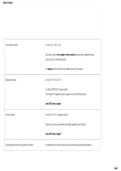
Polynomial Function ex: f(x)= 2x^4 + 3x^2 - 10x
all powers must be non negative whole numbers cannot have negative powers,
square roots, or fractional powers
the degree of the function is the highest power (in this case 4)
Rational Function ex: f(x)= (x^3 +5x^2 -7) / x+1
It is the QUOTIENT of 2 polynomials
This means NO negative powers, square roots or fractional powers
does NOT have a degree
Power Function ex: f(x)= 2x^5, 3x^-2, square roots, etc
Powers can be any real number (including negatives and fractions)
does NOT have a degree
All polynomial functions are power functions... but the reverse is not true! Not all power functions are polynomial functions
Page 1
, Math 110 Exam 1
Equilibrium Point occurs where the supply function equals the demand function
s(x) = d(x)
To find equilibrium quantity set s(x)=d(x) and solve for x
To find equilibrium price, p set s(x)=d(x) and solve for x and plug it back into either s(x) or d(x)
Demand p(x) p denotes price and x is the amount produced
Revenue R(x) R(x)= x * p(x)
Total Cost C(x) Fixed cost + variable cost
Avg. Cost C(x) / x
Profit P(x) R(x) - C(x)
Break Even Level Where R(x) = C(x) or
Where P(x) = 0
Limits The limit is the y-value that a function approaches as it gets closer and closer to a
given x-value
You start every limit by plugging in the x value
Page 2
Polynomial Function ex: f(x)= 2x^4 + 3x^2 - 10x
all powers must be non negative whole numbers cannot have negative powers,
square roots, or fractional powers
the degree of the function is the highest power (in this case 4)
Rational Function ex: f(x)= (x^3 +5x^2 -7) / x+1
It is the QUOTIENT of 2 polynomials
This means NO negative powers, square roots or fractional powers
does NOT have a degree
Power Function ex: f(x)= 2x^5, 3x^-2, square roots, etc
Powers can be any real number (including negatives and fractions)
does NOT have a degree
All polynomial functions are power functions... but the reverse is not true! Not all power functions are polynomial functions
Page 1
, Math 110 Exam 1
Equilibrium Point occurs where the supply function equals the demand function
s(x) = d(x)
To find equilibrium quantity set s(x)=d(x) and solve for x
To find equilibrium price, p set s(x)=d(x) and solve for x and plug it back into either s(x) or d(x)
Demand p(x) p denotes price and x is the amount produced
Revenue R(x) R(x)= x * p(x)
Total Cost C(x) Fixed cost + variable cost
Avg. Cost C(x) / x
Profit P(x) R(x) - C(x)
Break Even Level Where R(x) = C(x) or
Where P(x) = 0
Limits The limit is the y-value that a function approaches as it gets closer and closer to a
given x-value
You start every limit by plugging in the x value
Page 2