Math 110 Exam Review
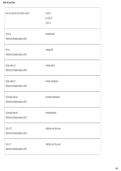
How do you know if a function is even? f(-x)=f(x)
ex. f(x)=x^2
f(-x)=x^2
f(x)=(x-c) horizontal shift
What kind of transformation is this?
f(x)=x-c vertical shift
What kind of transformation is this?
f(x)=ax when a>1 vertical stretch
What kind of transformation is this?
f(x)=ax when a<1 vertical compression
What kind of transformation is this?
f(x)=sin(ax) when a>1 horizontal compression
What kind of transformation is this?
f(x)=sin(ax) when a<1 horizontal stretch
What kind of transformation is this?
f(x)=(-x)^2 reflection over the x-axis
What kind of transformation is this?
f(x)=-x^2 reflection over the y-axis
What kind of transformation is this?
1 of 6
, Math 110 Exam Review
f(x)=a(x-h)^2 +k vertex form of a quadratic
What is this called?
What is the domain for composition functions when they are Where f(x) and g(x) overlap
sums, differences, or products? f(g(x))
What is the domain for composition functions when it is a where f(x) and g(x) overlap EXCEPT where g(x)=0
quotient? f(g(x))
When can you use synthetic division? When the divisor is (x-c) or (x+c)
What is factor theorem? Use the factor given and do synthetic division. If there is no remainder, the number is a
factor
Is there a sign change for odd or even multiplicity? Odd
What is the quadratic formula? x = (-b ± √b^2 - 4ac)/2a
(will get 2 answers)
How do you find a hole in a rational function? Factors in the numerator and denominator cancel out
How do you find vertical asymptotes in rational functions? Whatever unconcealed factors are in the numerator are the vertical asymptotes
How do you find the horizontal asymptotes in rational degree on top < degree on bottom, y=0
functions? degree on top=degree on bottom, y=ratio of leading coefficients
degree on top > degree on bottom, no horizontal asymptote, has a slant asymptote
2 of 6
How do you know if a function is even? f(-x)=f(x)
ex. f(x)=x^2
f(-x)=x^2
f(x)=(x-c) horizontal shift
What kind of transformation is this?
f(x)=x-c vertical shift
What kind of transformation is this?
f(x)=ax when a>1 vertical stretch
What kind of transformation is this?
f(x)=ax when a<1 vertical compression
What kind of transformation is this?
f(x)=sin(ax) when a>1 horizontal compression
What kind of transformation is this?
f(x)=sin(ax) when a<1 horizontal stretch
What kind of transformation is this?
f(x)=(-x)^2 reflection over the x-axis
What kind of transformation is this?
f(x)=-x^2 reflection over the y-axis
What kind of transformation is this?
1 of 6
, Math 110 Exam Review
f(x)=a(x-h)^2 +k vertex form of a quadratic
What is this called?
What is the domain for composition functions when they are Where f(x) and g(x) overlap
sums, differences, or products? f(g(x))
What is the domain for composition functions when it is a where f(x) and g(x) overlap EXCEPT where g(x)=0
quotient? f(g(x))
When can you use synthetic division? When the divisor is (x-c) or (x+c)
What is factor theorem? Use the factor given and do synthetic division. If there is no remainder, the number is a
factor
Is there a sign change for odd or even multiplicity? Odd
What is the quadratic formula? x = (-b ± √b^2 - 4ac)/2a
(will get 2 answers)
How do you find a hole in a rational function? Factors in the numerator and denominator cancel out
How do you find vertical asymptotes in rational functions? Whatever unconcealed factors are in the numerator are the vertical asymptotes
How do you find the horizontal asymptotes in rational degree on top < degree on bottom, y=0
functions? degree on top=degree on bottom, y=ratio of leading coefficients
degree on top > degree on bottom, no horizontal asymptote, has a slant asymptote
2 of 6