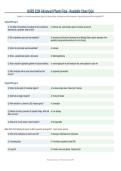
NURS 5334 Advanced Pharm Final - Readable Clean Q&A
Readable v2: one-column landscape layout, larger font, cleaner spacing, no cramped two-column compression. Original order preserved from the uploaded PDF.
Original PDF page 2
Q: The ability of the anesthetic to penetrate the axon membrane is A: Molecular size, Lipid solubility, degree of ionization at tissue pH
determined by 3 properties. What are they?
Q: Why is epinephrine given with local anesthetics? A: Decreases local blood flow (decreased risk of bleeding) Delays systemic absorption of the
anesthetic prolongs anesthesia reduces the risk of toxicity
Q: What is the most widely used local anesthetic? A: Lidocaine
Q: What is a possible fatal reaction to benzocaine A: Methemoglobinemia
Q: What is included in application guidelines for topical anesthetics A: avoid wrapping the site and heating the site, avoid application to open skin
Q: Which medication will not cause rebound headaches from A: propranolol (preventative)
overuse?
Original PDF page 3
Q: What is the best option for menstrual migraine? A: low dose estrogen about 3 days prior to menses
Q: What food can trigger migraines? A: Hot dog d/t nitrates
Q: What medication is a Serotonin 1B1D receptor agonist? A: Sumatriptan
Q: Butterbur can help as prevention for migraine therapy. What side A: Liver damage
effect can occur?
Q: What are the 3 main classes of opioid receptors? A: Mu kappa delta
Note: Which of the following will reserve he effects caused by opioid agonist? - correct answer naloxone
Q: Which of the medications are used to treat OIC? A: Naloxegol, methylnaltrexone, lubiprostone
Q: Prescribing basics A: Prescribing is regulated by state BON
Q: Proper RX A: Providers name and address, Telephone DEA
Readable cleaned copy - reformatted from uploaded PDF
,Original PDF page 4
Note: Pt name/DOB/Address Name of Drug, strength, SIG(directions) with indication/Route and frequency, Quantity and signature.
Q: Drug Schedules: Most addictive to least A: 1: Heroin,LSD, MJ 2: hydrocodone, cocaine, Methamphetamine, methadone, oxycodone,
meperidine, fentanyl, adderall, ritalin 3: codeine, ketamine, testosterone 4: xanax, valium, soma,
Ambien, tramadol 5: antidiarrheal, antitussives, lomotil, lyrica
Q: Pharmacodynamics A: The effects of drug on the body. Receptors are large molecules usually proteins, that interact and
mediate the action of drugs
Q: agonist A: produce receptor stimulation and a conformational change every time they bind. Do not need all
available receptors to produce a maximum response
Q: Partial agonist A: drugs that have properties in b/w those of full agonist and antagonist. They bind to receptors but
when they occupy the receptor sites, they stimulate only some of the receptors.
Original PDF page 5
Q: antagonist A: drugs with affinity for a receptor but with no intrinsic activity. Affinity allows the antagonist to bind to
receptors, but lack of intrinsic activity prevents the bound antagonist from causing receptor activation.
The block action of drugs (ex. Narcan)
Q: Bioavailability A: % of administered dosage of the drug that survives the first pass through the liver and reaches the
blood stream
Q: half life A: Time required for the amount of a drug in the body to decline by 50%, drugs with shorter half lives
must be administer frequently. 4.5-5.5 times the half life to get steady state and to be limited from the
body
Q: what the body does to the drug A: absorption, distribution, metabolism, excretion
Q: Distribution A: movement of absorbed drug in bodily fluids throughout the body to target tissue. Properties
affecting: lipid/water solubility, PH affects ionization of drug, protein binding, size of molecule (smaller
molecules are more able to diffuse)
Note: Tissue: fat, bone, blood/brain barrier (only lipid soluble will pass), placental barrier (many drugs can pass)
Original PDF page 6
Q: Protein binding A: unbound drug is free which is active, crosses membrane. Low plasma proteins result in more free
drug. Competition: when 2 highly bound drugs are given it increases the level of both drugs
Q: Metabolism A: take place in the liver mostly. Chemical change of a drug structure to: Enhance excretion, inactivate
the drug, increase therapeutic action, active a prodrug (inactive until metabolized in the body into the
active compound, ex: levodopa), increase or decrease toxicity
Readable cleaned copy - reformatted from uploaded PDF
, Q: CYP450 A: enzymes constitutes the most important of the phase I metabolizing enzymes (account for about
75% of drug metabolism in the liver) Phase 2: conjugation reaction occur leading to large increases in
hydrophilicity of the substrates rendering them more readily excretable
Q: Substrate A: an agent that is metabolized by an enzyme into a metabolite and product and eventually excreted
Q: Inhibitors A: compete with other drugs for a particular enzyme affecting the metabolism (decreased) of the
substrate and decreases the excretion of the substrate and increasing the circulating drug
Original PDF page 7
Q: inducer A: competes with other drugs for a particular enzyme affecting metabolism of the substrate (increases)
decreasing the efficacy of the drug
Q: excretion A: renal: passive glomerular filtration, active tubular secretion, tubular reabsorption, gi tract, lung,
sweat and salivary, mammary
Q: genomics A: study of the complete set of genetic information present in a cell, an organism, or species
Q: pharmacogenetics A: the study of the influence of hereditary factors on the response of individual organisms to drugs,
and the study of variations of DNA and RNA characteristics as related to drug response
Q: Pharmacogenetics tests A: Mentioned on drug labels can be classified as "test required," "test recommended," and "information
only." Currently, four drugs are required to have pharmacogenetics testing performed before they are
prescribed: cetuximab, trastuzumab, maraviroc and dasatinib
Note: warfarin, carbamazepine, valproic acid and abacavir are recommended to tests prior to initial dosing
Original PDF page 8
Q: Carbamazepine and Asians A: Initiating carbamazepine therapy in these patients (allele HLA-B*1502) are at high risk for
developing Steven Johnson syndrome or toxic epidermal necrolysis (TEN)
Q: Tolerance is defined as A: increased does of a med needed to obtain the same response
Q: Which medication is used for opioid abuse? A: Naltrexone
Q: Euphoria induced by morphine: A: An exaggerated sense of well-being caused by the activation of mu receptors
Q: Which medication is given nasally for migraines? A: Butorphanol
Readable cleaned copy - reformatted from uploaded PDF
Readable v2: one-column landscape layout, larger font, cleaner spacing, no cramped two-column compression. Original order preserved from the uploaded PDF.
Original PDF page 2
Q: The ability of the anesthetic to penetrate the axon membrane is A: Molecular size, Lipid solubility, degree of ionization at tissue pH
determined by 3 properties. What are they?
Q: Why is epinephrine given with local anesthetics? A: Decreases local blood flow (decreased risk of bleeding) Delays systemic absorption of the
anesthetic prolongs anesthesia reduces the risk of toxicity
Q: What is the most widely used local anesthetic? A: Lidocaine
Q: What is a possible fatal reaction to benzocaine A: Methemoglobinemia
Q: What is included in application guidelines for topical anesthetics A: avoid wrapping the site and heating the site, avoid application to open skin
Q: Which medication will not cause rebound headaches from A: propranolol (preventative)
overuse?
Original PDF page 3
Q: What is the best option for menstrual migraine? A: low dose estrogen about 3 days prior to menses
Q: What food can trigger migraines? A: Hot dog d/t nitrates
Q: What medication is a Serotonin 1B1D receptor agonist? A: Sumatriptan
Q: Butterbur can help as prevention for migraine therapy. What side A: Liver damage
effect can occur?
Q: What are the 3 main classes of opioid receptors? A: Mu kappa delta
Note: Which of the following will reserve he effects caused by opioid agonist? - correct answer naloxone
Q: Which of the medications are used to treat OIC? A: Naloxegol, methylnaltrexone, lubiprostone
Q: Prescribing basics A: Prescribing is regulated by state BON
Q: Proper RX A: Providers name and address, Telephone DEA
Readable cleaned copy - reformatted from uploaded PDF
,Original PDF page 4
Note: Pt name/DOB/Address Name of Drug, strength, SIG(directions) with indication/Route and frequency, Quantity and signature.
Q: Drug Schedules: Most addictive to least A: 1: Heroin,LSD, MJ 2: hydrocodone, cocaine, Methamphetamine, methadone, oxycodone,
meperidine, fentanyl, adderall, ritalin 3: codeine, ketamine, testosterone 4: xanax, valium, soma,
Ambien, tramadol 5: antidiarrheal, antitussives, lomotil, lyrica
Q: Pharmacodynamics A: The effects of drug on the body. Receptors are large molecules usually proteins, that interact and
mediate the action of drugs
Q: agonist A: produce receptor stimulation and a conformational change every time they bind. Do not need all
available receptors to produce a maximum response
Q: Partial agonist A: drugs that have properties in b/w those of full agonist and antagonist. They bind to receptors but
when they occupy the receptor sites, they stimulate only some of the receptors.
Original PDF page 5
Q: antagonist A: drugs with affinity for a receptor but with no intrinsic activity. Affinity allows the antagonist to bind to
receptors, but lack of intrinsic activity prevents the bound antagonist from causing receptor activation.
The block action of drugs (ex. Narcan)
Q: Bioavailability A: % of administered dosage of the drug that survives the first pass through the liver and reaches the
blood stream
Q: half life A: Time required for the amount of a drug in the body to decline by 50%, drugs with shorter half lives
must be administer frequently. 4.5-5.5 times the half life to get steady state and to be limited from the
body
Q: what the body does to the drug A: absorption, distribution, metabolism, excretion
Q: Distribution A: movement of absorbed drug in bodily fluids throughout the body to target tissue. Properties
affecting: lipid/water solubility, PH affects ionization of drug, protein binding, size of molecule (smaller
molecules are more able to diffuse)
Note: Tissue: fat, bone, blood/brain barrier (only lipid soluble will pass), placental barrier (many drugs can pass)
Original PDF page 6
Q: Protein binding A: unbound drug is free which is active, crosses membrane. Low plasma proteins result in more free
drug. Competition: when 2 highly bound drugs are given it increases the level of both drugs
Q: Metabolism A: take place in the liver mostly. Chemical change of a drug structure to: Enhance excretion, inactivate
the drug, increase therapeutic action, active a prodrug (inactive until metabolized in the body into the
active compound, ex: levodopa), increase or decrease toxicity
Readable cleaned copy - reformatted from uploaded PDF
, Q: CYP450 A: enzymes constitutes the most important of the phase I metabolizing enzymes (account for about
75% of drug metabolism in the liver) Phase 2: conjugation reaction occur leading to large increases in
hydrophilicity of the substrates rendering them more readily excretable
Q: Substrate A: an agent that is metabolized by an enzyme into a metabolite and product and eventually excreted
Q: Inhibitors A: compete with other drugs for a particular enzyme affecting the metabolism (decreased) of the
substrate and decreases the excretion of the substrate and increasing the circulating drug
Original PDF page 7
Q: inducer A: competes with other drugs for a particular enzyme affecting metabolism of the substrate (increases)
decreasing the efficacy of the drug
Q: excretion A: renal: passive glomerular filtration, active tubular secretion, tubular reabsorption, gi tract, lung,
sweat and salivary, mammary
Q: genomics A: study of the complete set of genetic information present in a cell, an organism, or species
Q: pharmacogenetics A: the study of the influence of hereditary factors on the response of individual organisms to drugs,
and the study of variations of DNA and RNA characteristics as related to drug response
Q: Pharmacogenetics tests A: Mentioned on drug labels can be classified as "test required," "test recommended," and "information
only." Currently, four drugs are required to have pharmacogenetics testing performed before they are
prescribed: cetuximab, trastuzumab, maraviroc and dasatinib
Note: warfarin, carbamazepine, valproic acid and abacavir are recommended to tests prior to initial dosing
Original PDF page 8
Q: Carbamazepine and Asians A: Initiating carbamazepine therapy in these patients (allele HLA-B*1502) are at high risk for
developing Steven Johnson syndrome or toxic epidermal necrolysis (TEN)
Q: Tolerance is defined as A: increased does of a med needed to obtain the same response
Q: Which medication is used for opioid abuse? A: Naltrexone
Q: Euphoria induced by morphine: A: An exaggerated sense of well-being caused by the activation of mu receptors
Q: Which medication is given nasally for migraines? A: Butorphanol
Readable cleaned copy - reformatted from uploaded PDF