

Written by students who passed Immediately available after payment Read online or as PDF Wrong document? Swap it for free 4.6 TrustPilot
logo-home
Document preview thumbnail
Preview 3 out of 16 pages
Exam (elaborations)

NSG 122 Fundamentals of Nursing Exam 4 2026/2027 | Questions & Answers | Mobility, Exercise, Sleep, Pain, Stress, End-of-Life Care & Aging

Document preview thumbnail
Preview 3 out of 16 pages

This NSG 122 Fundamentals of Nursing Exam 4 2026/2027 is a focused 16-page exam question-and-answer study guide covering essential concepts in fundamental nursing care. The document concentrates on mobility and exercise, body alignment, patient positioning and transfers, sleep and rest, stress and coping, pain assessment and management, advance care planning, grief and loss, and physiological changes associated with aging. The material is organized in concise question-and-answer format and is identified on the cover as an Exam 4 resource that has been “Already Graded A+.” A substantial portion of the exam focuses on mobility, exercise, positioning, and patient safety. Students review the physiological effects of exercise, including increased oxygen demand, systolic blood pressure, respiratory rate, and heart rate. Mobility assessment covers endurance, activities of daily living, mobility limitations, patient feelings about changes in function, and promotion of self-care. The document explains lateral, Fowler’s, prone, and supine positioning and specifically discusses pressure relief involving the scapulae, sacrum, and heels. It also outlines safe first-time out-of-bed procedures, including dangling, assessing strength and readiness, determining the assistance required, and monitoring for numbness, tingling, dizziness, and lightheadedness. The guide provides detailed review of musculoskeletal movement and exercise terminology. Topics include fibrous, cartilaginous, and synovial joints; flexion, extension, abduction, and adduction; and the skeletal, muscular, nervous, joint, and tendon components involved in maintaining body alignment. Isotonic exercise is described through active movement such as ADLs, range-of-motion exercises, swimming, walking, jogging, and bicycling, while isometric exercise involves muscle contraction with little or no shortening, such as quadriceps or gluteal contractions and holding a yoga pose. Benefits reviewed include improved muscle strength and tone, circulation, joint mobility, cardiorespiratory function, and bone-building activity. Patient handling and assistive-device content covers gait belts, powered stand-assist devices, lateral-assist equipment, full-body mechanical lifts, trapeze bars, boots, pillows, wedges, and graduated compression stockings. The questions differentiate equipment based on a patient’s ability to bear weight, cooperate, follow directions, and provide assistance during transfers. Nursing safety concepts include assessing pedal pulses and neurovascular status before applying compression stockings, avoiding leg massage because of potential clot concerns, maintaining dorsiflexion to reduce footdrop, reducing friction during lateral transfers, and avoiding excessive pressure behind the knee that may impair lower-extremity circulation. The document also identifies nursing diagnoses involving activity intolerance, impaired transfer mobility, and risk for injury. The sleep and rest section reviews NREM and REM sleep, the stages of NREM sleep, typical proportions of total sleep, ease of arousal, and physiological changes occurring during deeper sleep. Stage 4 NREM content includes slower EEG waves, decreased pulse and respiratory rates, lower blood pressure, muscle relaxation, slowed metabolism, and reduced body temperature. REM sleep is contrasted with increases in pulse, respiratory rate, blood pressure, metabolism, and temperature alongside reduced skeletal-muscle tone. Sleep disorders covered include insomnia, narcolepsy, obstructive sleep apnea, CPAP use, and circadian rhythm disorder. Another major exam area is stress, coping, and pain. The document distinguishes psychosocial, physiological, developmental, and situational stressors and provides examples across the lifespan, including childhood development, adolescence, aging, illness, injury, marriage, divorce, loss, employment, and role changes. Pain content differentiates deep somatic, cutaneous, visceral, and referred pain. Assessment methods include nonverbal behavior, PQRST and OLDCARTS questioning, and patient self-report, which the document identifies as the best pain-assessment approach. Nonpharmacological interventions reviewed include distraction, music therapy, meditation, and cutaneous stimulation. The exam also addresses caregiver role strain, code status, advance directives, and end-of-life nursing care. Students review manifestations of caregiver strain such as fatigue, gastrointestinal distress, headache, and weight change and are instructed to assess how caregivers are caring for themselves. The material distinguishes DNR orders, living wills, and durable power of attorney for healthcare and discusses the nurse’s role in advance-care planning. It further covers family support during grief and loss, including assessing support systems, coping ability, understanding of grief, and preferences regarding the nurse’s presence. The final portion focuses on normal aging and older-adult nursing considerations. Age-related changes presented include decreased saliva, receding gums, bone demineralization, increased bone fragility, joint stiffness, reduced flexibility and range of motion, diminished digestive secretions, decreased nutrient absorption, constipation, indigestion, malnutrition, and anemia. Psychosocial concepts related to retirement and loss of occupational identity include encouraging discussion of feelings about loss, supporting continued psychosocial development, and assessing whether the older adult feels like a burden to family members. Relevant students: NSG 122 students, Fundamentals of Nursing students, BSN students, ADN students, RN students, LPN students, LVN students, practical nursing students, prelicensure nursing students, first-year nursing students, nursing fundamentals students, nursing skills students, geriatric nursing students, nursing exam candidates, NCLEX fundamentals review students Source accuracy note: The uploaded document explicitly identifies the course as NSG 122 Fundamentals of Nursing, the assessment as Exam 4, and the academic period as 2026/2027. However, it does not identify a university, referenced textbook, journal article, DOI, or formal APA bibliography. Therefore, no unsupported university name or academic reference has been added. Keywords: NSG 122 Fundamentals of Nursing, NSG 122 Exam 4, NSG 122 Exam 4 2026, NSG 122 Exam 4 2026/2027, NSG 122 questions and answers, NSG 122 study guide, Fundamentals of Nursing Exam 4, nursing fundamentals questions and answers, nursing mobility, exercise nursing, patient positioning, body alignment, range of motion, isotonic exercise, isometric exercise, gait belt, mechanical lift nursing, graduated compression stockings, activity intolerance, impaired mobility, sleep stages nursing, NREM sleep, REM sleep, insomnia, narcolepsy, obstructive sleep apnea, circadian rhythm, stress and coping nursing, pain assessment, PQRST pain assessment, OLDCARTS, nonpharmacological pain management, caregiver role strain, DNR nursing, advance directives, end of life nursing, grief and loss nursing, aging changes nursing, geriatric nursing, nursing exam preparation

Content preview

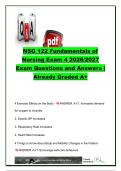
NSG 122 Fundamentals of
Nursing Exam 4 2026/2027
Exam Questions and Answers |
Already Graded A+


4 Exercise Effects on the Body - ANSWER ✔✔1. Increased demand

for oxygen to muscles

2. Systolic BP Increases

3. Respiratory Rate Increases

4. Heart Rate Increases

4 Things to Know About Body and Mobility Changes in the Patient -

ANSWER ✔✔1. Encourage self-care behaviors

,2. Sensitivity to feelings about body and mobility

3. Be supportive and expect frustration

4. Encourage patient to correct behavior that may worsen progress

4 Things to Know When Getting Mobility & Exercise History -

ANSWER ✔✔1. Endurance


2. Mobility issues

3. ADLs

4. Mental health mobility issue causing


4 Patient Positions to Relieve Pressure - ANSWER ✔✔1. Lateral

(side lying)

2. Fowlers

3. Prone

4. Supine


Why is lateral position preferred for relieving pressure? - ANSWER

✔✔Comfortable position for resting. Relives pressure on scapulae,

sacrum, and heels and allows the legs and feet to be comfortably flexed,

support pillows are needed for correct positioning

, Steps for Graduated Compression Stockings - ANSWER ✔✔1.

Measurement of each leg

2. Assess each pedal pulse for circulation

3. Assess skin and neurovascular of each leg

4. Apply before patient gets out of Bed

5. Avoid massage of legs

Why do you avoid massaging the legs for graduated compression

stockings? - ANSWER ✔✔Do not massage the legs. If a clot is

present, it may break away from the vessel wall and circulate in the

bloodstream.


Steps for Getting OOB for the 1st Time - ANSWER ✔✔1. Assist from

lying to sitting with dangle

2. Determine strength and readiness of patient to stand

3. Determine assistance needed-do not assume

4. Assess for numbness, tingling, dizziness, lightheaded

5. Teach patient to keep head up and eyes forward


Fibrous Joints - ANSWER ✔✔Immoveable


3
COPYRIGHT©JOSHCLAY 2026/2027. YEAR PUBLISHED 2026. COMPANY REGISTRATION NUMBER: 619652435. TERMS OF USE. PRIVACY
STATEMENT. ALL RIGHTS RESERVED


Document information

Uploaded on
August 26, 2026
Number of pages
16
Written in
2026/2027
Type
Exam (elaborations)
Contains
Questions & answers
$18.99

Wrong document? Swap it for free Within 14 days of purchase and before downloading, you can choose a different document. You can simply spend the amount again.
Written by students who passed
Immediately available after payment
Read online or as PDF

Seller avatar
Reputation scores are based on the amount of documents a seller has sold for a fee and the reviews they have received for those documents. There are three levels: Bronze, Silver and Gold. The better the reputation, the more your can rely on the quality of the sellers work.
JOSHCLAY
3.5
(83)
Sold
390
Followers
16
Items
20497
Last sold
1 day ago


Why students choose Stuvia

Created by fellow students, verified by reviews

Quality you can trust: written by students who passed their tests and reviewed by others who've used these notes.

Didn't get what you expected? Choose another document

No worries! You can instantly pick a different document that better fits what you're looking for.

Pay as you like, start learning right away

No subscription, no commitments. Pay the way you're used to via credit card and download your PDF document instantly.

Student with book image

“Bought, downloaded, and aced it. It really can be that simple.”

Alisha Student

Working on your references?

Create accurate citations in APA, MLA and Harvard with our free citation generator.

Working on your references?

Frequently asked questions
