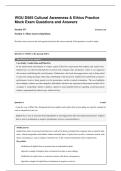
WGU D565 Cultural Awareness & Ethics Practice
Mock Exam Questions and Answers
Section 1/5 20 Marks total
Section 1: Short Answer Questions
Provide concise answers for each question based on the source material. Each question is worth 4 marks.
Question 1–2 Refer to the passage below.
The Ellen Pao Case Analysis
Case Study: Gender Bias and Ellen Pao
In the professional environment of venture capital, Ellen Pao experienced both implicit and explicit bias.
Implicit bias was observed through her exclusion from company trips and dinners, where it was suggested
that women would disrupt the social dynamic. Furthermore, she faced microaggressions, such as being asked
to take notes during meetings rather than contributing to the discussion. Explicit bias manifested in negative
performance reviews, being passed over for promotions, and her eventual termination. The case highlights
that workplace cultures are often shaped by individuals who have not experienced harassment and thus fail to
recognize it. Leadership’s failure to address a partner’s unaccountable behavior regarding sexual harassment
further compounded the ethical issues within the firm.
Question 1 4 marks
Using the case of Ellen Pao, distinguish between implicit and explicit bias by providing one specific example of
each as identified in the text.
Implicit bias is seen in exclusion from trips/dinners or microaggressions like note-taking (unconscious). Explicit
bias is seen in termination or negative performance reviews (conscious/direct).
Model answer:
Implicit bias refers to unconscious behaviors, such as Pao being excluded from company trips or asked to take
notes, which marginalize individuals without intended harm. Explicit bias involves conscious actions with
direct consequences, such as failing to promote her or the eventual termination of her employment.
Key points:
• Definition of implicit bias as unconscious or unintended actions.
• Specific example of implicit bias (exclusion from trips or note-taking).
• Definition of explicit bias as conscious actions with direct consequences.
• Specific example of explicit bias (termination or negative reviews).
,Question 2 4 marks
Identify two specific strategies suggested in the text that a senior partner could use to develop their own cultural
awareness and mitigate gender bias.
Attend socially engaged functions including women; practice active listening in meetings.
Model answer:
Senior partners can develop cultural awareness by hosting or attending socially engaged functions that include
women to immerse themselves in that culture. Additionally, they should engage in more frequent meetings
with women and practice active listening to understand their specific concerns.
Key points:
• Host or attend socially engaged functions involving women.
• Immerse themselves in the culture/perspective of women in the company.
• Increase conversations/meetings with women.
• Practice active listening to women’s concerns.
Question 3 Refer to the passage below.
Racial Bias and Student Success
Impact of Racial Bias in Academic Settings
Racial bias against Black students leads to significant psychological and academic consequences. These stu-
dents often experience ’imposter syndrome,’ feeling the need to constantly prove their worth in underrepre-
sented environments. Overt and subtle offenses contribute to chronic stress, anxiety, and a diminished sense
of belonging. Academically, this manifests as lowered expectations from professors, leading to disparities in
grading and support. Structural inequities reinforce harmful stereotypes, which can ultimately lead to higher
dropout rates among students who feel unwelcome or unsupported.
, Question 3 4 marks
Describe how ’imposter syndrome’ and ’lower academic expectations’ specifically affect the academic perfor-
mance and persistence of Black students.
Imposter syndrome reduces engagement in campus life; lower expectations lead to grading disparities and
limited resource access.
Model answer:
Imposter syndrome causes students to feel alienated and reluctant to engage in campus life, which affects their
overall performance. Lower academic expectations from professors lead to disparities in grading and reduced
access to mentorship, which fosters demotivation and higher dropout rates.
Key points:
• Imposter syndrome leads to a diminished sense of belonging and reluctance to engage.
• Lower expectations result in disparities in grading and support.
• Limited access to resources (mentorship, research) hinders growth.
• The cumulative effect increases the risk of dropping out.
Question 4 Refer to the passage below.
The Ellen Pao Case Analysis
Case Study: Gender Bias and Ellen Pao
In the professional environment of venture capital, Ellen Pao experienced both implicit and explicit bias.
Implicit bias was observed through her exclusion from company trips and dinners, where it was suggested
that women would disrupt the social dynamic. Furthermore, she faced microaggressions, such as being asked
to take notes during meetings rather than contributing to the discussion. Explicit bias manifested in negative
performance reviews, being passed over for promotions, and her eventual termination. The case highlights
that workplace cultures are often shaped by individuals who have not experienced harassment and thus fail to
recognize it. Leadership’s failure to address a partner’s unaccountable behavior regarding sexual harassment
further compounded the ethical issues within the firm.
Mock Exam Questions and Answers
Section 1/5 20 Marks total
Section 1: Short Answer Questions
Provide concise answers for each question based on the source material. Each question is worth 4 marks.
Question 1–2 Refer to the passage below.
The Ellen Pao Case Analysis
Case Study: Gender Bias and Ellen Pao
In the professional environment of venture capital, Ellen Pao experienced both implicit and explicit bias.
Implicit bias was observed through her exclusion from company trips and dinners, where it was suggested
that women would disrupt the social dynamic. Furthermore, she faced microaggressions, such as being asked
to take notes during meetings rather than contributing to the discussion. Explicit bias manifested in negative
performance reviews, being passed over for promotions, and her eventual termination. The case highlights
that workplace cultures are often shaped by individuals who have not experienced harassment and thus fail to
recognize it. Leadership’s failure to address a partner’s unaccountable behavior regarding sexual harassment
further compounded the ethical issues within the firm.
Question 1 4 marks
Using the case of Ellen Pao, distinguish between implicit and explicit bias by providing one specific example of
each as identified in the text.
Implicit bias is seen in exclusion from trips/dinners or microaggressions like note-taking (unconscious). Explicit
bias is seen in termination or negative performance reviews (conscious/direct).
Model answer:
Implicit bias refers to unconscious behaviors, such as Pao being excluded from company trips or asked to take
notes, which marginalize individuals without intended harm. Explicit bias involves conscious actions with
direct consequences, such as failing to promote her or the eventual termination of her employment.
Key points:
• Definition of implicit bias as unconscious or unintended actions.
• Specific example of implicit bias (exclusion from trips or note-taking).
• Definition of explicit bias as conscious actions with direct consequences.
• Specific example of explicit bias (termination or negative reviews).
,Question 2 4 marks
Identify two specific strategies suggested in the text that a senior partner could use to develop their own cultural
awareness and mitigate gender bias.
Attend socially engaged functions including women; practice active listening in meetings.
Model answer:
Senior partners can develop cultural awareness by hosting or attending socially engaged functions that include
women to immerse themselves in that culture. Additionally, they should engage in more frequent meetings
with women and practice active listening to understand their specific concerns.
Key points:
• Host or attend socially engaged functions involving women.
• Immerse themselves in the culture/perspective of women in the company.
• Increase conversations/meetings with women.
• Practice active listening to women’s concerns.
Question 3 Refer to the passage below.
Racial Bias and Student Success
Impact of Racial Bias in Academic Settings
Racial bias against Black students leads to significant psychological and academic consequences. These stu-
dents often experience ’imposter syndrome,’ feeling the need to constantly prove their worth in underrepre-
sented environments. Overt and subtle offenses contribute to chronic stress, anxiety, and a diminished sense
of belonging. Academically, this manifests as lowered expectations from professors, leading to disparities in
grading and support. Structural inequities reinforce harmful stereotypes, which can ultimately lead to higher
dropout rates among students who feel unwelcome or unsupported.
, Question 3 4 marks
Describe how ’imposter syndrome’ and ’lower academic expectations’ specifically affect the academic perfor-
mance and persistence of Black students.
Imposter syndrome reduces engagement in campus life; lower expectations lead to grading disparities and
limited resource access.
Model answer:
Imposter syndrome causes students to feel alienated and reluctant to engage in campus life, which affects their
overall performance. Lower academic expectations from professors lead to disparities in grading and reduced
access to mentorship, which fosters demotivation and higher dropout rates.
Key points:
• Imposter syndrome leads to a diminished sense of belonging and reluctance to engage.
• Lower expectations result in disparities in grading and support.
• Limited access to resources (mentorship, research) hinders growth.
• The cumulative effect increases the risk of dropping out.
Question 4 Refer to the passage below.
The Ellen Pao Case Analysis
Case Study: Gender Bias and Ellen Pao
In the professional environment of venture capital, Ellen Pao experienced both implicit and explicit bias.
Implicit bias was observed through her exclusion from company trips and dinners, where it was suggested
that women would disrupt the social dynamic. Furthermore, she faced microaggressions, such as being asked
to take notes during meetings rather than contributing to the discussion. Explicit bias manifested in negative
performance reviews, being passed over for promotions, and her eventual termination. The case highlights
that workplace cultures are often shaped by individuals who have not experienced harassment and thus fail to
recognize it. Leadership’s failure to address a partner’s unaccountable behavior regarding sexual harassment
further compounded the ethical issues within the firm.