

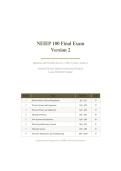
NEIEP 100 Final Exam
Version 2
Questions and Verified Answers | 100% Correct | Grade A
National Elevator Industry Educational Program
Latest 2026/2027 Update
Section Topic Questions Count
1 Elevator Safety Codes and Regulations Q1 - Q15 15
2 Elevator Systems and Components Q16 - Q30 15
3 Electrical Theory and Application Q31 - Q45 15
4 Mechanical Systems Q46 - Q55 10
5 Door Systems and Operations Q56 - Q65 10
6 Electrical and Electronic Controls Q66 - Q75 10
7 Hydraulic Systems Q76 - Q85 10
8 Preventive Maintenance and Troubleshooting Q86 - Q100 15
Comprehensive Preparation for NEIEP 100 Final Examination
, NEIEP 100 Final Exam Version 2
Section 1: Elevator Safety Codes and Regulations (Q1-Q15)
Q1: An elevator mechanic is performing the annual inspection of a traction elevator and discovers that the car door
interlock contacts have been bypassed with a jumper wire, allowing the car to run with the doors partially open. The
building owner tells the mechanic to remove the jumper but wants to delay any further corrective action until the next
budget cycle in four months. According to ASME A17.1/CSA B44, what is the mechanic's correct course of action?
A. Remove the jumper, document the condition, and allow the owner to schedule repairs at their discretion
B. Remove the jumper, immediately restore the interlock system to code-compliant condition, and file a report
with the local jurisdiction [CORRECT]
C. Remove the jumper and place the elevator on a temporary bypass tag pending owner approval for repair
D. Leave the jumper in place, lock out the elevator, and wait for the owner to authorize repairs
Correct Answer: B
Rationale: Rationale: ASME A17.1/CSA B44 Section 8.6 requires that safety devices be maintained in proper operating condition at
all times, and Section 8.11 mandates that any known unsafe condition be corrected immediately or the elevator removed from service.
A door interlock bypass is a critical safety violation that directly endangers passengers and must be corrected before the elevator is
returned to service, regardless of the owner's budget timeline. The mechanic is ethically and legally obligated to restore the interlock
system and report the unsafe condition per ASME A17.1/CSA B44 requirements and applicable local jurisdiction authority.
Q2: A construction elevator installer is setting up a temporary elevator for a high-rise building still in its steel frame
stage. The general contractor asks the installer to place the temporary machine room on the second floor with an open
edge adjacent to an elevator shaft opening that drops 40 feet. The contractor says a temporary rope barrier will be
installed around the opening. According to OSHA regulations, which requirement must be met before the installer
proceeds?
A. A fall protection system meeting OSHA 29 CFR 1926.502 requirements, such as a guardrail system or
personal fall arrest system, must be in place at the open edge before work begins [CORRECT]
B. The rope barrier is sufficient as long as it is flagged with high-visibility warning tape per OSHA standards
C. Fall protection is only required at edges greater than 6 feet for general industry, so the 40-foot drop does not
apply during construction
D. The installer must obtain a written waiver from OSHA before working near any open edge exceeding 15 feet
Correct Answer: A
Rationale: Rationale: OSHA 29 CFR 1926.502 requires that each employee on a walking or working surface with an unprotected side
or edge 6 feet or more above a lower level be protected from falling by guardrail systems, safety net systems, or personal fall arrest
systems. A rope barrier does not meet the OSHA definition of a guardrail system, which requires a top rail at 42 inches plus or minus
3 inches, a mid-rail, and the ability to withstand 200 pounds of force. The installer must not begin work until proper fall protection
meeting OSHA construction standards is in place.
Q3: An elevator mechanic is replacing a section of hoistway wiring between the machine room and the pit for a
traction elevator. The wiring must pass through a floor penetration where the car's traveling cable connects to the
hoistway feeder. The mechanic needs to select a wiring method that accommodates the vertical movement of the
traveling cable at the connection point. According to NEC Article 620, which wiring method is permitted for this
application?
A. Liquidtight flexible metal conduit (LFMC) or flexible metal conduit (FMC) as permitted by NEC 620.24 and
620.21(B) for locations requiring flexibility [CORRECT]
B. Nonmetallic-sheathed cable (Type NM-B) with an additional equipment grounding conductor
C. Electrical nonmetallic tubing (ENT) with listed fittings rated for the ambient temperature
D. Rigid galvanized steel conduit (GRC) installed in continuous sections without any flexible connections
Page 2
, NEIEP 100 Final Exam Version 2
Correct Answer: A
Rationale: Rationale: NEC Article 620.24 permits the use of flexible metal conduit (FMC) and liquidtight flexible metal conduit
(LFMC) for elevator wiring in locations where flexibility is required to accommodate movement, such as at traveling cable connection
points. NEC 620.21(B) addresses the specific requirements for flexible connections in elevator installations. Nonmetallic-sheathed
cable is not permitted for elevator hoistway wiring, ENT is not listed for this application, and rigid GRC cannot accommodate the
flexing required at a traveling cable connection point.
Q4: An electrician is installing a new branch circuit to serve a 40-hp traction elevator driving machine in a machine
room. The electrician is reviewing NEC Article 620 requirements for the disconnecting means and asks the project's
electrical inspector which of the following code requirements applies to the elevator disconnecting means.
A. The disconnecting means must be located inside the elevator car for emergency access by passengers
B. The disconnecting means must be rated at no more than 115% of the motor full-load current per NEC 430
C. Multiple disconnecting means may be used as long as they are all within 10 feet of each other
D. A single disconnecting means must be provided for each elevator, must be capable of being locked in the
open position, and must disconnect all ungrounded conductors per NEC 620.51 [CORRECT]
Correct Answer: D
Rationale: Rationale: NEC Article 620.51 requires that a single disconnecting means be provided for each elevator, capable of
disconnecting all ungrounded conductors of the elevator circuit. NEC 620.52 additionally requires that the disconnecting means be
capable of being locked in the open (off) position, and NEC 620.53 specifies that the disconnecting means must be readily accessible
and located in the machine room or machinery space. The disconnecting means is not located in the car, the 115% rule from NEC 430
is not the governing requirement for elevator disconnects, and a single disconnecting means (not multiple) is required.
Q5: A certified elevator inspector is conducting a Category 1 (routine) inspection on a 15-year-old hydraulic
passenger elevator. During the inspection, the inspector notices that the pit sump pump has been disconnected, there is
standing water in the pit above the controller enclosure, and the buffer has visible corrosion. According to
ANSI/ASME A17.2, what is the inspector's obligation regarding this situation?
A. Note the conditions in the inspection report and recommend the owner schedule repairs within 30 days
B. Fail the elevator, immediately remove it from service, and document all deficiencies per A17.2 inspection
requirements and jurisdictional authority [CORRECT]
C. Pass the elevator with a notation that non-safety-related maintenance items need attention
D. Repair the sump pump, clean the pit, and re-inspect before issuing a report
Correct Answer: B
Rationale: Rationale: ANSI/ASME A17.2 for hydraulic elevators requires that a Category 1 inspection evaluate the condition of all
safety-related components including pit conditions, buffers, and electrical equipment in the pit. Standing water above a controller
enclosure is a hazardous condition that can cause electrical shock, equipment malfunction, and compromised safety device operation,
while a corroded buffer may not perform within design parameters during an overtravel event. A17.2 directs the inspector to
immediately remove from service any elevator with conditions that constitute an imminent danger, and to document all findings on the
official inspection report for the local jurisdiction authority.
Q6: A building owner receives a notice that their freight elevator's annual inspection is overdue by 45 days. The owner
contacts the elevator service company and requests that the mechanic perform a quick visual check and sign the
annual inspection certificate so the building can pass a pending property sale inspection. The mechanic knows that a
full Category 1 test has not been performed in over 18 months. What is the correct response according to
code-required annual testing and inspection requirements?
A. Refuse to sign the annual inspection certificate, remove the elevator from service, and perform the full
code-required Category 1 inspection and testing per ASME A17.1 and A17.2 before returning it to service
[CORRECT]
Page 3
, NEIEP 100 Final Exam Version 2
B. Perform the visual check, sign the certificate, and schedule a full Category 1 test within the next 90 days
C. Sign the certificate with a disclaimer noting that a full test is pending
D. Perform only the safety device tests and omit the general maintenance inspection to save time
Correct Answer: A
Rationale: Rationale: ASME A17.1/CSA B44 requires that annual inspections be performed at intervals not exceeding 12 months, and
ANSI/ASME A17.2 specifies the detailed inspection and testing procedures that must be completed during a Category 1 inspection.
Signing an inspection certificate without performing the required tests constitutes fraud and violates both the safety code and the
inspector's professional obligations under the applicable jurisdiction's elevator safety law. The elevator should be removed from
service until a complete Category 1 inspection and all required tests are performed and documented.
Q7: A jurisdictional elevator inspector is reviewing a building's elevator maintenance records during a compliance
audit and finds that the records for three passenger elevators show quarterly maintenance visits but do not include any
documentation of annual load tests, door force tests, or governor tripping speed tests for the past two years. According
to ASME A17.1/CSA B44 and jurisdictional requirements, what is the typical minimum period for which written
inspection and test records must be retained?
A. 90 days from the date of each inspection or test
B. 6 months from the date of each inspection or test
C. Records retention is at the discretion of the building owner and no specific period is mandated by ASME
A17.1
D. Records must be retained for the period specified by the local jurisdiction, which typically ranges from 1 to 3
years or longer, per ASME A17.1 Section 8.11 [CORRECT]
Correct Answer: D
Rationale: Rationale: ASME A17.1/CSA B44 Section 8.11 requires that written records of inspections, tests, and maintenance be
maintained for each elevator, including specific code-required annual tests such as full-load tests, door force and time tests, governor
and safety tests, and fire recall tests. While ASME A17.1 references the applicable jurisdictional authority for the specific retention
period, most jurisdictions require records to be retained for a minimum of one to three years, and some require permanent retention of
certain records. The 90-day and 6-month periods are far too short, and records retention is not left to owner discretion.
Q8: A mechanic arrives at a modern office building to perform routine maintenance on a machine-room-less (MRL)
elevator and finds that the machine room space, located above the hoistway, has no permanent lighting fixture. The
only illumination available is the mechanic's portable work light, and the building manager states that the original
lighting was never installed because the room is only accessed during maintenance. Per ASME A17.1/CSA B44
machine room requirements, what code violation exists?
A. No violation exists because the mechanic has a portable light and the room is infrequently accessed
B. The machine room must have a minimum of 108 lux (10 foot-candles) of permanent illumination at the floor
level per ASME A17.1 Section 2.7.2 [CORRECT]
C. Machine room lighting is only required for conventional traction elevators, not MRL installations
D. Portable lighting is acceptable provided it is GFCI-protected per NEC standards
Correct Answer: B
Rationale: Rationale: ASME A17.1/CSA B44 Section 2.7.2 requires that machine rooms and machinery spaces, including those for
MRL elevators, be provided with adequate illumination of at least 108 lux (10 foot-candles) at the floor level, and that a light switch
be located at or near the point of entry. The code makes no exception for MRL installations or for rooms that are infrequently
accessed, as mechanics must be able to safely inspect, maintain, and repair equipment in a properly illuminated environment. Relying
on portable lighting does not satisfy the code requirement for permanent, code-compliant machine room illumination.
Page 4
Version 2
Questions and Verified Answers | 100% Correct | Grade A
National Elevator Industry Educational Program
Latest 2026/2027 Update
Section Topic Questions Count
1 Elevator Safety Codes and Regulations Q1 - Q15 15
2 Elevator Systems and Components Q16 - Q30 15
3 Electrical Theory and Application Q31 - Q45 15
4 Mechanical Systems Q46 - Q55 10
5 Door Systems and Operations Q56 - Q65 10
6 Electrical and Electronic Controls Q66 - Q75 10
7 Hydraulic Systems Q76 - Q85 10
8 Preventive Maintenance and Troubleshooting Q86 - Q100 15
Comprehensive Preparation for NEIEP 100 Final Examination
, NEIEP 100 Final Exam Version 2
Section 1: Elevator Safety Codes and Regulations (Q1-Q15)
Q1: An elevator mechanic is performing the annual inspection of a traction elevator and discovers that the car door
interlock contacts have been bypassed with a jumper wire, allowing the car to run with the doors partially open. The
building owner tells the mechanic to remove the jumper but wants to delay any further corrective action until the next
budget cycle in four months. According to ASME A17.1/CSA B44, what is the mechanic's correct course of action?
A. Remove the jumper, document the condition, and allow the owner to schedule repairs at their discretion
B. Remove the jumper, immediately restore the interlock system to code-compliant condition, and file a report
with the local jurisdiction [CORRECT]
C. Remove the jumper and place the elevator on a temporary bypass tag pending owner approval for repair
D. Leave the jumper in place, lock out the elevator, and wait for the owner to authorize repairs
Correct Answer: B
Rationale: Rationale: ASME A17.1/CSA B44 Section 8.6 requires that safety devices be maintained in proper operating condition at
all times, and Section 8.11 mandates that any known unsafe condition be corrected immediately or the elevator removed from service.
A door interlock bypass is a critical safety violation that directly endangers passengers and must be corrected before the elevator is
returned to service, regardless of the owner's budget timeline. The mechanic is ethically and legally obligated to restore the interlock
system and report the unsafe condition per ASME A17.1/CSA B44 requirements and applicable local jurisdiction authority.
Q2: A construction elevator installer is setting up a temporary elevator for a high-rise building still in its steel frame
stage. The general contractor asks the installer to place the temporary machine room on the second floor with an open
edge adjacent to an elevator shaft opening that drops 40 feet. The contractor says a temporary rope barrier will be
installed around the opening. According to OSHA regulations, which requirement must be met before the installer
proceeds?
A. A fall protection system meeting OSHA 29 CFR 1926.502 requirements, such as a guardrail system or
personal fall arrest system, must be in place at the open edge before work begins [CORRECT]
B. The rope barrier is sufficient as long as it is flagged with high-visibility warning tape per OSHA standards
C. Fall protection is only required at edges greater than 6 feet for general industry, so the 40-foot drop does not
apply during construction
D. The installer must obtain a written waiver from OSHA before working near any open edge exceeding 15 feet
Correct Answer: A
Rationale: Rationale: OSHA 29 CFR 1926.502 requires that each employee on a walking or working surface with an unprotected side
or edge 6 feet or more above a lower level be protected from falling by guardrail systems, safety net systems, or personal fall arrest
systems. A rope barrier does not meet the OSHA definition of a guardrail system, which requires a top rail at 42 inches plus or minus
3 inches, a mid-rail, and the ability to withstand 200 pounds of force. The installer must not begin work until proper fall protection
meeting OSHA construction standards is in place.
Q3: An elevator mechanic is replacing a section of hoistway wiring between the machine room and the pit for a
traction elevator. The wiring must pass through a floor penetration where the car's traveling cable connects to the
hoistway feeder. The mechanic needs to select a wiring method that accommodates the vertical movement of the
traveling cable at the connection point. According to NEC Article 620, which wiring method is permitted for this
application?
A. Liquidtight flexible metal conduit (LFMC) or flexible metal conduit (FMC) as permitted by NEC 620.24 and
620.21(B) for locations requiring flexibility [CORRECT]
B. Nonmetallic-sheathed cable (Type NM-B) with an additional equipment grounding conductor
C. Electrical nonmetallic tubing (ENT) with listed fittings rated for the ambient temperature
D. Rigid galvanized steel conduit (GRC) installed in continuous sections without any flexible connections
Page 2
, NEIEP 100 Final Exam Version 2
Correct Answer: A
Rationale: Rationale: NEC Article 620.24 permits the use of flexible metal conduit (FMC) and liquidtight flexible metal conduit
(LFMC) for elevator wiring in locations where flexibility is required to accommodate movement, such as at traveling cable connection
points. NEC 620.21(B) addresses the specific requirements for flexible connections in elevator installations. Nonmetallic-sheathed
cable is not permitted for elevator hoistway wiring, ENT is not listed for this application, and rigid GRC cannot accommodate the
flexing required at a traveling cable connection point.
Q4: An electrician is installing a new branch circuit to serve a 40-hp traction elevator driving machine in a machine
room. The electrician is reviewing NEC Article 620 requirements for the disconnecting means and asks the project's
electrical inspector which of the following code requirements applies to the elevator disconnecting means.
A. The disconnecting means must be located inside the elevator car for emergency access by passengers
B. The disconnecting means must be rated at no more than 115% of the motor full-load current per NEC 430
C. Multiple disconnecting means may be used as long as they are all within 10 feet of each other
D. A single disconnecting means must be provided for each elevator, must be capable of being locked in the
open position, and must disconnect all ungrounded conductors per NEC 620.51 [CORRECT]
Correct Answer: D
Rationale: Rationale: NEC Article 620.51 requires that a single disconnecting means be provided for each elevator, capable of
disconnecting all ungrounded conductors of the elevator circuit. NEC 620.52 additionally requires that the disconnecting means be
capable of being locked in the open (off) position, and NEC 620.53 specifies that the disconnecting means must be readily accessible
and located in the machine room or machinery space. The disconnecting means is not located in the car, the 115% rule from NEC 430
is not the governing requirement for elevator disconnects, and a single disconnecting means (not multiple) is required.
Q5: A certified elevator inspector is conducting a Category 1 (routine) inspection on a 15-year-old hydraulic
passenger elevator. During the inspection, the inspector notices that the pit sump pump has been disconnected, there is
standing water in the pit above the controller enclosure, and the buffer has visible corrosion. According to
ANSI/ASME A17.2, what is the inspector's obligation regarding this situation?
A. Note the conditions in the inspection report and recommend the owner schedule repairs within 30 days
B. Fail the elevator, immediately remove it from service, and document all deficiencies per A17.2 inspection
requirements and jurisdictional authority [CORRECT]
C. Pass the elevator with a notation that non-safety-related maintenance items need attention
D. Repair the sump pump, clean the pit, and re-inspect before issuing a report
Correct Answer: B
Rationale: Rationale: ANSI/ASME A17.2 for hydraulic elevators requires that a Category 1 inspection evaluate the condition of all
safety-related components including pit conditions, buffers, and electrical equipment in the pit. Standing water above a controller
enclosure is a hazardous condition that can cause electrical shock, equipment malfunction, and compromised safety device operation,
while a corroded buffer may not perform within design parameters during an overtravel event. A17.2 directs the inspector to
immediately remove from service any elevator with conditions that constitute an imminent danger, and to document all findings on the
official inspection report for the local jurisdiction authority.
Q6: A building owner receives a notice that their freight elevator's annual inspection is overdue by 45 days. The owner
contacts the elevator service company and requests that the mechanic perform a quick visual check and sign the
annual inspection certificate so the building can pass a pending property sale inspection. The mechanic knows that a
full Category 1 test has not been performed in over 18 months. What is the correct response according to
code-required annual testing and inspection requirements?
A. Refuse to sign the annual inspection certificate, remove the elevator from service, and perform the full
code-required Category 1 inspection and testing per ASME A17.1 and A17.2 before returning it to service
[CORRECT]
Page 3
, NEIEP 100 Final Exam Version 2
B. Perform the visual check, sign the certificate, and schedule a full Category 1 test within the next 90 days
C. Sign the certificate with a disclaimer noting that a full test is pending
D. Perform only the safety device tests and omit the general maintenance inspection to save time
Correct Answer: A
Rationale: Rationale: ASME A17.1/CSA B44 requires that annual inspections be performed at intervals not exceeding 12 months, and
ANSI/ASME A17.2 specifies the detailed inspection and testing procedures that must be completed during a Category 1 inspection.
Signing an inspection certificate without performing the required tests constitutes fraud and violates both the safety code and the
inspector's professional obligations under the applicable jurisdiction's elevator safety law. The elevator should be removed from
service until a complete Category 1 inspection and all required tests are performed and documented.
Q7: A jurisdictional elevator inspector is reviewing a building's elevator maintenance records during a compliance
audit and finds that the records for three passenger elevators show quarterly maintenance visits but do not include any
documentation of annual load tests, door force tests, or governor tripping speed tests for the past two years. According
to ASME A17.1/CSA B44 and jurisdictional requirements, what is the typical minimum period for which written
inspection and test records must be retained?
A. 90 days from the date of each inspection or test
B. 6 months from the date of each inspection or test
C. Records retention is at the discretion of the building owner and no specific period is mandated by ASME
A17.1
D. Records must be retained for the period specified by the local jurisdiction, which typically ranges from 1 to 3
years or longer, per ASME A17.1 Section 8.11 [CORRECT]
Correct Answer: D
Rationale: Rationale: ASME A17.1/CSA B44 Section 8.11 requires that written records of inspections, tests, and maintenance be
maintained for each elevator, including specific code-required annual tests such as full-load tests, door force and time tests, governor
and safety tests, and fire recall tests. While ASME A17.1 references the applicable jurisdictional authority for the specific retention
period, most jurisdictions require records to be retained for a minimum of one to three years, and some require permanent retention of
certain records. The 90-day and 6-month periods are far too short, and records retention is not left to owner discretion.
Q8: A mechanic arrives at a modern office building to perform routine maintenance on a machine-room-less (MRL)
elevator and finds that the machine room space, located above the hoistway, has no permanent lighting fixture. The
only illumination available is the mechanic's portable work light, and the building manager states that the original
lighting was never installed because the room is only accessed during maintenance. Per ASME A17.1/CSA B44
machine room requirements, what code violation exists?
A. No violation exists because the mechanic has a portable light and the room is infrequently accessed
B. The machine room must have a minimum of 108 lux (10 foot-candles) of permanent illumination at the floor
level per ASME A17.1 Section 2.7.2 [CORRECT]
C. Machine room lighting is only required for conventional traction elevators, not MRL installations
D. Portable lighting is acceptable provided it is GFCI-protected per NEC standards
Correct Answer: B
Rationale: Rationale: ASME A17.1/CSA B44 Section 2.7.2 requires that machine rooms and machinery spaces, including those for
MRL elevators, be provided with adequate illumination of at least 108 lux (10 foot-candles) at the floor level, and that a light switch
be located at or near the point of entry. The code makes no exception for MRL installations or for rooms that are infrequently
accessed, as mechanics must be able to safely inspect, maintain, and repair equipment in a properly illuminated environment. Relying
on portable lighting does not satisfy the code requirement for permanent, code-compliant machine room illumination.
Page 4


