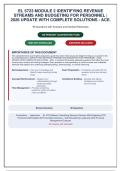
EL 5723 MODULE 2 IDENTIFYING REVENUE
STREAMS AND BUDGETING FOR PERSONNEL |
2026 UPDATE WITH COMPLETE SOLUTIONS - ACE.
99 Questions with Answers and Detailed Rationales
100 PERCENT GUARANTEED PASS
INSTANT DOWNLOAD ANSWERS INCLUDED
IMPORTANCE OF THIS DOCUMENT
This comprehensive examination preparation guide has been meticulously developed to help you succeed in the
EL 5723 MODULE 2 IDENTIFYING REVENUE STREAMS AND BUDGETING FOR PERSONNEL | 2026
UPDATE WITH COMPLETE SOLUTIONS - ACE.. It contains 99 carefully selected questions that reflect the most
current exam content and testing strategies. Each question is accompanied by a correct answer and a detailed
rationale that explains the underlying pathophysiology, pharmacology, or clinical reasoning.
Self-Assessment – Test your knowledge and Exam Preparation – Familiarize yourself with the
identify areas requiring further question format and content
study areas
Concept Reinforcement – Deepen your Confidence Building – Develop test-taking
understanding through strategies and reduce
evidence-based exam anxiety
rationales
Time Management – Practice answering
questions under simulated
exam conditions
Review Summary 99 Questions
Foundations - Application - EL 5723 Module 2 Identifying Revenue Streams AND Budgeting FOR
Personnel 2026 Update WITH Complete Solutions - ACE Educational Leadership AND Financial
Management Graduate
All answers with rationales
,Table of Contents
Content Area Questions Key Topics
Identifying Revenue Streams 1-17 Budget, Revenue, Personnel, Department, Tuition
Budgeting FOR Personnel 18-34 Budget, Department, Revenue, University, Indirect COST
Revenue Cycle Management 35-51 University, Salary, Grant, Total, Revenue
Personnel COST Analysis 52-68 Costs, Revenue, Budget, Approach, Critical
Budget Development AND 69-85 Budget, Revenue, State, Salary, Rolling
Monitoring
Financial Reporting AND 86-99 Budget, Financial, Revenue, Personnel, Enrollment
Analysis
TOTAL 99 All questions include answers and detailed rationales
,Section A - Identifying Revenue Streams
Q1.
A school district is considering a new vocational program. Which revenue stream requires
the most careful legal scrutiny due to potential restrictions on use?
A. State per-pupil funding B. Federal Perkins grant
C. Local property tax revenue D. Private donation from an alumni
foundation
Correct: B - Federal Perkins grant
Rationale:Federal grants like Perkins have strict allowable-use rules and compliance
requirements. State per-pupil funding, local property taxes, and donations have fewer
restrictions, though donations may have donor intent constraints. The correct answer is B.
Q2.
A university's endowment has a spending rate of 5% and a 10-year average return of 7%.
Inflation is 2.5%. What is the real net contribution to the operating budget per $1 million of
endowment?
A. $50,000 B. $25,000
C. $45,000 D. $20,000
Correct: B - $25,000
Rationale:The spending amount is $50,000 (5% of $1M). However, to maintain purchasing
power, the endowment must retain enough to cover inflation. The real net contribution is
spending minus inflation-adjusted principal erosion: $50,000 - ($1M * 2.5%) = $50,000 -
$25,000 = $25,000. The return rate is irrelevant to the spending rule but ensures
sustainability. Thus, B is correct.
Q3.
A school administrator is creating a personnel budget. Which approach best aligns with
zero-based budgeting principles?
A. Using last year's budget plus a 3% B. Justifying every position based on current
inflation factor student needs and program objectives
C. Allocating funds equally across all D. Basing the budget on projected
departments enrollment without program review
Correct: B - Justifying every position based on current student needs and program
objectives
Page 3
, Section A - Identifying Revenue Streams
Rationale: Zero-based budgeting requires starting from zero and justifying every expense,
including personnel, based on current needs and objectives. Option A is incremental
budgeting, C is egalitarian, and D is enrollment-driven without justification. B is correct.
Q4.
A district is negotiating a new teacher contract. Which factor most significantly impacts
long-term personnel budget sustainability?
A. Starting salary B. Step-and-lane salary schedule
C. Health insurance premium share D. Number of professional development
days
Correct: B - Step-and-lane salary schedule
Rationale:Step-and-lane schedules create predictable but escalating costs as teachers gain
experience and education. Long-term sustainability depends on the trajectory of these
increments. Starting salary, insurance share, and PD days have less compounding effect.
Thus, B is correct.
Q5.
A private school is considering a tuition increase. Which economic concept best explains
the potential trade-off between higher tuition and enrollment?
A. Price elasticity of demand B. Marginal cost of instruction
C. Opportunity cost of facilities D. Economies of scale
Correct: A - Price elasticity of demand
Rationale:Price elasticity of demand measures how sensitive enrollment is to tuition changes.
If demand is elastic, a tuition increase could reduce total revenue. Marginal cost, opportunity
cost, and economies of scale are relevant but don't directly address the trade-off. A is correct.
Q6.
In a school district, which scenario best illustrates the 'cost-to-serve' concept in
budgeting?
A. Allocating the same per-student amount B. Determining the actual cost of educating
to all schools a student with special needs versus a
general education student
C. Calculating the average teacher salary D. Estimating the total utility costs for all
across the district buildings
Correct: B - Determining the actual cost of educating a student with special needs versus
a general education student
Page 4
STREAMS AND BUDGETING FOR PERSONNEL |
2026 UPDATE WITH COMPLETE SOLUTIONS - ACE.
99 Questions with Answers and Detailed Rationales
100 PERCENT GUARANTEED PASS
INSTANT DOWNLOAD ANSWERS INCLUDED
IMPORTANCE OF THIS DOCUMENT
This comprehensive examination preparation guide has been meticulously developed to help you succeed in the
EL 5723 MODULE 2 IDENTIFYING REVENUE STREAMS AND BUDGETING FOR PERSONNEL | 2026
UPDATE WITH COMPLETE SOLUTIONS - ACE.. It contains 99 carefully selected questions that reflect the most
current exam content and testing strategies. Each question is accompanied by a correct answer and a detailed
rationale that explains the underlying pathophysiology, pharmacology, or clinical reasoning.
Self-Assessment – Test your knowledge and Exam Preparation – Familiarize yourself with the
identify areas requiring further question format and content
study areas
Concept Reinforcement – Deepen your Confidence Building – Develop test-taking
understanding through strategies and reduce
evidence-based exam anxiety
rationales
Time Management – Practice answering
questions under simulated
exam conditions
Review Summary 99 Questions
Foundations - Application - EL 5723 Module 2 Identifying Revenue Streams AND Budgeting FOR
Personnel 2026 Update WITH Complete Solutions - ACE Educational Leadership AND Financial
Management Graduate
All answers with rationales
,Table of Contents
Content Area Questions Key Topics
Identifying Revenue Streams 1-17 Budget, Revenue, Personnel, Department, Tuition
Budgeting FOR Personnel 18-34 Budget, Department, Revenue, University, Indirect COST
Revenue Cycle Management 35-51 University, Salary, Grant, Total, Revenue
Personnel COST Analysis 52-68 Costs, Revenue, Budget, Approach, Critical
Budget Development AND 69-85 Budget, Revenue, State, Salary, Rolling
Monitoring
Financial Reporting AND 86-99 Budget, Financial, Revenue, Personnel, Enrollment
Analysis
TOTAL 99 All questions include answers and detailed rationales
,Section A - Identifying Revenue Streams
Q1.
A school district is considering a new vocational program. Which revenue stream requires
the most careful legal scrutiny due to potential restrictions on use?
A. State per-pupil funding B. Federal Perkins grant
C. Local property tax revenue D. Private donation from an alumni
foundation
Correct: B - Federal Perkins grant
Rationale:Federal grants like Perkins have strict allowable-use rules and compliance
requirements. State per-pupil funding, local property taxes, and donations have fewer
restrictions, though donations may have donor intent constraints. The correct answer is B.
Q2.
A university's endowment has a spending rate of 5% and a 10-year average return of 7%.
Inflation is 2.5%. What is the real net contribution to the operating budget per $1 million of
endowment?
A. $50,000 B. $25,000
C. $45,000 D. $20,000
Correct: B - $25,000
Rationale:The spending amount is $50,000 (5% of $1M). However, to maintain purchasing
power, the endowment must retain enough to cover inflation. The real net contribution is
spending minus inflation-adjusted principal erosion: $50,000 - ($1M * 2.5%) = $50,000 -
$25,000 = $25,000. The return rate is irrelevant to the spending rule but ensures
sustainability. Thus, B is correct.
Q3.
A school administrator is creating a personnel budget. Which approach best aligns with
zero-based budgeting principles?
A. Using last year's budget plus a 3% B. Justifying every position based on current
inflation factor student needs and program objectives
C. Allocating funds equally across all D. Basing the budget on projected
departments enrollment without program review
Correct: B - Justifying every position based on current student needs and program
objectives
Page 3
, Section A - Identifying Revenue Streams
Rationale: Zero-based budgeting requires starting from zero and justifying every expense,
including personnel, based on current needs and objectives. Option A is incremental
budgeting, C is egalitarian, and D is enrollment-driven without justification. B is correct.
Q4.
A district is negotiating a new teacher contract. Which factor most significantly impacts
long-term personnel budget sustainability?
A. Starting salary B. Step-and-lane salary schedule
C. Health insurance premium share D. Number of professional development
days
Correct: B - Step-and-lane salary schedule
Rationale:Step-and-lane schedules create predictable but escalating costs as teachers gain
experience and education. Long-term sustainability depends on the trajectory of these
increments. Starting salary, insurance share, and PD days have less compounding effect.
Thus, B is correct.
Q5.
A private school is considering a tuition increase. Which economic concept best explains
the potential trade-off between higher tuition and enrollment?
A. Price elasticity of demand B. Marginal cost of instruction
C. Opportunity cost of facilities D. Economies of scale
Correct: A - Price elasticity of demand
Rationale:Price elasticity of demand measures how sensitive enrollment is to tuition changes.
If demand is elastic, a tuition increase could reduce total revenue. Marginal cost, opportunity
cost, and economies of scale are relevant but don't directly address the trade-off. A is correct.
Q6.
In a school district, which scenario best illustrates the 'cost-to-serve' concept in
budgeting?
A. Allocating the same per-student amount B. Determining the actual cost of educating
to all schools a student with special needs versus a
general education student
C. Calculating the average teacher salary D. Estimating the total utility costs for all
across the district buildings
Correct: B - Determining the actual cost of educating a student with special needs versus
a general education student
Page 4