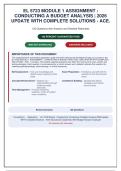
EL 5723 MODULE 1 ASSIGNMENT :
CONDUCTING A BUDGET ANALYSIS | 2026
UPDATE WITH COMPLETE SOLUTIONS - ACE.
120 Questions with Answers and Detailed Rationales
100 PERCENT GUARANTEED PASS
INSTANT DOWNLOAD ANSWERS INCLUDED
IMPORTANCE OF THIS DOCUMENT
This comprehensive examination preparation guide has been meticulously developed to help you succeed in the
EL 5723 MODULE 1 ASSIGNMENT : CONDUCTING A BUDGET ANALYSIS | 2026 UPDATE WITH COMPLETE
SOLUTIONS - ACE.. It contains 120 carefully selected questions that reflect the most current exam content and
testing strategies. Each question is accompanied by a correct answer and a detailed rationale that explains the
underlying pathophysiology, pharmacology, or clinical reasoning.
Self-Assessment – Test your knowledge and Exam Preparation – Familiarize yourself with the
identify areas requiring further question format and content
study areas
Concept Reinforcement – Deepen your Confidence Building – Develop test-taking
understanding through strategies and reduce
evidence-based exam anxiety
rationales
Time Management – Practice answering
questions under simulated
exam conditions
Review Summary 120 Questions
Foundations - Application - EL 5723 Module 1 Assignment Conducting A Budget Analysis 2026 Update
WITH Complete Solutions - ACE Educational Leadership AND Budget Analysis Graduate
All answers with rationales
,Table of Contents
Content Area Questions Key Topics
Introduction TO Budget 1-20 Budget, Analysis, Program, District, Variance
Analysis
Budgeting Concepts AND 21-40 Budget, Analysis, Variance, University, Department
Terminology
Types OF Budgets Operating 41-60 Budget, Variance, Analysis, Approach, Costs
Capital CASH
Budget Preparation Process 61-80 Budget, Variance, Annual, Public, Division
Revenue AND Expense 81-100 Budget, University, School, District S, Analysis
Forecasting
Variance Analysis 101-120 Budget, University, Analysis, Costs, Program
TOTAL 120 All questions include answers and detailed rationales
,Section A - Introduction TO Budget Analysis
Q1.
A district is transitioning from incremental budgeting to zero-based budgeting (ZBB) to
improve resource allocation. Which of the following is the most significant challenge
when implementing ZBB in an educational setting?
A. It requires each program to justify its B. It eliminates all flexibility for unexpected
entire budget from zero, which is expenditures during the fiscal year.
time-intensive and may overwhelm
administrators.
C. It focuses exclusively on student D. It mandates that all budget requests be
outcomes, ignoring operational necessities. approved by external auditors.
Correct: A - It requires each program to justify its entire budget from zero, which is
time-intensive and may overwhelm administrators.
Rationale:ZBB requires every program to justify its budget from scratch, which is
labor-intensive and demands substantial administrative time and data. It does not eliminate
flexibility (B) nor focus solely on outcomes (C), and external auditors are not inherently
mandated (D).
Q2.
In a program budget, which of the following best describes the relationship between
inputs, activities, and outputs in a logic model used for budget justification?
A. Inputs are the financial resources B. Inputs are the desired outcomes;
allocated; activities are the actions taken; activities are the budget lines; outputs are
outputs are the direct results of those the expenditures.
actions.
C. Inputs are the staff hired; activities are D. Inputs are the raw data collected;
the training provided; outputs are the activities are the analysis performed;
long-term student achievement gains. outputs are the budget reports generated.
Correct: A - Inputs are the financial resources allocated; activities are the actions taken;
outputs are the direct results of those actions.
Rationale:In a logic model, inputs are resources (funds, staff, materials), activities are what
the program does, and outputs are the direct products or counts of activities. Option C
confuses outputs with outcomes (long-term gains), and B and D mislabel the components.
Q3.
A school district's budget director is performing a variance analysis for the special
education department. The actual cost per student exceeded the budgeted cost by 12%,
Page 3
, Section A - Introduction TO Budget Analysis
while the number of students served was 8% lower than projected. What is the most likely
explanation for the total expenditure variance?
A. The department experienced a favorable B. The department experienced an
volume variance but an unfavorable price unfavorable volume variance and an
variance that outweighed it. unfavorable price variance.
C. The department experienced a favorable D. The total variance is primarily due to a
price variance and an unfavorable volume favorable volume variance.
variance.
Correct: A - The department experienced a favorable volume variance but an unfavorable
price variance that outweighed it.
Rationale:Lower enrollment creates a favorable volume variance (fewer students, lower
expected cost), but higher cost per student creates an unfavorable price variance. Since total
cost increased, the unfavorable price variance must exceed the favorable volume variance.
Option B incorrectly labels volume as unfavorable, C and D misstate the signs.
Q4.
When using trend analysis to forecast next year's enrollment, which method would be
most appropriate if enrollment has shown a consistent growth pattern of 2% per year for
the past five years, but last year saw a sudden 5% spike due to a new housing
development?
A. Use a moving average of the last three B. Extrapolate the 5% growth rate from the
years to smooth out the spike. most recent year.
C. Use a weighted moving average giving D. Ignore the spike and use the 2%
more weight to recent years but adjusting for historical average.
the one-time spike.
Correct: C - Use a weighted moving average giving more weight to recent years but
adjusting for the one-time spike.
Rationale:A weighted moving average that gives more weight to recent data but accounts for
the one-time spike balances trend and anomaly. Option A would still include the spike, B
overreacts, and D ignores relevant recent data. C is the most methodologically sound.
Q5.
A school board is considering a budget proposal that increases funding for technology
infrastructure while cutting funding for arts programs. Which ethical framework would
prioritize the long-term educational benefits to all students over the immediate loss of arts
programs?
Page 4
CONDUCTING A BUDGET ANALYSIS | 2026
UPDATE WITH COMPLETE SOLUTIONS - ACE.
120 Questions with Answers and Detailed Rationales
100 PERCENT GUARANTEED PASS
INSTANT DOWNLOAD ANSWERS INCLUDED
IMPORTANCE OF THIS DOCUMENT
This comprehensive examination preparation guide has been meticulously developed to help you succeed in the
EL 5723 MODULE 1 ASSIGNMENT : CONDUCTING A BUDGET ANALYSIS | 2026 UPDATE WITH COMPLETE
SOLUTIONS - ACE.. It contains 120 carefully selected questions that reflect the most current exam content and
testing strategies. Each question is accompanied by a correct answer and a detailed rationale that explains the
underlying pathophysiology, pharmacology, or clinical reasoning.
Self-Assessment – Test your knowledge and Exam Preparation – Familiarize yourself with the
identify areas requiring further question format and content
study areas
Concept Reinforcement – Deepen your Confidence Building – Develop test-taking
understanding through strategies and reduce
evidence-based exam anxiety
rationales
Time Management – Practice answering
questions under simulated
exam conditions
Review Summary 120 Questions
Foundations - Application - EL 5723 Module 1 Assignment Conducting A Budget Analysis 2026 Update
WITH Complete Solutions - ACE Educational Leadership AND Budget Analysis Graduate
All answers with rationales
,Table of Contents
Content Area Questions Key Topics
Introduction TO Budget 1-20 Budget, Analysis, Program, District, Variance
Analysis
Budgeting Concepts AND 21-40 Budget, Analysis, Variance, University, Department
Terminology
Types OF Budgets Operating 41-60 Budget, Variance, Analysis, Approach, Costs
Capital CASH
Budget Preparation Process 61-80 Budget, Variance, Annual, Public, Division
Revenue AND Expense 81-100 Budget, University, School, District S, Analysis
Forecasting
Variance Analysis 101-120 Budget, University, Analysis, Costs, Program
TOTAL 120 All questions include answers and detailed rationales
,Section A - Introduction TO Budget Analysis
Q1.
A district is transitioning from incremental budgeting to zero-based budgeting (ZBB) to
improve resource allocation. Which of the following is the most significant challenge
when implementing ZBB in an educational setting?
A. It requires each program to justify its B. It eliminates all flexibility for unexpected
entire budget from zero, which is expenditures during the fiscal year.
time-intensive and may overwhelm
administrators.
C. It focuses exclusively on student D. It mandates that all budget requests be
outcomes, ignoring operational necessities. approved by external auditors.
Correct: A - It requires each program to justify its entire budget from zero, which is
time-intensive and may overwhelm administrators.
Rationale:ZBB requires every program to justify its budget from scratch, which is
labor-intensive and demands substantial administrative time and data. It does not eliminate
flexibility (B) nor focus solely on outcomes (C), and external auditors are not inherently
mandated (D).
Q2.
In a program budget, which of the following best describes the relationship between
inputs, activities, and outputs in a logic model used for budget justification?
A. Inputs are the financial resources B. Inputs are the desired outcomes;
allocated; activities are the actions taken; activities are the budget lines; outputs are
outputs are the direct results of those the expenditures.
actions.
C. Inputs are the staff hired; activities are D. Inputs are the raw data collected;
the training provided; outputs are the activities are the analysis performed;
long-term student achievement gains. outputs are the budget reports generated.
Correct: A - Inputs are the financial resources allocated; activities are the actions taken;
outputs are the direct results of those actions.
Rationale:In a logic model, inputs are resources (funds, staff, materials), activities are what
the program does, and outputs are the direct products or counts of activities. Option C
confuses outputs with outcomes (long-term gains), and B and D mislabel the components.
Q3.
A school district's budget director is performing a variance analysis for the special
education department. The actual cost per student exceeded the budgeted cost by 12%,
Page 3
, Section A - Introduction TO Budget Analysis
while the number of students served was 8% lower than projected. What is the most likely
explanation for the total expenditure variance?
A. The department experienced a favorable B. The department experienced an
volume variance but an unfavorable price unfavorable volume variance and an
variance that outweighed it. unfavorable price variance.
C. The department experienced a favorable D. The total variance is primarily due to a
price variance and an unfavorable volume favorable volume variance.
variance.
Correct: A - The department experienced a favorable volume variance but an unfavorable
price variance that outweighed it.
Rationale:Lower enrollment creates a favorable volume variance (fewer students, lower
expected cost), but higher cost per student creates an unfavorable price variance. Since total
cost increased, the unfavorable price variance must exceed the favorable volume variance.
Option B incorrectly labels volume as unfavorable, C and D misstate the signs.
Q4.
When using trend analysis to forecast next year's enrollment, which method would be
most appropriate if enrollment has shown a consistent growth pattern of 2% per year for
the past five years, but last year saw a sudden 5% spike due to a new housing
development?
A. Use a moving average of the last three B. Extrapolate the 5% growth rate from the
years to smooth out the spike. most recent year.
C. Use a weighted moving average giving D. Ignore the spike and use the 2%
more weight to recent years but adjusting for historical average.
the one-time spike.
Correct: C - Use a weighted moving average giving more weight to recent years but
adjusting for the one-time spike.
Rationale:A weighted moving average that gives more weight to recent data but accounts for
the one-time spike balances trend and anomaly. Option A would still include the spike, B
overreacts, and D ignores relevant recent data. C is the most methodologically sound.
Q5.
A school board is considering a budget proposal that increases funding for technology
infrastructure while cutting funding for arts programs. Which ethical framework would
prioritize the long-term educational benefits to all students over the immediate loss of arts
programs?
Page 4