

NUR 111 exam 3
NUR 111 exam 3
Study online at https://quizlet.com/_i3gx3z
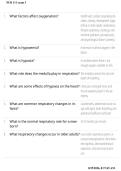
1. What factors affect oxygenation? Health level, cardiac/respiratory dis-
orders, obesity, development stage
(infant or older adult), medications,
lifestyle (sedentary, smoking), envi-
ronment (pollution, job exposure),
and psychological factors (anxiety).
2. What is hypoxemia? A decrease in arterial oxygen in the
blood.
3. What is hypoxia? A condition where there is not
enough oxygen available to cells.
4. What role does the medulla play in respiration? The medulla controls the rate and
depth of breathing.
5. What are some effects of hypoxia on the heart? Chest pain, enlarged heart, and
muscle weakness/pain in the pe-
riphery.
6. What are common respiratory changes in in- Loud breaths, abdominal muscle us-
fants? age until age 6, faster breathing, and
potential insufficient surfactant.
7. What is the normal respiratory rate for a new- 35-55 breaths per minute.
born?
8. What respiratory changes occur in older adults? Less elastic respiratory system, in-
creased anteroposterior chest diam-
eter, kyphosis, decreased thoracic
expansion, and accessory muscle
use.
8/25/2026, 8:37:45 AM
, NUR 111 exam 3
NUR 111 exam 3
Study online at https://quizlet.com/_i3gx3z
9. What are normal findings during respiratory in- Regular breathing, alertness, even
spection? color, transverse diameter greater
than anteroposterior diameter, sym-
metric and unlabored smooth
breathing at 12-20 breaths per
minute.
10. What are abnormal findings during respiratory Anxiety, decreased consciousness,
inspection? pallor/cyanosis, nasal flaring, barrel
chest, dyspnea, pale color, and ab-
normal breathing patterns.
11. What does pulse oximetry measure? Arterial oxyhemoglobin saturation
(SpO2) of arterial blood.
12. What is the normal range for pulse oximetry? 95-100%.
13. What are some strategies to improve oxygena- Pollution-free environment, reduce
tion? anxiety, better nutrition, proper po-
sitioning, increased fluid intake, hu-
midified air, and breathing exercises.
14. What is the purpose of incentive spirometry? To maximize lung inflation and pre-
vent/reduce atelectasis (lung col-
lapse).
15. What are the types of oxygen delivery systems? Low flow (e.g., nasal cannula, simple
face mask) and high flow (e.g., Ven-
turi mask, nonrebreather mask).
16. What are the side effects of corticosteroids? Weight gain, moon face, hy-
perglycemia, jitteriness, and taste
changes.
8/25/2026, 8:37:45 AM
NUR 111 exam 3
Study online at https://quizlet.com/_i3gx3z
1. What factors affect oxygenation? Health level, cardiac/respiratory dis-
orders, obesity, development stage
(infant or older adult), medications,
lifestyle (sedentary, smoking), envi-
ronment (pollution, job exposure),
and psychological factors (anxiety).
2. What is hypoxemia? A decrease in arterial oxygen in the
blood.
3. What is hypoxia? A condition where there is not
enough oxygen available to cells.
4. What role does the medulla play in respiration? The medulla controls the rate and
depth of breathing.
5. What are some effects of hypoxia on the heart? Chest pain, enlarged heart, and
muscle weakness/pain in the pe-
riphery.
6. What are common respiratory changes in in- Loud breaths, abdominal muscle us-
fants? age until age 6, faster breathing, and
potential insufficient surfactant.
7. What is the normal respiratory rate for a new- 35-55 breaths per minute.
born?
8. What respiratory changes occur in older adults? Less elastic respiratory system, in-
creased anteroposterior chest diam-
eter, kyphosis, decreased thoracic
expansion, and accessory muscle
use.
8/25/2026, 8:37:45 AM
, NUR 111 exam 3
NUR 111 exam 3
Study online at https://quizlet.com/_i3gx3z
9. What are normal findings during respiratory in- Regular breathing, alertness, even
spection? color, transverse diameter greater
than anteroposterior diameter, sym-
metric and unlabored smooth
breathing at 12-20 breaths per
minute.
10. What are abnormal findings during respiratory Anxiety, decreased consciousness,
inspection? pallor/cyanosis, nasal flaring, barrel
chest, dyspnea, pale color, and ab-
normal breathing patterns.
11. What does pulse oximetry measure? Arterial oxyhemoglobin saturation
(SpO2) of arterial blood.
12. What is the normal range for pulse oximetry? 95-100%.
13. What are some strategies to improve oxygena- Pollution-free environment, reduce
tion? anxiety, better nutrition, proper po-
sitioning, increased fluid intake, hu-
midified air, and breathing exercises.
14. What is the purpose of incentive spirometry? To maximize lung inflation and pre-
vent/reduce atelectasis (lung col-
lapse).
15. What are the types of oxygen delivery systems? Low flow (e.g., nasal cannula, simple
face mask) and high flow (e.g., Ven-
turi mask, nonrebreather mask).
16. What are the side effects of corticosteroids? Weight gain, moon face, hy-
perglycemia, jitteriness, and taste
changes.
8/25/2026, 8:37:45 AM


