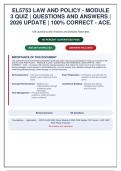
EL5753 LAW AND POLICY - MODULE
3 QUIZ | QUESTIONS AND ANSWERS |
2026 UPDATE | 100% CORRECT - ACE.
128 Questions with Answers and Detailed Rationales
100 PERCENT GUARANTEED PASS
INSTANT DOWNLOAD ANSWERS INCLUDED
IMPORTANCE OF THIS DOCUMENT
This comprehensive examination preparation guide has been meticulously developed to help you succeed in the
EL5753 LAW AND POLICY - MODULE 3 QUIZ | QUESTIONS AND ANSWERS | 2026 UPDATE | 100%
CORRECT - ACE.. It contains 128 carefully selected questions that reflect the most current exam content and
testing strategies. Each question is accompanied by a correct answer and a detailed rationale that explains the
underlying pathophysiology, pharmacology, or clinical reasoning.
Self-Assessment – Test your knowledge and Exam Preparation – Familiarize yourself with the
identify areas requiring further question format and content
study areas
Concept Reinforcement – Deepen your Confidence Building – Develop test-taking
understanding through strategies and reduce
evidence-based exam anxiety
rationales
Time Management – Practice answering
questions under simulated
exam conditions
Review Summary 128 Questions
Foundations - Application - El5753 LAW AND Policy Module 3 AND 2026 Update 100 Correct - ACE LAW
AND Policy Graduate
All answers with rationales
,Table of Contents
Content Area Questions Key Topics
Introduction TO LAW AND 1-22 Agency, Court, Statute, Federal, State
Policy
Legal Frameworks AND 23-44 Statute, Federal, Court, Agency S, State
Regulatory Bodies
Policy Development AND 45-66 Agency, Federal, Court, Statute, Likely
Implementation
Ethical Considerations IN 67-88 Agency, Federal, Court, Issues, Without
LAW AND Policy
Constitutional LAW AND 89-110 Agency, Federal, Statute, Court, Standard
Civil Rights
Administrative LAW AND 111-128 Federal, Agency, Statute, State, Court
Agency Rulemaking
TOTAL 128 All questions include answers and detailed rationales
,Section A - Introduction TO LAW AND Policy
Q1.
In a recent decision, the Supreme Court held that a federal agency's interpretation of an
ambiguous statute is entitled to deference only when Congress delegated authority to the
agency to make rules with the force of law. This holding most directly reflects which
principle?
A. The major questions doctrine requires B. Chevron deference applies only when the
clear congressional authorization for major agency's interpretation is promulgated
regulatory actions. through formal adjudication.
C. Courts must independently determine the D. Deference is warranted only if the
best interpretation of a statute without agency's interpretation is reasonable and
deference to agency views. consistent with the statute's purpose.
Correct: C - Courts must independently determine the best interpretation of a statute
without deference to agency views.
Rationale:The scenario describes the holding of Loper Bright Enterprises v. Raimondo
(2024), which overruled Chevron and held that courts must exercise independent judgment in
interpreting statutes. Option A is the major questions doctrine, distinct from the general
deference question. Option B misstates the trigger for Chevron, which applied to rulemaking
and adjudication. Option D reflects Chevron step two, which is no longer controlling.
Q2.
A federal statute authorizes the Secretary of Transportation to 'promulgate regulations
necessary to ensure the safe operation of commercial drones.' The Secretary issues a rule
requiring all drones to have remote identification technology. A drone hobbyist challenges
the rule, arguing the statute does not explicitly authorize this requirement. Applying the
major questions doctrine, how should a court rule?
A. The rule is invalid because Congress did B. The rule is valid because 'safe operation'
not clearly authorize the imposition of a is broad enough to encompass remote
significant new burden on a large segment identification, and the agency has expertise.
of the economy.
C. The rule is invalid because the statute is D. The rule is valid because the major
ambiguous and the agency did not follow questions doctrine only applies to rules that
formal rulemaking procedures. exceed $100 million in economic impact.
Correct: A - The rule is invalid because Congress did not clearly authorize the imposition
of a significant new burden on a large segment of the economy.
Page 3
, Section A - Introduction TO LAW AND Policy
Rationale: Under the major questions doctrine, courts presume Congress does not delegate
major policy decisions to agencies absent clear statutory language. Remote ID affects
millions of hobbyists and imposes significant compliance costs, implicating the doctrine.
Option B ignores the doctrine's requirement for clear authorization. Option C incorrectly
focuses on procedure, as the rule was likely promulgated under notice-and-comment. Option
D misstates the doctrine's threshold, which is not purely economic.
Q3.
In a state where marijuana is legal for recreational use, an employer maintains a
zero-tolerance drug policy and terminates an employee who tests positive for THC. The
employee sues, claiming the termination violates public policy. The state's marijuana
statute is silent on employment protections. Which legal principle is most relevant to the
court's analysis?
A. The doctrine of federal preemption, B. The employment-at-will doctrine, which
because federal law criminalizes marijuana. allows termination for any reason unless an
exception applies.
C. The covenant of good faith and fair D. The statutory interpretation canon that
dealing, which implies a duty of fair statutes in derogation of common law are
treatment in all contracts. strictly construed.
Correct: B - The employment-at-will doctrine, which allows termination for any reason
unless an exception applies.
Rationale:Employment-at-will is the default rule, and courts generally refuse to create a
public policy exception for off-duty marijuana use unless the statute explicitly protects
employees. Federal preemption (A) is not directly relevant because the state law is not being
challenged. Good faith (C) is not recognized in most employment contexts. Strict construction
(D) is a tool, but the core issue is whether public policy exception applies, which is an
exception to at-will.
Q4.
An administrative agency promulgates a rule that interprets a statute it administers. The
agency did not receive explicit congressional delegation to make rules with the force of
law, but the rule is issued after notice-and-comment. A court reviewing the rule should
apply which standard?
A. De novo review, giving no deference to B. Skidmore deference, based on the
the agency's interpretation. persuasiveness of the agency's reasoning.
C. Chevron deference, because the statute D. Hard look review, focusing on whether
is ambiguous and the rule is reasonable. the agency considered all relevant factors.
Correct: B - Skidmore deference, based on the persuasiveness of the agency's reasoning.
Page 4
3 QUIZ | QUESTIONS AND ANSWERS |
2026 UPDATE | 100% CORRECT - ACE.
128 Questions with Answers and Detailed Rationales
100 PERCENT GUARANTEED PASS
INSTANT DOWNLOAD ANSWERS INCLUDED
IMPORTANCE OF THIS DOCUMENT
This comprehensive examination preparation guide has been meticulously developed to help you succeed in the
EL5753 LAW AND POLICY - MODULE 3 QUIZ | QUESTIONS AND ANSWERS | 2026 UPDATE | 100%
CORRECT - ACE.. It contains 128 carefully selected questions that reflect the most current exam content and
testing strategies. Each question is accompanied by a correct answer and a detailed rationale that explains the
underlying pathophysiology, pharmacology, or clinical reasoning.
Self-Assessment – Test your knowledge and Exam Preparation – Familiarize yourself with the
identify areas requiring further question format and content
study areas
Concept Reinforcement – Deepen your Confidence Building – Develop test-taking
understanding through strategies and reduce
evidence-based exam anxiety
rationales
Time Management – Practice answering
questions under simulated
exam conditions
Review Summary 128 Questions
Foundations - Application - El5753 LAW AND Policy Module 3 AND 2026 Update 100 Correct - ACE LAW
AND Policy Graduate
All answers with rationales
,Table of Contents
Content Area Questions Key Topics
Introduction TO LAW AND 1-22 Agency, Court, Statute, Federal, State
Policy
Legal Frameworks AND 23-44 Statute, Federal, Court, Agency S, State
Regulatory Bodies
Policy Development AND 45-66 Agency, Federal, Court, Statute, Likely
Implementation
Ethical Considerations IN 67-88 Agency, Federal, Court, Issues, Without
LAW AND Policy
Constitutional LAW AND 89-110 Agency, Federal, Statute, Court, Standard
Civil Rights
Administrative LAW AND 111-128 Federal, Agency, Statute, State, Court
Agency Rulemaking
TOTAL 128 All questions include answers and detailed rationales
,Section A - Introduction TO LAW AND Policy
Q1.
In a recent decision, the Supreme Court held that a federal agency's interpretation of an
ambiguous statute is entitled to deference only when Congress delegated authority to the
agency to make rules with the force of law. This holding most directly reflects which
principle?
A. The major questions doctrine requires B. Chevron deference applies only when the
clear congressional authorization for major agency's interpretation is promulgated
regulatory actions. through formal adjudication.
C. Courts must independently determine the D. Deference is warranted only if the
best interpretation of a statute without agency's interpretation is reasonable and
deference to agency views. consistent with the statute's purpose.
Correct: C - Courts must independently determine the best interpretation of a statute
without deference to agency views.
Rationale:The scenario describes the holding of Loper Bright Enterprises v. Raimondo
(2024), which overruled Chevron and held that courts must exercise independent judgment in
interpreting statutes. Option A is the major questions doctrine, distinct from the general
deference question. Option B misstates the trigger for Chevron, which applied to rulemaking
and adjudication. Option D reflects Chevron step two, which is no longer controlling.
Q2.
A federal statute authorizes the Secretary of Transportation to 'promulgate regulations
necessary to ensure the safe operation of commercial drones.' The Secretary issues a rule
requiring all drones to have remote identification technology. A drone hobbyist challenges
the rule, arguing the statute does not explicitly authorize this requirement. Applying the
major questions doctrine, how should a court rule?
A. The rule is invalid because Congress did B. The rule is valid because 'safe operation'
not clearly authorize the imposition of a is broad enough to encompass remote
significant new burden on a large segment identification, and the agency has expertise.
of the economy.
C. The rule is invalid because the statute is D. The rule is valid because the major
ambiguous and the agency did not follow questions doctrine only applies to rules that
formal rulemaking procedures. exceed $100 million in economic impact.
Correct: A - The rule is invalid because Congress did not clearly authorize the imposition
of a significant new burden on a large segment of the economy.
Page 3
, Section A - Introduction TO LAW AND Policy
Rationale: Under the major questions doctrine, courts presume Congress does not delegate
major policy decisions to agencies absent clear statutory language. Remote ID affects
millions of hobbyists and imposes significant compliance costs, implicating the doctrine.
Option B ignores the doctrine's requirement for clear authorization. Option C incorrectly
focuses on procedure, as the rule was likely promulgated under notice-and-comment. Option
D misstates the doctrine's threshold, which is not purely economic.
Q3.
In a state where marijuana is legal for recreational use, an employer maintains a
zero-tolerance drug policy and terminates an employee who tests positive for THC. The
employee sues, claiming the termination violates public policy. The state's marijuana
statute is silent on employment protections. Which legal principle is most relevant to the
court's analysis?
A. The doctrine of federal preemption, B. The employment-at-will doctrine, which
because federal law criminalizes marijuana. allows termination for any reason unless an
exception applies.
C. The covenant of good faith and fair D. The statutory interpretation canon that
dealing, which implies a duty of fair statutes in derogation of common law are
treatment in all contracts. strictly construed.
Correct: B - The employment-at-will doctrine, which allows termination for any reason
unless an exception applies.
Rationale:Employment-at-will is the default rule, and courts generally refuse to create a
public policy exception for off-duty marijuana use unless the statute explicitly protects
employees. Federal preemption (A) is not directly relevant because the state law is not being
challenged. Good faith (C) is not recognized in most employment contexts. Strict construction
(D) is a tool, but the core issue is whether public policy exception applies, which is an
exception to at-will.
Q4.
An administrative agency promulgates a rule that interprets a statute it administers. The
agency did not receive explicit congressional delegation to make rules with the force of
law, but the rule is issued after notice-and-comment. A court reviewing the rule should
apply which standard?
A. De novo review, giving no deference to B. Skidmore deference, based on the
the agency's interpretation. persuasiveness of the agency's reasoning.
C. Chevron deference, because the statute D. Hard look review, focusing on whether
is ambiguous and the rule is reasonable. the agency considered all relevant factors.
Correct: B - Skidmore deference, based on the persuasiveness of the agency's reasoning.
Page 4