
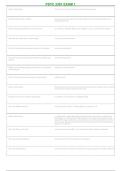
PSYC 2301 EXAM 1
Define Psychology study of mind; study of behavior and mental processing
Describe the scientific method is a way to ask and answer scientific questions by making observations and
doing experiments.
Why is Psychology defined as a hub science? bc numerous scientific fields come together in psyc, connect other disciplin
What are the major roots of Psychology? 2: phil and physical science
What is the relationship between behavior and biology? reciprocal relationship
How did most early philosophers believe knowledge was sensive/ introspection
gained?
When did Psychology distinguish itself from the discipline adopt the scientific method
of Philosophy?
Who conducted the first experiment in psychology? wilhelm wundt
Define structuralism Structuralism is the study of the parts and elements that make up the mind while
functionalism is the processes of the mind
Identify the founders of Gestalt psychology kurt koffka, max wertheimer, wolfgang kohler
Who was William James? wrote principal of PSYC / functionalism/ 1st school in US
Define behaviorism on observable, measurable behavior Behaviorism, also known as behavioral
psychology, is a theory of learning based upon the idea that all behaviors are
acquired through conditioning. Conditioning occurs through interaction with the
environment. Behaviorists believe that our responses to environmental stimuli
shape our behaviors. -
Who was Sigmund Freud? wrote unconscious conflict , sex, important of early childhood experiene
Who was Abraham Maslow? found 3rd force in PSYC & theory of motivation
Who was Carl Rogers? found humanistic movement / importance of personal growth, freewill, selfdome
, PSYC 2301 EXAM 1
Define the perspectives approach different way to look
Why do psychologists rely on different perspective in bc help better understand complex phenomena, single perspective give only us
psychology? part of answer. combine give big picture
Define evolutionary psychology asks how our evolutionary past continues to shape our behavior = maintain -
allow adapt
Define cognitive psychology investigates mental processes including thinking, problem solving, and
information processing = mind how code message
Define social psychology recognizes that behavior varies around averages and that individual differences
often interact with environment = influenced by people
Define developmental psychology investigates the normal changes in behavior that occur across the lifespan = how
we grow
Define clinical psychology explains, defines, and treats psychological disorders and promotes general well
being
What do the authors of your text believe regarding the will be 1 of combine & integrating new and existing perspective
future of psychology?
Where will the highest percentage of doctoral level 37%
psychologist work?
What is the current trend in many psychology graduate not prescribe medication / students are being trained in combined specialties
school programs?
According to your text how is "science" described today? science = knowledge + special way learning about reality through systematic
observation and experimental
Define critical thinking ability to think clearly, rationally and independently. follow logical argument
identify mistake logic -> attitude belief , value
Describe peer review it's scrutinized by other scientists who are expert on your area
Describe replication repeat an experiment and producing the same result
Describe case study Non experimental = descriptive studies depth analysis - very rare and unusual,
@ medical field, (HM) Disadv : can not specific to generalize information
Describe naturalistic observation Non experimental = descriptive studies / behavior of people and animals in their
natural setting ( watch + observe ) / expensive + time
Define Psychology study of mind; study of behavior and mental processing
Describe the scientific method is a way to ask and answer scientific questions by making observations and
doing experiments.
Why is Psychology defined as a hub science? bc numerous scientific fields come together in psyc, connect other disciplin
What are the major roots of Psychology? 2: phil and physical science
What is the relationship between behavior and biology? reciprocal relationship
How did most early philosophers believe knowledge was sensive/ introspection
gained?
When did Psychology distinguish itself from the discipline adopt the scientific method
of Philosophy?
Who conducted the first experiment in psychology? wilhelm wundt
Define structuralism Structuralism is the study of the parts and elements that make up the mind while
functionalism is the processes of the mind
Identify the founders of Gestalt psychology kurt koffka, max wertheimer, wolfgang kohler
Who was William James? wrote principal of PSYC / functionalism/ 1st school in US
Define behaviorism on observable, measurable behavior Behaviorism, also known as behavioral
psychology, is a theory of learning based upon the idea that all behaviors are
acquired through conditioning. Conditioning occurs through interaction with the
environment. Behaviorists believe that our responses to environmental stimuli
shape our behaviors. -
Who was Sigmund Freud? wrote unconscious conflict , sex, important of early childhood experiene
Who was Abraham Maslow? found 3rd force in PSYC & theory of motivation
Who was Carl Rogers? found humanistic movement / importance of personal growth, freewill, selfdome
, PSYC 2301 EXAM 1
Define the perspectives approach different way to look
Why do psychologists rely on different perspective in bc help better understand complex phenomena, single perspective give only us
psychology? part of answer. combine give big picture
Define evolutionary psychology asks how our evolutionary past continues to shape our behavior = maintain -
allow adapt
Define cognitive psychology investigates mental processes including thinking, problem solving, and
information processing = mind how code message
Define social psychology recognizes that behavior varies around averages and that individual differences
often interact with environment = influenced by people
Define developmental psychology investigates the normal changes in behavior that occur across the lifespan = how
we grow
Define clinical psychology explains, defines, and treats psychological disorders and promotes general well
being
What do the authors of your text believe regarding the will be 1 of combine & integrating new and existing perspective
future of psychology?
Where will the highest percentage of doctoral level 37%
psychologist work?
What is the current trend in many psychology graduate not prescribe medication / students are being trained in combined specialties
school programs?
According to your text how is "science" described today? science = knowledge + special way learning about reality through systematic
observation and experimental
Define critical thinking ability to think clearly, rationally and independently. follow logical argument
identify mistake logic -> attitude belief , value
Describe peer review it's scrutinized by other scientists who are expert on your area
Describe replication repeat an experiment and producing the same result
Describe case study Non experimental = descriptive studies depth analysis - very rare and unusual,
@ medical field, (HM) Disadv : can not specific to generalize information
Describe naturalistic observation Non experimental = descriptive studies / behavior of people and animals in their
natural setting ( watch + observe ) / expensive + time


