
PATH 370 - W1 Chp 1, 2, 4, 7 (simplified)
PATH 370 - W1 Chp 1, 2, 4, 7 (simplified)
Study online at https://quizlet.com/_ajlli3
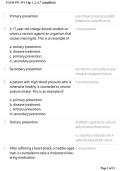
1. Primary prevention prevent disease by reducing susceptibili-
ty/exposure for susceptible persons
2. A 17-year-old college-bound student re- c. primary prevention.
ceives a vaccine against an organism that
causes meningitis. This is an example of
a. tertiary prevention.
b. disease treatment.
c. primary prevention.
d. secondary prevention.
3. Secondary prevention early detection, screening/physical exam,
(immediate) management of disease
4. A patient with high blood pressure who is d. secondary prevention.
otherwise healthy is counseled to restrict
sodium intake. This is an example of
a. primary prevention.
b. disease treatment.
c. tertiary prevention.
d. secondary prevention.
5. Tertiary prevention rehabilitation; supportive care; reduce dis-
ability and restore effective function
i.e., counseling on medications after al-
ready being diagnosed with a disease
6. After suffering a heart attack, a middle-aged d. tertiary prevention.
man is counseled to take a cholesterol-low-
ering medication.
Page 1 of 11
, PATH 370 - W1 Chp 1, 2, 4, 7 (simplified)
PATH 370 - W1 Chp 1, 2, 4, 7 (simplified)
Study online at https://quizlet.com/_ajlli3
a. disease treatment.
b. primary prevention.
c. secondary prevention.
d. tertiary prevention.
7. Latent period time b/w exposure of tissue to injurious
agent; ~no signs and symptoms
8. A patient has been exposed to meningococ- b. latent
cal meningitis, but is not yet demonstrating
signs of this disease. This stage of illness is
called the _____ stage.
a. sequela
b. latent
c. prodromal
d. convalescence
9. S/Sx appear during the latent or prodromal prodromal period
period?
10. The stage during which the patient subclinical
functions normally, although the disease
processes are well established, is referred to
as
Latent
Subclinical
Prodromal
Convalescence
11. endemic
Page 2 of 11
PATH 370 - W1 Chp 1, 2, 4, 7 (simplified)
Study online at https://quizlet.com/_ajlli3
1. Primary prevention prevent disease by reducing susceptibili-
ty/exposure for susceptible persons
2. A 17-year-old college-bound student re- c. primary prevention.
ceives a vaccine against an organism that
causes meningitis. This is an example of
a. tertiary prevention.
b. disease treatment.
c. primary prevention.
d. secondary prevention.
3. Secondary prevention early detection, screening/physical exam,
(immediate) management of disease
4. A patient with high blood pressure who is d. secondary prevention.
otherwise healthy is counseled to restrict
sodium intake. This is an example of
a. primary prevention.
b. disease treatment.
c. tertiary prevention.
d. secondary prevention.
5. Tertiary prevention rehabilitation; supportive care; reduce dis-
ability and restore effective function
i.e., counseling on medications after al-
ready being diagnosed with a disease
6. After suffering a heart attack, a middle-aged d. tertiary prevention.
man is counseled to take a cholesterol-low-
ering medication.
Page 1 of 11
, PATH 370 - W1 Chp 1, 2, 4, 7 (simplified)
PATH 370 - W1 Chp 1, 2, 4, 7 (simplified)
Study online at https://quizlet.com/_ajlli3
a. disease treatment.
b. primary prevention.
c. secondary prevention.
d. tertiary prevention.
7. Latent period time b/w exposure of tissue to injurious
agent; ~no signs and symptoms
8. A patient has been exposed to meningococ- b. latent
cal meningitis, but is not yet demonstrating
signs of this disease. This stage of illness is
called the _____ stage.
a. sequela
b. latent
c. prodromal
d. convalescence
9. S/Sx appear during the latent or prodromal prodromal period
period?
10. The stage during which the patient subclinical
functions normally, although the disease
processes are well established, is referred to
as
Latent
Subclinical
Prodromal
Convalescence
11. endemic
Page 2 of 11


