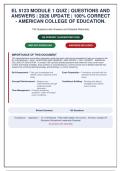
EL 5123 MODULE 1 QUIZ | QUESTIONS AND
ANSWERS | 2026 UPDATE | 100% CORRECT
- AMERICAN COLLEGE OF EDUCATION.
150 Questions with Answers and Detailed Rationales
100 PERCENT GUARANTEED PASS
INSTANT DOWNLOAD ANSWERS INCLUDED
IMPORTANCE OF THIS DOCUMENT
This comprehensive examination preparation guide has been meticulously developed to help you succeed in the
EL 5123 MODULE 1 QUIZ | QUESTIONS AND ANSWERS | 2026 UPDATE | 100% CORRECT - AMERICAN
COLLEGE OF EDUCATION.. It contains 150 carefully selected questions that reflect the most current exam
content and testing strategies. Each question is accompanied by a correct answer and a detailed rationale that
explains the underlying pathophysiology, pharmacology, or clinical reasoning.
Self-Assessment – Test your knowledge and Exam Preparation – Familiarize yourself with the
identify areas requiring further question format and content
study areas
Concept Reinforcement – Deepen your Confidence Building – Develop test-taking
understanding through strategies and reduce
evidence-based exam anxiety
rationales
Time Management – Practice answering
questions under simulated
exam conditions
Review Summary 150 Questions
Foundations - Application - EL 5123 Module 1 AND 2026 Update 100 Correct - American College OF
Education Educational Leadership Graduate
All answers with rationales
,Table of Contents
Content Area Questions Key Topics
Leadership AND Ethical 1-25 Teacher, Reading, Learning, School, Principal
Decision-making
Legal AND Regulatory 26-50 Student S, Reading, School, Teacher, Instruction
Compliance IN Education
School Finance AND 51-75 School, Principal, Leader, Model, Teacher
Resource Management
Curriculum Development 76-100 Teacher, School, Leader, Program, Student
AND Instructional Leadership
Data-driven Decision Making 101-125 School, Teacher, Student, District, Instructional
AND Assessment
Community AND Stakeholder 126-150 School, Leadership, Approach, Student, Learning
Engagement
TOTAL 150 All questions include answers and detailed rationales
,Section A - Leadership AND Ethical Decision-making
Q1.
In a school undergoing turnaround, a principal prioritizes building relationships and
empowering teachers, yet struggles with maintaining accountability for instructional
outcomes. Which leadership approach best synthesizes both humanistic and structural
demands?
A. Transformational leadership with B. Instructional leadership solely focused on
distributed components teacher evaluation
C. Servant leadership prioritizing staff needs D. Bureaucratic leadership emphasizing
over outcomes policy compliance
Correct: A - Transformational leadership with distributed components
Rationale:Transformational leadership emphasizes inspiration and empowerment, while
distributed leadership shares responsibility and accountability, balancing human relations with
structural demands. Pure instructional leadership may neglect empowerment; servant
leadership can underemphasize accountability; bureaucratic leadership stifles the relational
aspects.
Q2.
A district policy mandates a new reading curriculum, but site data show no improvement
in literacy. As a leader, which ethical framework would best guide a response that
balances fidelity to policy with student-centered advocacy?
A. Utilitarianism, prioritizing greatest good B. Deontology, adhering strictly to the policy
for the most students mandate
C. Ethics of care, focusing on individual D. Virtue ethics, emphasizing leader's
student relationships character in decision-making
Correct: A - Utilitarianism, prioritizing greatest good for the most students
Rationale:Utilitarianism weighs outcomes, justifying adjustment or advocacy for change if the
policy harms student learning. Deontology would rigidly enforce policy; ethics of care neglects
systemic impact; virtue ethics lacks specific guidance for this dilemma.
Q3.
When a school's leadership team implements a new data-driven instruction model, they
notice a significant gap in buy-in among veteran teachers. Which barrier to change is
most likely at play, and what strategy best addresses it?
A. Lack of resources; provide additional B. Resistance to change; involve teachers in
technology training co-designing the model
Page 3
, Section A - Leadership AND Ethical Decision-making
C. Poor communication; increase frequency D. Insufficient leadership; hire an external
of staff meetings consultant
Correct: B - Resistance to change; involve teachers in co-designing the model
Rationale:Veteran teachers often resist change when they lack ownership; involving them in
design builds commitment and reduces resistance. Lack of resources or communication may
not be the core issue, and external consultants can exacerbate alienation.
Q4.
A principal is evaluating two candidates for a teaching position: one with strong content
knowledge but weak classroom management, another with average content knowledge
but excellent rapport with students. Which hiring decision best aligns with a holistic view
of teacher effectiveness?
A. Hire the first candidate because content B. Hire the second candidate because
knowledge is non-negotiable rapport is foundational to learning
C. Reject both and continue searching for a D. Hire the first candidate but provide
candidate strong in both areas intensive classroom management coaching
Correct: B - Hire the second candidate because rapport is foundational to learning
Rationale:Research indicates that teacher-student relationships significantly impact learning;
content knowledge can be developed, but rapport is harder to teach. Option D is pragmatic
but overlooks the immediate need for relational competence. Option C is unrealistic in many
contexts.
Q5.
A district's strategic plan emphasizes personalized learning, yet the master schedule
remains rigid. Which systemic adjustment would most effectively align structure with the
pedagogical vision?
A. Introduce a block schedule to allow B. Implement a flexible scheduling model
deeper learning with common planning time
C. Maintain the current schedule to preserve D. Adopt a year-round calendar to reduce
stability learning loss
Correct: B - Implement a flexible scheduling model with common planning time
Rationale:Flexible scheduling directly supports personalized learning by allowing varied
groupings and teacher collaboration. Block schedules alone may not provide flexibility;
maintaining the status quo contradicts the vision; year-round calendars address time but not
personalization.
Page 4
ANSWERS | 2026 UPDATE | 100% CORRECT
- AMERICAN COLLEGE OF EDUCATION.
150 Questions with Answers and Detailed Rationales
100 PERCENT GUARANTEED PASS
INSTANT DOWNLOAD ANSWERS INCLUDED
IMPORTANCE OF THIS DOCUMENT
This comprehensive examination preparation guide has been meticulously developed to help you succeed in the
EL 5123 MODULE 1 QUIZ | QUESTIONS AND ANSWERS | 2026 UPDATE | 100% CORRECT - AMERICAN
COLLEGE OF EDUCATION.. It contains 150 carefully selected questions that reflect the most current exam
content and testing strategies. Each question is accompanied by a correct answer and a detailed rationale that
explains the underlying pathophysiology, pharmacology, or clinical reasoning.
Self-Assessment – Test your knowledge and Exam Preparation – Familiarize yourself with the
identify areas requiring further question format and content
study areas
Concept Reinforcement – Deepen your Confidence Building – Develop test-taking
understanding through strategies and reduce
evidence-based exam anxiety
rationales
Time Management – Practice answering
questions under simulated
exam conditions
Review Summary 150 Questions
Foundations - Application - EL 5123 Module 1 AND 2026 Update 100 Correct - American College OF
Education Educational Leadership Graduate
All answers with rationales
,Table of Contents
Content Area Questions Key Topics
Leadership AND Ethical 1-25 Teacher, Reading, Learning, School, Principal
Decision-making
Legal AND Regulatory 26-50 Student S, Reading, School, Teacher, Instruction
Compliance IN Education
School Finance AND 51-75 School, Principal, Leader, Model, Teacher
Resource Management
Curriculum Development 76-100 Teacher, School, Leader, Program, Student
AND Instructional Leadership
Data-driven Decision Making 101-125 School, Teacher, Student, District, Instructional
AND Assessment
Community AND Stakeholder 126-150 School, Leadership, Approach, Student, Learning
Engagement
TOTAL 150 All questions include answers and detailed rationales
,Section A - Leadership AND Ethical Decision-making
Q1.
In a school undergoing turnaround, a principal prioritizes building relationships and
empowering teachers, yet struggles with maintaining accountability for instructional
outcomes. Which leadership approach best synthesizes both humanistic and structural
demands?
A. Transformational leadership with B. Instructional leadership solely focused on
distributed components teacher evaluation
C. Servant leadership prioritizing staff needs D. Bureaucratic leadership emphasizing
over outcomes policy compliance
Correct: A - Transformational leadership with distributed components
Rationale:Transformational leadership emphasizes inspiration and empowerment, while
distributed leadership shares responsibility and accountability, balancing human relations with
structural demands. Pure instructional leadership may neglect empowerment; servant
leadership can underemphasize accountability; bureaucratic leadership stifles the relational
aspects.
Q2.
A district policy mandates a new reading curriculum, but site data show no improvement
in literacy. As a leader, which ethical framework would best guide a response that
balances fidelity to policy with student-centered advocacy?
A. Utilitarianism, prioritizing greatest good B. Deontology, adhering strictly to the policy
for the most students mandate
C. Ethics of care, focusing on individual D. Virtue ethics, emphasizing leader's
student relationships character in decision-making
Correct: A - Utilitarianism, prioritizing greatest good for the most students
Rationale:Utilitarianism weighs outcomes, justifying adjustment or advocacy for change if the
policy harms student learning. Deontology would rigidly enforce policy; ethics of care neglects
systemic impact; virtue ethics lacks specific guidance for this dilemma.
Q3.
When a school's leadership team implements a new data-driven instruction model, they
notice a significant gap in buy-in among veteran teachers. Which barrier to change is
most likely at play, and what strategy best addresses it?
A. Lack of resources; provide additional B. Resistance to change; involve teachers in
technology training co-designing the model
Page 3
, Section A - Leadership AND Ethical Decision-making
C. Poor communication; increase frequency D. Insufficient leadership; hire an external
of staff meetings consultant
Correct: B - Resistance to change; involve teachers in co-designing the model
Rationale:Veteran teachers often resist change when they lack ownership; involving them in
design builds commitment and reduces resistance. Lack of resources or communication may
not be the core issue, and external consultants can exacerbate alienation.
Q4.
A principal is evaluating two candidates for a teaching position: one with strong content
knowledge but weak classroom management, another with average content knowledge
but excellent rapport with students. Which hiring decision best aligns with a holistic view
of teacher effectiveness?
A. Hire the first candidate because content B. Hire the second candidate because
knowledge is non-negotiable rapport is foundational to learning
C. Reject both and continue searching for a D. Hire the first candidate but provide
candidate strong in both areas intensive classroom management coaching
Correct: B - Hire the second candidate because rapport is foundational to learning
Rationale:Research indicates that teacher-student relationships significantly impact learning;
content knowledge can be developed, but rapport is harder to teach. Option D is pragmatic
but overlooks the immediate need for relational competence. Option C is unrealistic in many
contexts.
Q5.
A district's strategic plan emphasizes personalized learning, yet the master schedule
remains rigid. Which systemic adjustment would most effectively align structure with the
pedagogical vision?
A. Introduce a block schedule to allow B. Implement a flexible scheduling model
deeper learning with common planning time
C. Maintain the current schedule to preserve D. Adopt a year-round calendar to reduce
stability learning loss
Correct: B - Implement a flexible scheduling model with common planning time
Rationale:Flexible scheduling directly supports personalized learning by allowing varied
groupings and teacher collaboration. Block schedules alone may not provide flexibility;
maintaining the status quo contradicts the vision; year-round calendars address time but not
personalization.
Page 4