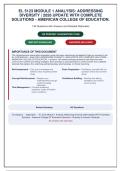
EL 5123 MODULE 1 ANALYSIS: ADDRESSING
DIVERSITY | 2026 UPDATE WITH COMPLETE
SOLUTIONS - AMERICAN COLLEGE OF EDUCATION.
140 Questions with Answers and Detailed Rationales
100 PERCENT GUARANTEED PASS
INSTANT DOWNLOAD ANSWERS INCLUDED
IMPORTANCE OF THIS DOCUMENT
This comprehensive examination preparation guide has been meticulously developed to help you succeed in the
EL 5123 MODULE 1 ANALYSIS: ADDRESSING DIVERSITY | 2026 UPDATE WITH COMPLETE SOLUTIONS -
AMERICAN COLLEGE OF EDUCATION.. It contains 140 carefully selected questions that reflect the most
current exam content and testing strategies. Each question is accompanied by a correct answer and a detailed
rationale that explains the underlying pathophysiology, pharmacology, or clinical reasoning.
Self-Assessment – Test your knowledge and Exam Preparation – Familiarize yourself with the
identify areas requiring further question format and content
study areas
Concept Reinforcement – Deepen your Confidence Building – Develop test-taking
understanding through strategies and reduce
evidence-based exam anxiety
rationales
Time Management – Practice answering
questions under simulated
exam conditions
Review Summary 140 Questions
Foundations - Application - EL 5123 Module 1 Analysis Addressing Diversity 2026 Update WITH Complete
Solutions - American College OF Education Education / Diversity & Inclusion Graduate
All answers with rationales
,Table of Contents
Content Area Questions Key Topics
Foundations OF Diversity 1-24 Teacher, Culturally, Approach, School, Sustaining
AND Inclusion IN Education
Legal AND Ethical 25-48 Students, School, Black, Equity, Education
Frameworks FOR Equity
Culturally Responsive 49-72 School, Teacher, Education, Students, Culturally
Teaching Strategies
Understanding BIAS AND 73-96 Approach, Culturally, School, Teacher, Sustaining
Stereotypes
Differentiated Instruction 97-120 Students, Teacher, School, Culturally, Approach
FOR Diverse Learners
Assessment AND Evaluation 121-140 School, Approach, Students, Teacher, Culturally
IN Diverse Classrooms
TOTAL 140 All questions include answers and detailed rationales
,Section A - Foundations OF Diversity AND Inclusion IN
Education
Q1.
A district's equity audit reveals that English learners are disproportionately placed in
remedial tracks despite comparable performance on benchmark assessments. Which
framework best explains this pattern as a systemic issue rather than a student deficit?
A. Deficit thinking model B. Institutionalized racism framework
C. Culturally relevant pedagogy D. Social reproduction theory
Correct: B - Institutionalized racism framework
Rationale:Institutionalized racism framework focuses on how policies and practices, even
unintentional, produce disparate outcomes-here, overrepresentation in remedial tracks. Deficit
thinking blames students, culturally relevant pedagogy is a teaching approach, and social
reproduction theory is broader class-based, not specifically about racialized tracking.
Q2.
When implementing culturally sustaining pedagogy, which teacher practice best
exemplifies the shift from 'relevant' to 'sustaining'?
A. Using student heritage languages as a B. Celebrating cultural holidays in classroom
bridge to English instruction. displays.
C. Incorporating texts that reflect students' D. Supporting students in maintaining their
cultural backgrounds in the curriculum. cultural competencies while accessing
dominant culture.
Correct: D - Supporting students in maintaining their cultural competencies while
accessing dominant culture.
Rationale:Culturally sustaining pedagogy goes beyond relevance by actively supporting the
maintenance of students' cultural practices and languages, not just using them for academic
access. Option A is transitional, B is superficial, C is relevance-focused.
Q3.
A school's data shows that Black and Latinx students receive office referrals at rates 3x
higher than White peers for subjective infractions like 'defiance'. An equity team wants to
address this. Which initial step is most aligned with a critical multicultural education
approach?
A. Implement a restorative justice program B. Examine staff implicit bias and the
for all students. racialized nature of discipline policies.
Page 3
, Section A - Foundations OF Diversity AND Inclusion IN Education
C. Provide cultural sensitivity training for D. Increase counseling services for referred
teachers. students.
Correct: B - Examine staff implicit bias and the racialized nature of discipline policies.
Rationale:Critical multicultural education interrogates power structures and systemic
inequities; examining bias and policies addresses root causes. Restorative justice, sensitivity
training, and counseling are interventions that may help but do not first critically analyze the
systemic issue.
Q4.
In a faculty meeting, a teacher argues that 'colorblindness' is the fairest approach to
student interaction. Which counterargument best reflects contemporary research on racial
identity development?
A. Colorblindness reduces prejudice by B. Colorblindness ignores the lived
focusing on common humanity. experiences of students of color and can
invalidate their identities.
C. Colorblindness is effective if applied D. Colorblindness is a legal requirement
consistently across all student groups. under equal protection.
Correct: B - Colorblindness ignores the lived experiences of students of color and can
invalidate their identities.
Rationale:Research indicates that colorblind approaches fail to acknowledge racialized
experiences, which can marginalize students of color. It does not reduce prejudice (often
maintains it), is not legally mandated, and consistency does not address the harm.
Q5.
A school district is analyzing achievement gaps. Which data disaggregation practice
would produce the most actionable insight for addressing inequities?
A. Comparing overall school pass rates to B. Analyzing performance by race,
state averages. socioeconomic status, language status, and
disability intersectionally.
C. Tracking individual student growth over D. Reviewing only standardized test scores
one academic year. for math and reading.
Correct: B - Analyzing performance by race, socioeconomic status, language status, and
disability intersectionally.
Rationale:Intersectional disaggregation reveals compounded inequities that single-category
analysis misses. Overall averages mask gaps, growth tracking alone doesn't identify systemic
patterns, and limiting to test scores narrows the picture.
Page 4
DIVERSITY | 2026 UPDATE WITH COMPLETE
SOLUTIONS - AMERICAN COLLEGE OF EDUCATION.
140 Questions with Answers and Detailed Rationales
100 PERCENT GUARANTEED PASS
INSTANT DOWNLOAD ANSWERS INCLUDED
IMPORTANCE OF THIS DOCUMENT
This comprehensive examination preparation guide has been meticulously developed to help you succeed in the
EL 5123 MODULE 1 ANALYSIS: ADDRESSING DIVERSITY | 2026 UPDATE WITH COMPLETE SOLUTIONS -
AMERICAN COLLEGE OF EDUCATION.. It contains 140 carefully selected questions that reflect the most
current exam content and testing strategies. Each question is accompanied by a correct answer and a detailed
rationale that explains the underlying pathophysiology, pharmacology, or clinical reasoning.
Self-Assessment – Test your knowledge and Exam Preparation – Familiarize yourself with the
identify areas requiring further question format and content
study areas
Concept Reinforcement – Deepen your Confidence Building – Develop test-taking
understanding through strategies and reduce
evidence-based exam anxiety
rationales
Time Management – Practice answering
questions under simulated
exam conditions
Review Summary 140 Questions
Foundations - Application - EL 5123 Module 1 Analysis Addressing Diversity 2026 Update WITH Complete
Solutions - American College OF Education Education / Diversity & Inclusion Graduate
All answers with rationales
,Table of Contents
Content Area Questions Key Topics
Foundations OF Diversity 1-24 Teacher, Culturally, Approach, School, Sustaining
AND Inclusion IN Education
Legal AND Ethical 25-48 Students, School, Black, Equity, Education
Frameworks FOR Equity
Culturally Responsive 49-72 School, Teacher, Education, Students, Culturally
Teaching Strategies
Understanding BIAS AND 73-96 Approach, Culturally, School, Teacher, Sustaining
Stereotypes
Differentiated Instruction 97-120 Students, Teacher, School, Culturally, Approach
FOR Diverse Learners
Assessment AND Evaluation 121-140 School, Approach, Students, Teacher, Culturally
IN Diverse Classrooms
TOTAL 140 All questions include answers and detailed rationales
,Section A - Foundations OF Diversity AND Inclusion IN
Education
Q1.
A district's equity audit reveals that English learners are disproportionately placed in
remedial tracks despite comparable performance on benchmark assessments. Which
framework best explains this pattern as a systemic issue rather than a student deficit?
A. Deficit thinking model B. Institutionalized racism framework
C. Culturally relevant pedagogy D. Social reproduction theory
Correct: B - Institutionalized racism framework
Rationale:Institutionalized racism framework focuses on how policies and practices, even
unintentional, produce disparate outcomes-here, overrepresentation in remedial tracks. Deficit
thinking blames students, culturally relevant pedagogy is a teaching approach, and social
reproduction theory is broader class-based, not specifically about racialized tracking.
Q2.
When implementing culturally sustaining pedagogy, which teacher practice best
exemplifies the shift from 'relevant' to 'sustaining'?
A. Using student heritage languages as a B. Celebrating cultural holidays in classroom
bridge to English instruction. displays.
C. Incorporating texts that reflect students' D. Supporting students in maintaining their
cultural backgrounds in the curriculum. cultural competencies while accessing
dominant culture.
Correct: D - Supporting students in maintaining their cultural competencies while
accessing dominant culture.
Rationale:Culturally sustaining pedagogy goes beyond relevance by actively supporting the
maintenance of students' cultural practices and languages, not just using them for academic
access. Option A is transitional, B is superficial, C is relevance-focused.
Q3.
A school's data shows that Black and Latinx students receive office referrals at rates 3x
higher than White peers for subjective infractions like 'defiance'. An equity team wants to
address this. Which initial step is most aligned with a critical multicultural education
approach?
A. Implement a restorative justice program B. Examine staff implicit bias and the
for all students. racialized nature of discipline policies.
Page 3
, Section A - Foundations OF Diversity AND Inclusion IN Education
C. Provide cultural sensitivity training for D. Increase counseling services for referred
teachers. students.
Correct: B - Examine staff implicit bias and the racialized nature of discipline policies.
Rationale:Critical multicultural education interrogates power structures and systemic
inequities; examining bias and policies addresses root causes. Restorative justice, sensitivity
training, and counseling are interventions that may help but do not first critically analyze the
systemic issue.
Q4.
In a faculty meeting, a teacher argues that 'colorblindness' is the fairest approach to
student interaction. Which counterargument best reflects contemporary research on racial
identity development?
A. Colorblindness reduces prejudice by B. Colorblindness ignores the lived
focusing on common humanity. experiences of students of color and can
invalidate their identities.
C. Colorblindness is effective if applied D. Colorblindness is a legal requirement
consistently across all student groups. under equal protection.
Correct: B - Colorblindness ignores the lived experiences of students of color and can
invalidate their identities.
Rationale:Research indicates that colorblind approaches fail to acknowledge racialized
experiences, which can marginalize students of color. It does not reduce prejudice (often
maintains it), is not legally mandated, and consistency does not address the harm.
Q5.
A school district is analyzing achievement gaps. Which data disaggregation practice
would produce the most actionable insight for addressing inequities?
A. Comparing overall school pass rates to B. Analyzing performance by race,
state averages. socioeconomic status, language status, and
disability intersectionally.
C. Tracking individual student growth over D. Reviewing only standardized test scores
one academic year. for math and reading.
Correct: B - Analyzing performance by race, socioeconomic status, language status, and
disability intersectionally.
Rationale:Intersectional disaggregation reveals compounded inequities that single-category
analysis misses. Overall averages mask gaps, growth tracking alone doesn't identify systemic
patterns, and limiting to test scores narrows the picture.
Page 4