

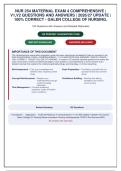
NUR 254 MATERNAL EXAM 4 COMPREHENSIVE |
V1,V2 QUESTIONS AND ANSWERS | 2026/27 UPDATE |
100% CORRECT - GALEN COLLEGE OF NURSING.
120 Questions with Answers and Detailed Rationales
100 PERCENT GUARANTEED PASS
INSTANT DOWNLOAD ANSWERS INCLUDED
IMPORTANCE OF THIS DOCUMENT
This comprehensive examination preparation guide has been meticulously developed to help you succeed in the
NUR 254 MATERNAL EXAM 4 COMPREHENSIVE | V1,V2 QUESTIONS AND ANSWERS | 2026/27 UPDATE |
100% CORRECT - GALEN COLLEGE OF NURSING.. It contains 120 carefully selected questions that reflect the
most current exam content and testing strategies. Each question is accompanied by a correct answer and a
detailed rationale that explains the underlying pathophysiology, pharmacology, or clinical reasoning.
Self-Assessment – Test your knowledge and Exam Preparation – Familiarize yourself with the
identify areas requiring further question format and content
study areas
Concept Reinforcement – Deepen your Confidence Building – Develop test-taking
understanding through strategies and reduce
evidence-based exam anxiety
rationales
Time Management – Practice answering
questions under simulated
exam conditions
Review Summary 120 Questions
Foundations - Application - NUR 254 Maternal 4 Comprehensive V1 V2 AND 2026/27 Update 100 Correct -
Galen College OF Nursing Maternal-newborn Nursing Undergraduate YEAR 3 Pre-licensure BSN
All answers with rationales
,Table of Contents
Content Area Questions Key Topics
Management OF CARE 1-20 Finding, Weeks Gestation, Indicates, Fetal, Heart
Safety AND Infection Control 21-40 Finding, Intervention, Magnesium, Weeks Gestation, Fetal
Health Promotion AND 41-60 Weeks, Intervention, Finding, Immediate, Fetal
Maintenance
Psychosocial Integrity 61-80 Weeks, Gestation, Intervention, Finding, Fetal
Basic CARE AND Comfort 81-100 Weeks Gestation, Rupture, Appropriate, Finding, Membranes
Pharmacological Therapies 101-120 Weeks Gestation, Fetal, Labor, Vaginal, Heart RATE
TOTAL 120 All questions include answers and detailed rationales
,Section A - Management OF CARE
Q1.
In a patient with severe preeclampsia receiving IV magnesium sulfate, which assessment
finding indicates magnesium toxicity requiring immediate intervention?
A. Respiratory rate of 12 breaths/min and B. Urine output of 30 mL/hr over 4 hours
loss of deep tendon reflexes
C. Serum magnesium level of 6.2 mEq/L D. Blood pressure of 150/100 mm Hg
Correct: A - Respiratory rate of 12 breaths/min and loss of deep tendon reflexes
Rationale:Loss of deep tendon reflexes and respiratory depression (RR <12) are classic
signs of magnesium toxicity. A serum level of 6.2 mEq/L is therapeutic (normal 4-7), urine
output >30 mL/hr is adequate, and BP elevation is expected in preeclampsia.
Q2.
A laboring patient with a Category II fetal heart tracing shows recurrent late decelerations.
Which intervention should the nurse implement first?
A. Increase the oxytocin infusion rate B. Reposition the patient to left lateral
C. Prepare for immediate cesarean birth D. Administer an IV fluid bolus
Correct: B - Reposition the patient to left lateral
Rationale:Repositioning to left lateral displaces the uterus off the vena cava, improving
placental perfusion. This is the initial intervention for late decelerations. Increasing oxytocin
would worsen fetal hypoxia; cesarean is not immediate unless other measures fail; fluid bolus
is secondary.
Q3.
Which finding in a postpartum patient 12 hours after vaginal delivery requires immediate
notification of the healthcare provider?
A. Temperature of 100.2°F (37.9°C) B. Fundus at the level of the umbilicus
C. Lochia rubra with a moderate amount of D. Unilateral calf pain and swelling
small clots
Correct: D - Unilateral calf pain and swelling
Rationale:Unilateral calf pain and swelling are classic signs of deep vein thrombosis (DVT), a
postpartum emergency. A slight temperature elevation, fundus at umbilicus, and lochia rubra
are normal findings at 12 hours postpartum.
Page 3
, Section A - Management OF CARE
Q4.
A patient with preterm premature rupture of membranes at 32 weeks gestation is
prescribed betamethasone. What is the primary purpose of this medication?
A. Reduce the risk of maternal infection B. Accelerate fetal lung maturity
C. Suppress uterine contractions D. Decrease fetal urine output
Correct: B - Accelerate fetal lung maturity
Rationale:Betamethasone is a corticosteroid given to enhance fetal lung maturation by
promoting surfactant production, reducing the risk of respiratory distress syndrome. It does
not treat infection, stop labor, or affect fetal urine output.
Q5.
During a nonstress test, the fetal heart rate shows no accelerations after 40 minutes. The
fetus is noted to be in a sleep state. What is the nurse's next best action?
A. Reposition the mother to supine B. Use vibroacoustic stimulation to arouse
the fetus
C. Prepare the patient for immediate D. Reassess the fetal heart rate in 24 hours
cesarean birth
Correct: B - Use vibroacoustic stimulation to arouse the fetus
Rationale:Vibroacoustic stimulation is a non-invasive method to stimulate fetal activity and
elicit accelerations, which can convert a non-reactive test to reactive. Supine positioning may
compromise perfusion; cesarean is not indicated for a non-reactive NST alone; waiting 24
hours is inappropriate.
Q6.
A patient at 28 weeks gestation with placenta previa presents with painless bright red
bleeding. Which nursing action is contraindicated?
A. Continuous external fetal monitoring B. Performing a digital cervical examination
C. Maintaining bed rest with pelvic rest D. Starting IV access with two large-bore
catheters
Correct: B - Performing a digital cervical examination
Rationale:Digital cervical examination is contraindicated in placenta previa because it can
disrupt the placental attachment and cause severe hemorrhage. External monitoring, bed
rest, and IV access are appropriate interventions for suspected placenta previa.
Page 4
V1,V2 QUESTIONS AND ANSWERS | 2026/27 UPDATE |
100% CORRECT - GALEN COLLEGE OF NURSING.
120 Questions with Answers and Detailed Rationales
100 PERCENT GUARANTEED PASS
INSTANT DOWNLOAD ANSWERS INCLUDED
IMPORTANCE OF THIS DOCUMENT
This comprehensive examination preparation guide has been meticulously developed to help you succeed in the
NUR 254 MATERNAL EXAM 4 COMPREHENSIVE | V1,V2 QUESTIONS AND ANSWERS | 2026/27 UPDATE |
100% CORRECT - GALEN COLLEGE OF NURSING.. It contains 120 carefully selected questions that reflect the
most current exam content and testing strategies. Each question is accompanied by a correct answer and a
detailed rationale that explains the underlying pathophysiology, pharmacology, or clinical reasoning.
Self-Assessment – Test your knowledge and Exam Preparation – Familiarize yourself with the
identify areas requiring further question format and content
study areas
Concept Reinforcement – Deepen your Confidence Building – Develop test-taking
understanding through strategies and reduce
evidence-based exam anxiety
rationales
Time Management – Practice answering
questions under simulated
exam conditions
Review Summary 120 Questions
Foundations - Application - NUR 254 Maternal 4 Comprehensive V1 V2 AND 2026/27 Update 100 Correct -
Galen College OF Nursing Maternal-newborn Nursing Undergraduate YEAR 3 Pre-licensure BSN
All answers with rationales
,Table of Contents
Content Area Questions Key Topics
Management OF CARE 1-20 Finding, Weeks Gestation, Indicates, Fetal, Heart
Safety AND Infection Control 21-40 Finding, Intervention, Magnesium, Weeks Gestation, Fetal
Health Promotion AND 41-60 Weeks, Intervention, Finding, Immediate, Fetal
Maintenance
Psychosocial Integrity 61-80 Weeks, Gestation, Intervention, Finding, Fetal
Basic CARE AND Comfort 81-100 Weeks Gestation, Rupture, Appropriate, Finding, Membranes
Pharmacological Therapies 101-120 Weeks Gestation, Fetal, Labor, Vaginal, Heart RATE
TOTAL 120 All questions include answers and detailed rationales
,Section A - Management OF CARE
Q1.
In a patient with severe preeclampsia receiving IV magnesium sulfate, which assessment
finding indicates magnesium toxicity requiring immediate intervention?
A. Respiratory rate of 12 breaths/min and B. Urine output of 30 mL/hr over 4 hours
loss of deep tendon reflexes
C. Serum magnesium level of 6.2 mEq/L D. Blood pressure of 150/100 mm Hg
Correct: A - Respiratory rate of 12 breaths/min and loss of deep tendon reflexes
Rationale:Loss of deep tendon reflexes and respiratory depression (RR <12) are classic
signs of magnesium toxicity. A serum level of 6.2 mEq/L is therapeutic (normal 4-7), urine
output >30 mL/hr is adequate, and BP elevation is expected in preeclampsia.
Q2.
A laboring patient with a Category II fetal heart tracing shows recurrent late decelerations.
Which intervention should the nurse implement first?
A. Increase the oxytocin infusion rate B. Reposition the patient to left lateral
C. Prepare for immediate cesarean birth D. Administer an IV fluid bolus
Correct: B - Reposition the patient to left lateral
Rationale:Repositioning to left lateral displaces the uterus off the vena cava, improving
placental perfusion. This is the initial intervention for late decelerations. Increasing oxytocin
would worsen fetal hypoxia; cesarean is not immediate unless other measures fail; fluid bolus
is secondary.
Q3.
Which finding in a postpartum patient 12 hours after vaginal delivery requires immediate
notification of the healthcare provider?
A. Temperature of 100.2°F (37.9°C) B. Fundus at the level of the umbilicus
C. Lochia rubra with a moderate amount of D. Unilateral calf pain and swelling
small clots
Correct: D - Unilateral calf pain and swelling
Rationale:Unilateral calf pain and swelling are classic signs of deep vein thrombosis (DVT), a
postpartum emergency. A slight temperature elevation, fundus at umbilicus, and lochia rubra
are normal findings at 12 hours postpartum.
Page 3
, Section A - Management OF CARE
Q4.
A patient with preterm premature rupture of membranes at 32 weeks gestation is
prescribed betamethasone. What is the primary purpose of this medication?
A. Reduce the risk of maternal infection B. Accelerate fetal lung maturity
C. Suppress uterine contractions D. Decrease fetal urine output
Correct: B - Accelerate fetal lung maturity
Rationale:Betamethasone is a corticosteroid given to enhance fetal lung maturation by
promoting surfactant production, reducing the risk of respiratory distress syndrome. It does
not treat infection, stop labor, or affect fetal urine output.
Q5.
During a nonstress test, the fetal heart rate shows no accelerations after 40 minutes. The
fetus is noted to be in a sleep state. What is the nurse's next best action?
A. Reposition the mother to supine B. Use vibroacoustic stimulation to arouse
the fetus
C. Prepare the patient for immediate D. Reassess the fetal heart rate in 24 hours
cesarean birth
Correct: B - Use vibroacoustic stimulation to arouse the fetus
Rationale:Vibroacoustic stimulation is a non-invasive method to stimulate fetal activity and
elicit accelerations, which can convert a non-reactive test to reactive. Supine positioning may
compromise perfusion; cesarean is not indicated for a non-reactive NST alone; waiting 24
hours is inappropriate.
Q6.
A patient at 28 weeks gestation with placenta previa presents with painless bright red
bleeding. Which nursing action is contraindicated?
A. Continuous external fetal monitoring B. Performing a digital cervical examination
C. Maintaining bed rest with pelvic rest D. Starting IV access with two large-bore
catheters
Correct: B - Performing a digital cervical examination
Rationale:Digital cervical examination is contraindicated in placenta previa because it can
disrupt the placental attachment and cause severe hemorrhage. External monitoring, bed
rest, and IV access are appropriate interventions for suspected placenta previa.
Page 4


