

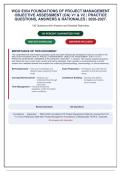
WGU E054 FOUNDATIONS OF PROJECT MANAGEMENT
OBJECTIVE ASSESSMENT (OA) V1 & V2 | PRACTICE
QUESTIONS, ANSWERS & RATIONALES | 2026-2027.
130 Questions with Answers and Detailed Rationales
100 PERCENT GUARANTEED PASS
INSTANT DOWNLOAD ANSWERS INCLUDED
IMPORTANCE OF THIS DOCUMENT
This comprehensive examination preparation guide has been meticulously developed to help you succeed in the
WGU E054 FOUNDATIONS OF PROJECT MANAGEMENT OBJECTIVE ASSESSMENT (OA) V1 & V2 |
PRACTICE QUESTIONS, ANSWERS & RATIONALES | 2026-2027.. It contains 130 carefully selected questions
that reflect the most current exam content and testing strategies. Each question is accompanied by a correct
answer and a detailed rationale that explains the underlying pathophysiology, pharmacology, or clinical reasoning.
Self-Assessment – Test your knowledge and Exam Preparation – Familiarize yourself with the
identify areas requiring further question format and content
study areas
Concept Reinforcement – Deepen your Confidence Building – Develop test-taking
understanding through strategies and reduce
evidence-based exam anxiety
rationales
Time Management – Practice answering
questions under simulated
exam conditions
Review Summary 130 Questions
Foundations - Application - WGU E054 Foundations OF Project Management Objective Assessment OA
V1 & V2 & Rationales 2026 2027 Project Management Foundations Undergraduate YEAR 3 / Graduate
All answers with rationales
,Table of Contents
Content Area Questions Key Topics
Foundations OF Project 1-22 Project, Manager, Change, Stakeholder, Development
Management
Project Management 23-44 Project, Manager, Approach, Leading, Needs
Processes AND LIFE Cycle
Project Integration 45-66 Project, Manager, Performance, Index, Duration
Management
Project Scope Management 67-88 Project, Manager, Effective, Impact, Communication
Project Schedule 89-110 Project, Manager, Change, Stakeholder, Critical
Management
Project COST Management 111-130 Project, Manager, Approach, Change, Stakeholder
TOTAL 130 All questions include answers and detailed rationales
,Section A - Foundations OF Project Management
Q1.
A project manager is leading a complex software development project. The team is
co-located, the requirements are expected to evolve, and the customer demands frequent
delivery of working features. Which combination of lifecycle and process group emphasis
is most appropriate?
A. Predictive lifecycle with heavy emphasis B. Iterative lifecycle with emphasis on
on Planning process group Executing and Monitoring & Controlling
C. Agile lifecycle with emphasis on D. Waterfall lifecycle with emphasis on
Executing and Monitoring & Controlling Initiating and Closing
Correct: C - Agile lifecycle with emphasis on Executing and Monitoring & Controlling
Rationale:Agile is designed for evolving requirements and frequent delivery, emphasizing
executing (iterations) and monitoring/controlling (adaptation). Predictive/waterfall is unsuitable
for evolving requirements. Iterative lacks the customer collaboration and frequent delivery
focus of agile.
Q2.
In a matrix organization, a project manager has been assigned to lead a cross-functional
project. The team members report functionally to their department heads, and the project
manager has limited authority. Which strategy best enhances the project manager's ability
to secure necessary resources and support?
A. Escalate all resource conflicts to the CEO B. Develop strong interpersonal
for immediate resolution relationships and negotiate directly with
functional managers
C. Issue formal directives to team members D. Rely solely on the project charter to
to bypass functional management mandate resource allocation
Correct: B - Develop strong interpersonal relationships and negotiate directly with
functional managers
Rationale:In a matrix, PMs lack direct authority; building relationships and negotiating with
functional managers is key to securing resources. Escalation should be reserved for critical
issues. Formal directives and charter alone are insufficient due to dual reporting.
Q3.
A project manager is evaluating potential risks for a construction project. Which risk
event, if it occurred, would have the highest overall impact considering both probability
and severity?
Page 3
, Section A - Foundations OF Project Management
A. A minor design change with high B. A safety incident with low probability but
probability but negligible cost impact catastrophic consequences
C. A supplier delay with medium probability D. A regulatory update with high probability
and moderate cost overrun and significant schedule impact
Correct: B - A safety incident with low probability but catastrophic consequences
Rationale:Risk impact is a function of probability and severity. Although low probability,
catastrophic consequences (e.g., safety) often dominate risk ranking due to severity.
Quantitative analysis may use expected monetary value, but high-severity risks warrant
priority regardless.
Q4.
During project execution, a key stakeholder requests a change that will significantly
increase project scope. The project manager has assessed the impact and presented it to
the change control board (CCB). What is the most appropriate next step?
A. Implement the change immediately to B. Reject the change because it will
satisfy the stakeholder increase scope
C. Await the CCB's decision and, if D. Communicate the change to the team
approved, update the project management and proceed with planning
plan
Correct: C - Await the CCB's decision and, if approved, update the project management
plan
Rationale:The CCB is authorized to approve or reject changes. The PM must wait for the
decision; upon approval, update all relevant plans and baseline. Implementing without
approval violates change control processes.
Q5.
A project manager is using a Kanban board to manage workflow. The team notices that
work items are piling up before the testing column, while testers are idle. What is the most
effective immediate action to improve flow?
A. Add more testers to the team B. Reduce the work-in-progress (WIP) limit
for the development column
C. Remove the testing column to simplify D. Increase the WIP limit for the testing
the process column to accept more work
Correct: B - Reduce the work-in-progress (WIP) limit for the development column
Page 4
OBJECTIVE ASSESSMENT (OA) V1 & V2 | PRACTICE
QUESTIONS, ANSWERS & RATIONALES | 2026-2027.
130 Questions with Answers and Detailed Rationales
100 PERCENT GUARANTEED PASS
INSTANT DOWNLOAD ANSWERS INCLUDED
IMPORTANCE OF THIS DOCUMENT
This comprehensive examination preparation guide has been meticulously developed to help you succeed in the
WGU E054 FOUNDATIONS OF PROJECT MANAGEMENT OBJECTIVE ASSESSMENT (OA) V1 & V2 |
PRACTICE QUESTIONS, ANSWERS & RATIONALES | 2026-2027.. It contains 130 carefully selected questions
that reflect the most current exam content and testing strategies. Each question is accompanied by a correct
answer and a detailed rationale that explains the underlying pathophysiology, pharmacology, or clinical reasoning.
Self-Assessment – Test your knowledge and Exam Preparation – Familiarize yourself with the
identify areas requiring further question format and content
study areas
Concept Reinforcement – Deepen your Confidence Building – Develop test-taking
understanding through strategies and reduce
evidence-based exam anxiety
rationales
Time Management – Practice answering
questions under simulated
exam conditions
Review Summary 130 Questions
Foundations - Application - WGU E054 Foundations OF Project Management Objective Assessment OA
V1 & V2 & Rationales 2026 2027 Project Management Foundations Undergraduate YEAR 3 / Graduate
All answers with rationales
,Table of Contents
Content Area Questions Key Topics
Foundations OF Project 1-22 Project, Manager, Change, Stakeholder, Development
Management
Project Management 23-44 Project, Manager, Approach, Leading, Needs
Processes AND LIFE Cycle
Project Integration 45-66 Project, Manager, Performance, Index, Duration
Management
Project Scope Management 67-88 Project, Manager, Effective, Impact, Communication
Project Schedule 89-110 Project, Manager, Change, Stakeholder, Critical
Management
Project COST Management 111-130 Project, Manager, Approach, Change, Stakeholder
TOTAL 130 All questions include answers and detailed rationales
,Section A - Foundations OF Project Management
Q1.
A project manager is leading a complex software development project. The team is
co-located, the requirements are expected to evolve, and the customer demands frequent
delivery of working features. Which combination of lifecycle and process group emphasis
is most appropriate?
A. Predictive lifecycle with heavy emphasis B. Iterative lifecycle with emphasis on
on Planning process group Executing and Monitoring & Controlling
C. Agile lifecycle with emphasis on D. Waterfall lifecycle with emphasis on
Executing and Monitoring & Controlling Initiating and Closing
Correct: C - Agile lifecycle with emphasis on Executing and Monitoring & Controlling
Rationale:Agile is designed for evolving requirements and frequent delivery, emphasizing
executing (iterations) and monitoring/controlling (adaptation). Predictive/waterfall is unsuitable
for evolving requirements. Iterative lacks the customer collaboration and frequent delivery
focus of agile.
Q2.
In a matrix organization, a project manager has been assigned to lead a cross-functional
project. The team members report functionally to their department heads, and the project
manager has limited authority. Which strategy best enhances the project manager's ability
to secure necessary resources and support?
A. Escalate all resource conflicts to the CEO B. Develop strong interpersonal
for immediate resolution relationships and negotiate directly with
functional managers
C. Issue formal directives to team members D. Rely solely on the project charter to
to bypass functional management mandate resource allocation
Correct: B - Develop strong interpersonal relationships and negotiate directly with
functional managers
Rationale:In a matrix, PMs lack direct authority; building relationships and negotiating with
functional managers is key to securing resources. Escalation should be reserved for critical
issues. Formal directives and charter alone are insufficient due to dual reporting.
Q3.
A project manager is evaluating potential risks for a construction project. Which risk
event, if it occurred, would have the highest overall impact considering both probability
and severity?
Page 3
, Section A - Foundations OF Project Management
A. A minor design change with high B. A safety incident with low probability but
probability but negligible cost impact catastrophic consequences
C. A supplier delay with medium probability D. A regulatory update with high probability
and moderate cost overrun and significant schedule impact
Correct: B - A safety incident with low probability but catastrophic consequences
Rationale:Risk impact is a function of probability and severity. Although low probability,
catastrophic consequences (e.g., safety) often dominate risk ranking due to severity.
Quantitative analysis may use expected monetary value, but high-severity risks warrant
priority regardless.
Q4.
During project execution, a key stakeholder requests a change that will significantly
increase project scope. The project manager has assessed the impact and presented it to
the change control board (CCB). What is the most appropriate next step?
A. Implement the change immediately to B. Reject the change because it will
satisfy the stakeholder increase scope
C. Await the CCB's decision and, if D. Communicate the change to the team
approved, update the project management and proceed with planning
plan
Correct: C - Await the CCB's decision and, if approved, update the project management
plan
Rationale:The CCB is authorized to approve or reject changes. The PM must wait for the
decision; upon approval, update all relevant plans and baseline. Implementing without
approval violates change control processes.
Q5.
A project manager is using a Kanban board to manage workflow. The team notices that
work items are piling up before the testing column, while testers are idle. What is the most
effective immediate action to improve flow?
A. Add more testers to the team B. Reduce the work-in-progress (WIP) limit
for the development column
C. Remove the testing column to simplify D. Increase the WIP limit for the testing
the process column to accept more work
Correct: B - Reduce the work-in-progress (WIP) limit for the development column
Page 4


