RNSG 1538 Exam 3 Prep: 51+ Essential Questions & Detailed
Answers
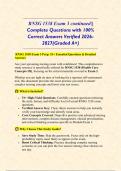
Ace your upcoming nursing exam with confidence! This comprehensive
study resource is specifically tailored for RNSG 1538 (Health Care
Concepts III), focusing on the critical materials covered in Exam 3.
Whether you are tight on time or looking for a rigorous self-assessment
tool, this document provides the exact practice you need to master
complex nursing concepts and boost your test scores.
What is Included?
• 51+ High-Yield Questions: Carefully curated questions mirroring
the style, format, and difficulty level of actual RNSG 1538 exam
questions.
• Verified Answer Key: Clear, direct answers to help you instantly
verify your knowledge and identify weak areas.
• Core Concepts Covered: Deep-dive practice into advanced nursing
interventions, complex disease management, clinical prioritization,
and critical thinking scenarios specific to Module/Exam 3.
Why Choose This Study Guide?
• Save Study Time: Skip the guesswork. Focus only on the high-
probability topics most likely to appear on the exam.
• Boost Critical Thinking: Practice decoding complex nursing
scenarios so you can pick the best answer among close choices on
test day.
, • Study Anywhere: Fully formatted and easy to read on your phone,
tablet, or laptop for quick on-the-go review sessions.
Maximize your study efficiency and secure the grade you deserve.
Download your copy today!
1. What oncologic syndrome can be caused by interleukins and
monoclonal antibodies (MoAbs) and may result in pulmonary edema?
• Answer: Capillary leak syndrome
• Rationale: Interleukins and monoclonal antibodies can trigger a systemic
inflammatory response. This response increases capillary permeability, causing fluid
and proteins to leak from the vascular space into the surrounding interstitial tissues.
When this occurs in the lungs, it leads to fluid accumulation in the alveoli, resulting in
pulmonary edema and compromised gas exchange.
2. What are nursing interventions for patients experiencing side
effects of immunotherapy treatment?
• Answer: Acetaminophen every 4 hours, meperidine (Demerol) to control severe
chills, monitoring adequate oral intake, assisting with Activities of Daily Living
(ADLs), and planning periods of rest.
• Rationale: Immunotherapy often causes flu-like symptoms due to systemic cytokine
release. Acetaminophen manages fever and myalgia, while meperidine specifically
targets severe rigors (chills). Because fatigue and weakness are profound, nurses must
conserve patient energy by assisting with ADLs, scheduling rest, and maintaining
hydration to combat fluid losses from fevers.
3. What is cancer cachexia?
• Answer: Generalized tissue wasting, muscle atrophy, immune dysfunction, and
metabolic abnormalities.
• Rationale: Cachexia is a complex metabolic syndrome driven by tumor-induced
inflammation and cytokine release (such as TNF-alpha). Unlike simple starvation, it
accelerates the breakdown of skeletal muscle and fat tissue that cannot be reversed by
nutritional supplementation alone, severely weakening the patient's immune system
and functional status.
Answers
Ace your upcoming nursing exam with confidence! This comprehensive
study resource is specifically tailored for RNSG 1538 (Health Care
Concepts III), focusing on the critical materials covered in Exam 3.
Whether you are tight on time or looking for a rigorous self-assessment
tool, this document provides the exact practice you need to master
complex nursing concepts and boost your test scores.
What is Included?
• 51+ High-Yield Questions: Carefully curated questions mirroring
the style, format, and difficulty level of actual RNSG 1538 exam
questions.
• Verified Answer Key: Clear, direct answers to help you instantly
verify your knowledge and identify weak areas.
• Core Concepts Covered: Deep-dive practice into advanced nursing
interventions, complex disease management, clinical prioritization,
and critical thinking scenarios specific to Module/Exam 3.
Why Choose This Study Guide?
• Save Study Time: Skip the guesswork. Focus only on the high-
probability topics most likely to appear on the exam.
• Boost Critical Thinking: Practice decoding complex nursing
scenarios so you can pick the best answer among close choices on
test day.
, • Study Anywhere: Fully formatted and easy to read on your phone,
tablet, or laptop for quick on-the-go review sessions.
Maximize your study efficiency and secure the grade you deserve.
Download your copy today!
1. What oncologic syndrome can be caused by interleukins and
monoclonal antibodies (MoAbs) and may result in pulmonary edema?
• Answer: Capillary leak syndrome
• Rationale: Interleukins and monoclonal antibodies can trigger a systemic
inflammatory response. This response increases capillary permeability, causing fluid
and proteins to leak from the vascular space into the surrounding interstitial tissues.
When this occurs in the lungs, it leads to fluid accumulation in the alveoli, resulting in
pulmonary edema and compromised gas exchange.
2. What are nursing interventions for patients experiencing side
effects of immunotherapy treatment?
• Answer: Acetaminophen every 4 hours, meperidine (Demerol) to control severe
chills, monitoring adequate oral intake, assisting with Activities of Daily Living
(ADLs), and planning periods of rest.
• Rationale: Immunotherapy often causes flu-like symptoms due to systemic cytokine
release. Acetaminophen manages fever and myalgia, while meperidine specifically
targets severe rigors (chills). Because fatigue and weakness are profound, nurses must
conserve patient energy by assisting with ADLs, scheduling rest, and maintaining
hydration to combat fluid losses from fevers.
3. What is cancer cachexia?
• Answer: Generalized tissue wasting, muscle atrophy, immune dysfunction, and
metabolic abnormalities.
• Rationale: Cachexia is a complex metabolic syndrome driven by tumor-induced
inflammation and cytokine release (such as TNF-alpha). Unlike simple starvation, it
accelerates the breakdown of skeletal muscle and fat tissue that cannot be reversed by
nutritional supplementation alone, severely weakening the patient's immune system
and functional status.