

NR507 Chamberlain Advanced Patho Final
NR507 Chamberlain: Advanced Patho Final
Study online at https://quizlet.com/_fgkn3q
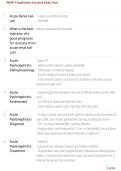
1. Acute Renal Fail- - Sudden loss of kidney function.
ure - Reversible.
2. What is the best Kidneys respond well to Furosemide
indicator of a
good prognosis
for recovery from
acute renal fail-
ure?
3. Acute "Upper UTI"
Pyelonephritis- - Bacteria enter & colonize in urethra and bladder
Pathophysiology - Inflammation and immune response
- Bacteria multiply and ascend to kidneys and colonize
- If still untreated: bacteria can spread into circulation via renal veins causing
bacteremia & septic shock
4. Acute - Diagnosing by clinical symptoms alone can be difficult (similar to cystitis- lower
Pyelonephritis- tract).
Assessment - S/S: flank pain, abdominal tenderness, fever.
- Severe infection: systemic signs: high fever, chills, tachycardia.
5. Acute - Urinalysis: positive urine culture with significant bacteriuria and the presence of
Pyelonephritis- pyuria. WBC casts indicates pyelonephritis, but may not always be present.
Diagnosis - CBC: can show an elevated WBC, indicating infection.
- Imaging studies: renal ultrasound or CT scan, can help identify structural abnor-
malities and complications like abscess formation or obstruction.
6. Acute - Antibiotics
Pyelonephritis- - Supportive care: adequate hydration and analgesics (NSAIDs)
Treatment - Hospitalization: severe cases, pregnant women, individuals w/underlying comor-
bidities, or those unable to tolerate oral intake may require hospitalization for IV
antibiotic therapy and close monitoring.
1 of 16
, NR507 Chamberlain Advanced Patho Final
NR507 Chamberlain: Advanced Patho Final
Study online at https://quizlet.com/_fgkn3q
- Follow-up: crucial to monitor treatment response, complete full course of antibi-
otics, and ensure resolution of infection through follow-up visits and repeat urine
cultures.
7. Renal Calculi - Supersaturation: urine becomes oversaturated with certain substances like calci-
(kidney stones)- um.
Pathophysiology - Nucleation: crystals act as nucleation sites, where further crystal deposition can
occur.
- Crystal retention: urinary stasis or inadequate urine flow allows crystals to remain
in the urinary tract.
- Stone growth and composition: overtime, crystals accumulate and grow into
stones.
8. Renal Calculi- As- - Medical hx: identify risk.
sessment - Physical exam: flank or abdominal pain, costovertebral angle (CVA) tenderness,
hematuria
- Imaging studies: crucial for assessing the presence, size, location, and composi-
tion of stones: CT scan, renal ultrasound, or X-ray.
- Lab tests: urinalysis (blood, crystals, or infection), blood tests evaluate renal
function and identify metabolic abnormalities.
9. Renal Calculi- - Conservative treatment for stones <5mm that are asymptomatic or causing mild
Treatment symptoms.
- Medical management: thiazide diuretics (calcium stones) or allopurinol (uric acid
stones).
- Stone removal (lithotripsy) for larger stones (>5mm) or stones causing severe
symptoms.
10. Renal Calculi: - Manage acute pain
Goals of Treat- - Promote passage of stone
ment - Reduce the size of stone already formed
- Prevent new stone formation
2 of 16
, NR507 Chamberlain Advanced Patho Final
NR507 Chamberlain: Advanced Patho Final
Study online at https://quizlet.com/_fgkn3q
11. Chronic Kidney - Progressive, irreversible loss of kidney function.
Disease (CKD) - Associated with systemic diseases such as diabetes mellitus (most significant risk
factor), hypertension, systemic lupus erythematosus, or intrinsic kidney disease.
- Once stage IV is reached, progression to stage V is inevitable (plus dialysis or
kidney transplant).
12. CKD- Candidates - Based on symptoms, kidney function, overall health status, and individual circum-
for Dialysis stances.
- Symptomatic uremia.
- Fluid overload and hypertension.
- Hyperkalemia.
- Acid/base imbalances.
- Progressive loss of kidney function.
13. 5 Stages of CKD - Determined by estimates of GFR and albuminuria.
- Stage 1: kidney damage with normal or increased GFR (eGFR 90-100 mL/min).
- Stage 2: kidney damage with mild decrease in GFR (60-89 mL/min).
- Stage 3: moderate decrease in GFR (30-59 mL/min).
- Stage 4: severe decrease in GFR (15-29 mL/min).
- Stage 5: kidney failure, end stage (<15)
14. Gastroe- - Lower esophageal sphincter (LES) dysfunction: reduced pressure or improper
sophageal Reflux relaxation allows gastric acid to flow back into the esophagus.
Disease (GERD): - Hiatal hernia: contributes to GERD by disrupting the normal barrier between the
Pathophysiology esophagus and stomach.
- Esophageal motility disorders: impaired esophageal peristalsis and reduced
esophageal clearance can lead to pooling of gastric acid in the esophagus.
- Acidic gastric contents.
15. GERD- Assess- - Subjective: heartburn (burning sensation in chest), regurgitation (acidic taste in
ment mouth), dysphagia (difficulty swallowing), chest pain (may mimic cardiac chest
pain).
3 of 16
NR507 Chamberlain: Advanced Patho Final
Study online at https://quizlet.com/_fgkn3q
1. Acute Renal Fail- - Sudden loss of kidney function.
ure - Reversible.
2. What is the best Kidneys respond well to Furosemide
indicator of a
good prognosis
for recovery from
acute renal fail-
ure?
3. Acute "Upper UTI"
Pyelonephritis- - Bacteria enter & colonize in urethra and bladder
Pathophysiology - Inflammation and immune response
- Bacteria multiply and ascend to kidneys and colonize
- If still untreated: bacteria can spread into circulation via renal veins causing
bacteremia & septic shock
4. Acute - Diagnosing by clinical symptoms alone can be difficult (similar to cystitis- lower
Pyelonephritis- tract).
Assessment - S/S: flank pain, abdominal tenderness, fever.
- Severe infection: systemic signs: high fever, chills, tachycardia.
5. Acute - Urinalysis: positive urine culture with significant bacteriuria and the presence of
Pyelonephritis- pyuria. WBC casts indicates pyelonephritis, but may not always be present.
Diagnosis - CBC: can show an elevated WBC, indicating infection.
- Imaging studies: renal ultrasound or CT scan, can help identify structural abnor-
malities and complications like abscess formation or obstruction.
6. Acute - Antibiotics
Pyelonephritis- - Supportive care: adequate hydration and analgesics (NSAIDs)
Treatment - Hospitalization: severe cases, pregnant women, individuals w/underlying comor-
bidities, or those unable to tolerate oral intake may require hospitalization for IV
antibiotic therapy and close monitoring.
1 of 16
, NR507 Chamberlain Advanced Patho Final
NR507 Chamberlain: Advanced Patho Final
Study online at https://quizlet.com/_fgkn3q
- Follow-up: crucial to monitor treatment response, complete full course of antibi-
otics, and ensure resolution of infection through follow-up visits and repeat urine
cultures.
7. Renal Calculi - Supersaturation: urine becomes oversaturated with certain substances like calci-
(kidney stones)- um.
Pathophysiology - Nucleation: crystals act as nucleation sites, where further crystal deposition can
occur.
- Crystal retention: urinary stasis or inadequate urine flow allows crystals to remain
in the urinary tract.
- Stone growth and composition: overtime, crystals accumulate and grow into
stones.
8. Renal Calculi- As- - Medical hx: identify risk.
sessment - Physical exam: flank or abdominal pain, costovertebral angle (CVA) tenderness,
hematuria
- Imaging studies: crucial for assessing the presence, size, location, and composi-
tion of stones: CT scan, renal ultrasound, or X-ray.
- Lab tests: urinalysis (blood, crystals, or infection), blood tests evaluate renal
function and identify metabolic abnormalities.
9. Renal Calculi- - Conservative treatment for stones <5mm that are asymptomatic or causing mild
Treatment symptoms.
- Medical management: thiazide diuretics (calcium stones) or allopurinol (uric acid
stones).
- Stone removal (lithotripsy) for larger stones (>5mm) or stones causing severe
symptoms.
10. Renal Calculi: - Manage acute pain
Goals of Treat- - Promote passage of stone
ment - Reduce the size of stone already formed
- Prevent new stone formation
2 of 16
, NR507 Chamberlain Advanced Patho Final
NR507 Chamberlain: Advanced Patho Final
Study online at https://quizlet.com/_fgkn3q
11. Chronic Kidney - Progressive, irreversible loss of kidney function.
Disease (CKD) - Associated with systemic diseases such as diabetes mellitus (most significant risk
factor), hypertension, systemic lupus erythematosus, or intrinsic kidney disease.
- Once stage IV is reached, progression to stage V is inevitable (plus dialysis or
kidney transplant).
12. CKD- Candidates - Based on symptoms, kidney function, overall health status, and individual circum-
for Dialysis stances.
- Symptomatic uremia.
- Fluid overload and hypertension.
- Hyperkalemia.
- Acid/base imbalances.
- Progressive loss of kidney function.
13. 5 Stages of CKD - Determined by estimates of GFR and albuminuria.
- Stage 1: kidney damage with normal or increased GFR (eGFR 90-100 mL/min).
- Stage 2: kidney damage with mild decrease in GFR (60-89 mL/min).
- Stage 3: moderate decrease in GFR (30-59 mL/min).
- Stage 4: severe decrease in GFR (15-29 mL/min).
- Stage 5: kidney failure, end stage (<15)
14. Gastroe- - Lower esophageal sphincter (LES) dysfunction: reduced pressure or improper
sophageal Reflux relaxation allows gastric acid to flow back into the esophagus.
Disease (GERD): - Hiatal hernia: contributes to GERD by disrupting the normal barrier between the
Pathophysiology esophagus and stomach.
- Esophageal motility disorders: impaired esophageal peristalsis and reduced
esophageal clearance can lead to pooling of gastric acid in the esophagus.
- Acidic gastric contents.
15. GERD- Assess- - Subjective: heartburn (burning sensation in chest), regurgitation (acidic taste in
ment mouth), dysphagia (difficulty swallowing), chest pain (may mimic cardiac chest
pain).
3 of 16


