

Metro Rail Rules - Section 1 Terminology
Metro Rail Rules - Section 1: Terminology 2019
Study online at https://quizlet.com/_5vntov
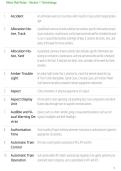
1. Accident An unforeseen event or occurrence, which results in injury and/or property dam-
age.
2. Allocation No- A published summary of work activities that contains specific information pertain-
tice, Track ing to contractors, maintenance, and test personnel who will be scheduled to work
in, on or around Rail Facilities and Right of Way. It contains the limits, time, and
dates of the week for these activities.
3. Allocation No- A published summary of work activities that indicates specific information per-
tice, Yard taining to contractors, maintenance, and test personnel who will be scheduled
to work in the Yard. It indicates the limits, time, and dates of the week for these
activities.
4. Amber Trouble An amber light strobe that is attached to a mast that extends above the top
Light of Train Control Bungalows, Signal Cases, Crossing Cases, and Traction Power
Sub-Stations that when activated, indicate equipment malfunction.
5. Aspect Color, orientation, or physical appearance of a signal.
6. Aspect Display Unit located in each operating cab providing basic train composition and identi-
Unit fication data through train-to-wayside communications.
7. Audible and Vi- Devices such as a horn, whistle, gong or visual warning devices such as turn
sual Warning De- signals, headlights and Roof Headlight.
vices
8. Authorization Time issued by Proper Authority whenever instruction or authorization is given for
Time appropriate rail activities.
9. Automatic Train The train control system comprised of ATO, ATP and ATS.
Control
10. Automatic Train Sub-system within ATC which automatically regulates train speed, performs pro-
Operation grammed station stopping, and is subordinate to ATP and ATS.
1
, Metro Rail Rules - Section 1 Terminology
Metro Rail Rules - Section 1: Terminology 2019
Study online at https://quizlet.com/_5vntov
11. Automatic Train A system, which maintains safe train operation through a combination of train
Protection detection, train separation and speed regulation.
12. Automatic Train Sub-system within ATC, which monitors train operation and maintains scheduled
Supervision traffic patterns.
13. Automatic Warn- Gates, flashing lights and bells at grade crossings which are activated by track
ing Devices circuit occupancy, TWC activation or Pushbutton Station Boxes.
14. Ballast Material placed onto the rail roadbed for the purpose of maintaining track align-
ment, profile, and providing drainage.
15. Berth The space designated for a train of a given length to occupy when it is stopped at
a station platform, or a terminal.
16. Berthing Verifica- A part of the ATO system that verifies when a train is properly positioned and
tion permits the platform side doors to be opened.
17. Block A length of track having defined limits.
18. Block, Absolute A block which no other train is permitted to enter while it is occupied by another
train.
19. Block, Manual A method used by the Controller to maintain train separation by use of defined
limits.
20. Block, Permissive A block that may be occupied by more than one train.
21. Block Protected A form of On Track Protection that uses interlocking signals to control train
Work Zone movement and protect work crews on the ROW.
22. Block, Test Length of track, having defined limits, designated for a specific test or tests.
23. Blue Flag
2
, Metro Rail Rules - Section 1 Terminology
Metro Rail Rules - Section 1: Terminology 2019
Study online at https://quizlet.com/_5vntov
A portable blue light, flag or marker placed on or near each end of a rail vehicle
to protect it against being moved, energized or coupled to.
24. Blue Light Sta- Designated location within the Rail System, identified by a blue light, where
tion traction power may be DEENERGIZED and emergency telephones are located and,
where provided, under-car deluge buttons are located.
25. Box A cut and cover section of the rail system where the mainline is below grade.
26. Brake, Friction Controlled pneumatic system applying stopping forces to brake discs/brake shoes
on an axle or wheel tread.
27. Brake, Track An electro-magnetic device located between the wheels of each truck which
applies stopping forces through friction contact with the running rail.
28. Brake Release The process of placing the Master/Manual Controller in "coast" momentarily to
Test see if the friction brakes release by observing the cylinder pressure needle on the
dual air gauge move to zero.
29. Braking, Dynam- Traction motors, operating as generators, to provide a controlled electrical braking
ic effort.
30. Braking, Emer- An irretrievable braking application, which may include Dynamic, Friction, Track
gency Brakes and Sand.
31. Braking, Full Ser- The highest service-braking rate using a combination of Dynamic and Friction
vice brakes.
32. Buff Forward motion by an electrically isolated LRV or HRV into another stopped
coupled LRV or HRV to compress the couplers.
33. Bulletin A written instruction which contains temporary or permanent changes to the rules,
procedures, or both. Bulletins are numbered consecutively from January 1 of the
year issued.
3
Metro Rail Rules - Section 1: Terminology 2019
Study online at https://quizlet.com/_5vntov
1. Accident An unforeseen event or occurrence, which results in injury and/or property dam-
age.
2. Allocation No- A published summary of work activities that contains specific information pertain-
tice, Track ing to contractors, maintenance, and test personnel who will be scheduled to work
in, on or around Rail Facilities and Right of Way. It contains the limits, time, and
dates of the week for these activities.
3. Allocation No- A published summary of work activities that indicates specific information per-
tice, Yard taining to contractors, maintenance, and test personnel who will be scheduled
to work in the Yard. It indicates the limits, time, and dates of the week for these
activities.
4. Amber Trouble An amber light strobe that is attached to a mast that extends above the top
Light of Train Control Bungalows, Signal Cases, Crossing Cases, and Traction Power
Sub-Stations that when activated, indicate equipment malfunction.
5. Aspect Color, orientation, or physical appearance of a signal.
6. Aspect Display Unit located in each operating cab providing basic train composition and identi-
Unit fication data through train-to-wayside communications.
7. Audible and Vi- Devices such as a horn, whistle, gong or visual warning devices such as turn
sual Warning De- signals, headlights and Roof Headlight.
vices
8. Authorization Time issued by Proper Authority whenever instruction or authorization is given for
Time appropriate rail activities.
9. Automatic Train The train control system comprised of ATO, ATP and ATS.
Control
10. Automatic Train Sub-system within ATC which automatically regulates train speed, performs pro-
Operation grammed station stopping, and is subordinate to ATP and ATS.
1
, Metro Rail Rules - Section 1 Terminology
Metro Rail Rules - Section 1: Terminology 2019
Study online at https://quizlet.com/_5vntov
11. Automatic Train A system, which maintains safe train operation through a combination of train
Protection detection, train separation and speed regulation.
12. Automatic Train Sub-system within ATC, which monitors train operation and maintains scheduled
Supervision traffic patterns.
13. Automatic Warn- Gates, flashing lights and bells at grade crossings which are activated by track
ing Devices circuit occupancy, TWC activation or Pushbutton Station Boxes.
14. Ballast Material placed onto the rail roadbed for the purpose of maintaining track align-
ment, profile, and providing drainage.
15. Berth The space designated for a train of a given length to occupy when it is stopped at
a station platform, or a terminal.
16. Berthing Verifica- A part of the ATO system that verifies when a train is properly positioned and
tion permits the platform side doors to be opened.
17. Block A length of track having defined limits.
18. Block, Absolute A block which no other train is permitted to enter while it is occupied by another
train.
19. Block, Manual A method used by the Controller to maintain train separation by use of defined
limits.
20. Block, Permissive A block that may be occupied by more than one train.
21. Block Protected A form of On Track Protection that uses interlocking signals to control train
Work Zone movement and protect work crews on the ROW.
22. Block, Test Length of track, having defined limits, designated for a specific test or tests.
23. Blue Flag
2
, Metro Rail Rules - Section 1 Terminology
Metro Rail Rules - Section 1: Terminology 2019
Study online at https://quizlet.com/_5vntov
A portable blue light, flag or marker placed on or near each end of a rail vehicle
to protect it against being moved, energized or coupled to.
24. Blue Light Sta- Designated location within the Rail System, identified by a blue light, where
tion traction power may be DEENERGIZED and emergency telephones are located and,
where provided, under-car deluge buttons are located.
25. Box A cut and cover section of the rail system where the mainline is below grade.
26. Brake, Friction Controlled pneumatic system applying stopping forces to brake discs/brake shoes
on an axle or wheel tread.
27. Brake, Track An electro-magnetic device located between the wheels of each truck which
applies stopping forces through friction contact with the running rail.
28. Brake Release The process of placing the Master/Manual Controller in "coast" momentarily to
Test see if the friction brakes release by observing the cylinder pressure needle on the
dual air gauge move to zero.
29. Braking, Dynam- Traction motors, operating as generators, to provide a controlled electrical braking
ic effort.
30. Braking, Emer- An irretrievable braking application, which may include Dynamic, Friction, Track
gency Brakes and Sand.
31. Braking, Full Ser- The highest service-braking rate using a combination of Dynamic and Friction
vice brakes.
32. Buff Forward motion by an electrically isolated LRV or HRV into another stopped
coupled LRV or HRV to compress the couplers.
33. Bulletin A written instruction which contains temporary or permanent changes to the rules,
procedures, or both. Bulletins are numbered consecutively from January 1 of the
year issued.
3


