

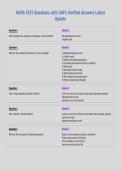
NURS 5357 Questions with 100% Verified Answers Latest
Update
Question: Answer:
What symptoms are necessary to diagnose a manic episode? Elevated/expansive mood
Irritable mood
Question: Answer:
What are the symptom dimensions of a manic episode? 1) Elevated/expansive mood
2) Irritable mood
3) Inflated self-esteem/grandiosity
4) Increased goal-directed activity or agitation
5) Risk-taking
6) Decreased need for sleep
7) Distractible/concentration
8) More talkative pressured speech
9) Flight of ideas/racing thoughts
Question: Answer:
How is major depressive disorder defined? by the occurrence of at least a single major depressive episode;
although most pt's will
experience recurrent episodes
Question: Answer:
How is Bipolar I disorder defined? as the occurrence of at least one full-blown manic episode; typically
experience major
depressive episodes as well
Question: Answer:
What are the main goals of treating depression? Reduce acute symptoms (sadness, anhedonia)
Restore psychosocial functioning
Prevent relapse and recurrence
Improve overall quality of life
,Question: Answer:
What is the mechanism of antidepressant? Increase synaptic levels of MOA (5-HT, NE, DA)
Enhance neuroplasticity and neurotrophic factors (e.g. BDNF)
Normalize activity in dysregulated neural circuits
Question: Answer:
Identify the residual symptoms of depression that may be less Fatigue, low motivation
likely to respond to medication treatment. Insomnia/sleep disturbances
Cognitive/concentration problems/memory deficits
Social withdrawal
Question: Answer:
What are the etiologies of depression? Hormone activity
Psychoneuroimmunology
Genetic
Neurotransmitters
Neutrophic Factors
Question: Answer:
How does hormone activity effect depression? HPA dysregulation
Early adversity
Thyroid imbalances
Possible imbalances of
growth hormones
Estrogen/progesterone
Question: Answer:
How does psychoneuroimmunology effect depression? Elevated pro-inflammatory cytokines affecting brain function
Neuro-inflammation
Microglial activation
Sleep alterations
Hormonal/temp regulation
Changes in food intake
, Question: Answer:
How does genetics effect depression? Family hx and gene variants linked to mood disorders
Other genes implicated: amino acid transporters, transporters for
MAOs, neurotrophic
factors (BDNF), immune sys regulatory genes, ion channels
Question: Answer:
How does neurotransmitters effect depression? Alterations in monoaminergic neurotransmission
Possible roles of glutamate, GABA, ACH or opioid dysregulation
Question: Answer:
How does neutrophoic factors effect depression? MDD & stress may result in neuronal degeneration
Antidepressant tx may stimulate neuronal growth via BDNF
Question: Answer:
What are the pathological mechanisms of bipolar disorder? Dysregulation of neurotransmitters (DA, 5-HT, NE)
Altered neural circuitry (PFC, Limbic sys)
Genetic vulnerability
Abnormalities in neuroplasticity and cellular resilience
Question: Answer:
What are the structural neuroimaging findings in depression? Reduced hippocampal & PFC volume
Question: Answer:
What are the functional neuroimaging findings in depression? Hypoactivity in PFC
Hyperactivity in amygdala
Question: Answer:
What are the other neuroimaging findings in depression? Altered connectivity in fronto-limbic circuits
Question: Answer:
What are the structural neuroimaging findings in bipolar Enlarged amygdala
depression? Altered PFC vol
Update
Question: Answer:
What symptoms are necessary to diagnose a manic episode? Elevated/expansive mood
Irritable mood
Question: Answer:
What are the symptom dimensions of a manic episode? 1) Elevated/expansive mood
2) Irritable mood
3) Inflated self-esteem/grandiosity
4) Increased goal-directed activity or agitation
5) Risk-taking
6) Decreased need for sleep
7) Distractible/concentration
8) More talkative pressured speech
9) Flight of ideas/racing thoughts
Question: Answer:
How is major depressive disorder defined? by the occurrence of at least a single major depressive episode;
although most pt's will
experience recurrent episodes
Question: Answer:
How is Bipolar I disorder defined? as the occurrence of at least one full-blown manic episode; typically
experience major
depressive episodes as well
Question: Answer:
What are the main goals of treating depression? Reduce acute symptoms (sadness, anhedonia)
Restore psychosocial functioning
Prevent relapse and recurrence
Improve overall quality of life
,Question: Answer:
What is the mechanism of antidepressant? Increase synaptic levels of MOA (5-HT, NE, DA)
Enhance neuroplasticity and neurotrophic factors (e.g. BDNF)
Normalize activity in dysregulated neural circuits
Question: Answer:
Identify the residual symptoms of depression that may be less Fatigue, low motivation
likely to respond to medication treatment. Insomnia/sleep disturbances
Cognitive/concentration problems/memory deficits
Social withdrawal
Question: Answer:
What are the etiologies of depression? Hormone activity
Psychoneuroimmunology
Genetic
Neurotransmitters
Neutrophic Factors
Question: Answer:
How does hormone activity effect depression? HPA dysregulation
Early adversity
Thyroid imbalances
Possible imbalances of
growth hormones
Estrogen/progesterone
Question: Answer:
How does psychoneuroimmunology effect depression? Elevated pro-inflammatory cytokines affecting brain function
Neuro-inflammation
Microglial activation
Sleep alterations
Hormonal/temp regulation
Changes in food intake
, Question: Answer:
How does genetics effect depression? Family hx and gene variants linked to mood disorders
Other genes implicated: amino acid transporters, transporters for
MAOs, neurotrophic
factors (BDNF), immune sys regulatory genes, ion channels
Question: Answer:
How does neurotransmitters effect depression? Alterations in monoaminergic neurotransmission
Possible roles of glutamate, GABA, ACH or opioid dysregulation
Question: Answer:
How does neutrophoic factors effect depression? MDD & stress may result in neuronal degeneration
Antidepressant tx may stimulate neuronal growth via BDNF
Question: Answer:
What are the pathological mechanisms of bipolar disorder? Dysregulation of neurotransmitters (DA, 5-HT, NE)
Altered neural circuitry (PFC, Limbic sys)
Genetic vulnerability
Abnormalities in neuroplasticity and cellular resilience
Question: Answer:
What are the structural neuroimaging findings in depression? Reduced hippocampal & PFC volume
Question: Answer:
What are the functional neuroimaging findings in depression? Hypoactivity in PFC
Hyperactivity in amygdala
Question: Answer:
What are the other neuroimaging findings in depression? Altered connectivity in fronto-limbic circuits
Question: Answer:
What are the structural neuroimaging findings in bipolar Enlarged amygdala
depression? Altered PFC vol


