
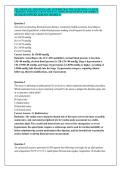
NSG 3100 EXAM 2 QUESTIONS AND ANSWERS PRACTICE QUESTIONS (3 LATEST
VERSIONS) WITH SOLUTIONS NEWEST COMPLETE QUESTIONS AND CORRECT
DETAILED ANSWERS| ALREADY GRADED A+
Question 1
The nurse is measuring blood pressure during a community health screening. According to
current clinical guidelines, which blood pressure reading would require the nurse to refer the
patient for follow-up evaluation for hypertension?
A) 108/70 mmHg
B) 116/78 mmHg
C) 124/78 mmHg
D) 138/88 mmHg
E) 118/74 mmHg
Correct Answer: D) 138/88 mmHg
Rationale: According to the ACC/AHA guidelines, normal blood pressure is less than
120/<80 mmHg, elevated blood pressure is 120–129/<80 mmHg, Stage 1 hypertension is
130–139/80–89 mmHg, and Stage 2 hypertension is 140/90 mmHg or higher. A reading of
138/88 mmHg falls directly into the Stage 1 hypertension category, requiring clinical
follow-up, lifestyle modifications, and reassessment.
Question 2
The nurse is admitting an adult patient for an elective, minor outpatient dermatologic procedure.
Which anatomical site is most commonly selected by the nurse to palpate the baseline pulse rate
in a conscious, stable adult?
A) Carotid artery
B) Apical site
C) Radial artery
D) Brachial artery
E) Femoral artery
Correct Answer: C) Radial artery
Rationale: The radial artery along the thumb side of the inner wrist is the most accessible,
noninvasive, and convenient peripheral site for routine pulse assessment in a stable,
conscious adult. The carotid and femoral sites are reserved for emergencies or severe
hypotension, the apical pulse requires a stethoscope and is used for cardiac instability or
before administering certain medications (like digoxin), and the brachial site is primarily
used in infants or during blood pressure measurement.
Question 3
An unlicensed assistive personnel (UAP) reports the following vital signs for an adult patient:
oral temperature 99.2°F (37.3°C), radial pulse 88 beats/min regular, respirations 18 breaths/min,
VERSIONS) WITH SOLUTIONS NEWEST COMPLETE QUESTIONS AND CORRECT
DETAILED ANSWERS| ALREADY GRADED A+
Question 1
The nurse is measuring blood pressure during a community health screening. According to
current clinical guidelines, which blood pressure reading would require the nurse to refer the
patient for follow-up evaluation for hypertension?
A) 108/70 mmHg
B) 116/78 mmHg
C) 124/78 mmHg
D) 138/88 mmHg
E) 118/74 mmHg
Correct Answer: D) 138/88 mmHg
Rationale: According to the ACC/AHA guidelines, normal blood pressure is less than
120/<80 mmHg, elevated blood pressure is 120–129/<80 mmHg, Stage 1 hypertension is
130–139/80–89 mmHg, and Stage 2 hypertension is 140/90 mmHg or higher. A reading of
138/88 mmHg falls directly into the Stage 1 hypertension category, requiring clinical
follow-up, lifestyle modifications, and reassessment.
Question 2
The nurse is admitting an adult patient for an elective, minor outpatient dermatologic procedure.
Which anatomical site is most commonly selected by the nurse to palpate the baseline pulse rate
in a conscious, stable adult?
A) Carotid artery
B) Apical site
C) Radial artery
D) Brachial artery
E) Femoral artery
Correct Answer: C) Radial artery
Rationale: The radial artery along the thumb side of the inner wrist is the most accessible,
noninvasive, and convenient peripheral site for routine pulse assessment in a stable,
conscious adult. The carotid and femoral sites are reserved for emergencies or severe
hypotension, the apical pulse requires a stethoscope and is used for cardiac instability or
before administering certain medications (like digoxin), and the brachial site is primarily
used in infants or during blood pressure measurement.
Question 3
An unlicensed assistive personnel (UAP) reports the following vital signs for an adult patient:
oral temperature 99.2°F (37.3°C), radial pulse 88 beats/min regular, respirations 18 breaths/min,



