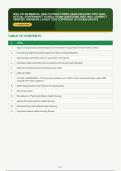
2025 ATI RN MENTAL HEALTH PROCTORED EXAM 2023/2025 WITH NGN:
ACTUAL SCREENSHOT 70 REAL EXAM QUESTIONS AND 100% CORRECT
VERIFIED ANSWERS LATEST 2025 COPYRIGHT ATI EXAM UPDATE
119 QUESTIONS
TABLE OF CONTENTS
# TOPIC
1 Apply nursing process and therapeutic communication in psychiatric-mental health contexts
2 Evaluate psychopharmacologic agents and their nursing implications
3 Analyze legal and ethical issues in psychiatric nursing care
4 Synthesize data to prioritize care for patients with mental health disorders
5 2025 ATI RN Mental Health Proctored Exam 2023
6 2025 with NGN
7 ACTUAL SCREENSHOT 70 Real Exam Questions and 100% Correct Verified Answers Latest 2025
Copyright ATI Exam Update In
8 Depth Study Guide & Test Prep for Nursing Students
9 Pass Guaranteed
10 Foundations of Psychiatric-Mental Health Nursing
11 Applied Psychiatric-Mental Health Nursing
12 Advanced Psychiatric-Mental Health Nursing
13 Psychiatric-Mental Health Nursing Review
Page 1
,Q1 APPLY NURSING PROCESS AND THERAPEUTIC COMMUNICATION IN
PSYCHIATRIC-MENTAL HEALTH CONTEXTS
In a milieu therapy setting, a patient with schizophrenia who is stable on
antipsychotic medication repeatedly interrupts group sessions, monopolizing the
conversation. Which nursing intervention best reflects the current
recovery-oriented model of care?
A. Redirect the patient to the group rules and impose a time-out from the group.
B. Collaborate with the patient to identify triggers and develop a self-monitoring plan.
CORRECT
C. Ask the patient to leave the group and discuss the behavior privately with the nurse.
D. Administer a PRN anxiolytic to reduce the patient's anxiety before the next group.
RATIONALE: Recovery-oriented care emphasizes patient collaboration, empowerment, and
skill-building. Option B partners with the patient to address behavior, fostering self-management.
Options A and C are punitive and paternalistic, while D uses medication as a behavioral control,
which is not first-line for a stable patient.
Q2 APPLY NURSING PROCESS AND THERAPEUTIC COMMUNICATION IN
PSYCHIATRIC-MENTAL HEALTH CONTEXTS
A patient with major depressive disorder has been taking fluoxetine 40 mg daily
for 6 weeks with minimal improvement. The provider plans to switch to
phenelzine. What is the required washout period, and why?
A. 14 days; to prevent hypertensive crisis from monoamine oxidase inhibition.
B. 5 weeks; to allow clearance of fluoxetine and its active metabolite to avoid serotonin
syndrome. CORRECT
C. 72 hours; to minimize the risk of drug-drug interactions.
D. No washout is needed; cross-taper is safe with close monitoring.
RATIONALE: Fluoxetine and its active metabolite norfluoxetine have a half-life of 4-16 days,
requiring a 5-week washout before starting an MAOI to prevent potentially fatal serotonin
syndrome. Options A, C, and D are incorrect because they do not account for the prolonged
half-life of fluoxetine.
Page 2
,Q3 APPLY NURSING PROCESS AND THERAPEUTIC COMMUNICATION IN
PSYCHIATRIC-MENTAL HEALTH CONTEXTS
A patient with borderline personality disorder is admitted after a suicide attempt.
The patient has a history of multiple hospitalizations and intense anger toward
staff. Using the principles of dialectical behavior therapy (DBT), which nursing
intervention is most appropriate during the first 24 hours?
A. Enforce strict unit rules to set limits on manipulative behavior.
B. Validate the patient's emotional pain while maintaining clear expectations for safety.
CORRECT
C. Avoid discussing the suicide attempt to prevent reinforcing attention-seeking behavior.
D. Encourage the patient to process childhood trauma immediately to address the root cause.
RATIONALE: DBT balances validation with change. Validating the patient's emotion while
maintaining safety expectations is core to DBT. Option A is punitive and lacks validation; C
avoids the issue; D is premature and not appropriate in acute crisis.
Q4 APPLY NURSING PROCESS AND THERAPEUTIC COMMUNICATION IN
PSYCHIATRIC-MENTAL HEALTH CONTEXTS
A patient with bipolar I disorder is in the manic phase and has not slept for 3 days.
The patient is pacing, talking rapidly, and appears agitated. Which medication
class is most appropriate for immediate symptom control?
A. Second-generation antipsychotic CORRECT
B. Lithium carbonate
C. Selective serotonin reuptake inhibitor
D. Benzodiazepine as monotherapy
RATIONALE: Second-generation antipsychotics (e.g., olanzapine, risperidone) have rapid onset
and are indicated for acute mania. Lithium is a first-line maintenance but takes days to weeks for
effect. SSRIs can precipitate mania; benzodiazepines are adjunctive, not monotherapy.
Page 3
, Q5 APPLY NURSING PROCESS AND THERAPEUTIC COMMUNICATION IN
PSYCHIATRIC-MENTAL HEALTH CONTEXTS
A patient with post-traumatic stress disorder (PTSD) is receiving prolonged
exposure therapy. During an imaginal exposure session, the patient becomes
extremely distressed and asks to stop. What is the best nursing response?
A. Terminate the session immediately and provide comfort measures.
B. Encourage the patient to continue, emphasizing the importance of habituation.
C. Offer a PRN sedative to reduce anxiety before continuing.
D. Acknowledge the distress but encourage the patient to remain with the memory for a few
more minutes. CORRECT
RATIONALE: Prolonged exposure requires staying with the feared memory to achieve
habituation. Premature termination reinforces avoidance. However, patient distress must be
monitored; a brief continuation is therapeutic. Option A reinforces avoidance; B ignores distress;
C is not part of exposure therapy.
Q6 APPLY NURSING PROCESS AND THERAPEUTIC COMMUNICATION IN
PSYCHIATRIC-MENTAL HEALTH CONTEXTS
A patient with schizophrenia is prescribed clozapine. The patient reports a sore
throat, fever, and fatigue after 8 weeks of treatment. Which laboratory value is
most critical to assess?
A. Absolute neutrophil count (ANC) CORRECT
B. Serum creatinine
C. Liver function tests
D. Thyroid-stimulating hormone
RATIONALE: Clozapine can cause agranulocytosis, especially in the first 6 months. Sore throat,
fever, and fatigue are signs of neutropenia/infection. ANC monitoring is essential. Other labs are
not routinely monitored for clozapine-induced agranulocytosis.
Page 4
ACTUAL SCREENSHOT 70 REAL EXAM QUESTIONS AND 100% CORRECT
VERIFIED ANSWERS LATEST 2025 COPYRIGHT ATI EXAM UPDATE
119 QUESTIONS
TABLE OF CONTENTS
# TOPIC
1 Apply nursing process and therapeutic communication in psychiatric-mental health contexts
2 Evaluate psychopharmacologic agents and their nursing implications
3 Analyze legal and ethical issues in psychiatric nursing care
4 Synthesize data to prioritize care for patients with mental health disorders
5 2025 ATI RN Mental Health Proctored Exam 2023
6 2025 with NGN
7 ACTUAL SCREENSHOT 70 Real Exam Questions and 100% Correct Verified Answers Latest 2025
Copyright ATI Exam Update In
8 Depth Study Guide & Test Prep for Nursing Students
9 Pass Guaranteed
10 Foundations of Psychiatric-Mental Health Nursing
11 Applied Psychiatric-Mental Health Nursing
12 Advanced Psychiatric-Mental Health Nursing
13 Psychiatric-Mental Health Nursing Review
Page 1
,Q1 APPLY NURSING PROCESS AND THERAPEUTIC COMMUNICATION IN
PSYCHIATRIC-MENTAL HEALTH CONTEXTS
In a milieu therapy setting, a patient with schizophrenia who is stable on
antipsychotic medication repeatedly interrupts group sessions, monopolizing the
conversation. Which nursing intervention best reflects the current
recovery-oriented model of care?
A. Redirect the patient to the group rules and impose a time-out from the group.
B. Collaborate with the patient to identify triggers and develop a self-monitoring plan.
CORRECT
C. Ask the patient to leave the group and discuss the behavior privately with the nurse.
D. Administer a PRN anxiolytic to reduce the patient's anxiety before the next group.
RATIONALE: Recovery-oriented care emphasizes patient collaboration, empowerment, and
skill-building. Option B partners with the patient to address behavior, fostering self-management.
Options A and C are punitive and paternalistic, while D uses medication as a behavioral control,
which is not first-line for a stable patient.
Q2 APPLY NURSING PROCESS AND THERAPEUTIC COMMUNICATION IN
PSYCHIATRIC-MENTAL HEALTH CONTEXTS
A patient with major depressive disorder has been taking fluoxetine 40 mg daily
for 6 weeks with minimal improvement. The provider plans to switch to
phenelzine. What is the required washout period, and why?
A. 14 days; to prevent hypertensive crisis from monoamine oxidase inhibition.
B. 5 weeks; to allow clearance of fluoxetine and its active metabolite to avoid serotonin
syndrome. CORRECT
C. 72 hours; to minimize the risk of drug-drug interactions.
D. No washout is needed; cross-taper is safe with close monitoring.
RATIONALE: Fluoxetine and its active metabolite norfluoxetine have a half-life of 4-16 days,
requiring a 5-week washout before starting an MAOI to prevent potentially fatal serotonin
syndrome. Options A, C, and D are incorrect because they do not account for the prolonged
half-life of fluoxetine.
Page 2
,Q3 APPLY NURSING PROCESS AND THERAPEUTIC COMMUNICATION IN
PSYCHIATRIC-MENTAL HEALTH CONTEXTS
A patient with borderline personality disorder is admitted after a suicide attempt.
The patient has a history of multiple hospitalizations and intense anger toward
staff. Using the principles of dialectical behavior therapy (DBT), which nursing
intervention is most appropriate during the first 24 hours?
A. Enforce strict unit rules to set limits on manipulative behavior.
B. Validate the patient's emotional pain while maintaining clear expectations for safety.
CORRECT
C. Avoid discussing the suicide attempt to prevent reinforcing attention-seeking behavior.
D. Encourage the patient to process childhood trauma immediately to address the root cause.
RATIONALE: DBT balances validation with change. Validating the patient's emotion while
maintaining safety expectations is core to DBT. Option A is punitive and lacks validation; C
avoids the issue; D is premature and not appropriate in acute crisis.
Q4 APPLY NURSING PROCESS AND THERAPEUTIC COMMUNICATION IN
PSYCHIATRIC-MENTAL HEALTH CONTEXTS
A patient with bipolar I disorder is in the manic phase and has not slept for 3 days.
The patient is pacing, talking rapidly, and appears agitated. Which medication
class is most appropriate for immediate symptom control?
A. Second-generation antipsychotic CORRECT
B. Lithium carbonate
C. Selective serotonin reuptake inhibitor
D. Benzodiazepine as monotherapy
RATIONALE: Second-generation antipsychotics (e.g., olanzapine, risperidone) have rapid onset
and are indicated for acute mania. Lithium is a first-line maintenance but takes days to weeks for
effect. SSRIs can precipitate mania; benzodiazepines are adjunctive, not monotherapy.
Page 3
, Q5 APPLY NURSING PROCESS AND THERAPEUTIC COMMUNICATION IN
PSYCHIATRIC-MENTAL HEALTH CONTEXTS
A patient with post-traumatic stress disorder (PTSD) is receiving prolonged
exposure therapy. During an imaginal exposure session, the patient becomes
extremely distressed and asks to stop. What is the best nursing response?
A. Terminate the session immediately and provide comfort measures.
B. Encourage the patient to continue, emphasizing the importance of habituation.
C. Offer a PRN sedative to reduce anxiety before continuing.
D. Acknowledge the distress but encourage the patient to remain with the memory for a few
more minutes. CORRECT
RATIONALE: Prolonged exposure requires staying with the feared memory to achieve
habituation. Premature termination reinforces avoidance. However, patient distress must be
monitored; a brief continuation is therapeutic. Option A reinforces avoidance; B ignores distress;
C is not part of exposure therapy.
Q6 APPLY NURSING PROCESS AND THERAPEUTIC COMMUNICATION IN
PSYCHIATRIC-MENTAL HEALTH CONTEXTS
A patient with schizophrenia is prescribed clozapine. The patient reports a sore
throat, fever, and fatigue after 8 weeks of treatment. Which laboratory value is
most critical to assess?
A. Absolute neutrophil count (ANC) CORRECT
B. Serum creatinine
C. Liver function tests
D. Thyroid-stimulating hormone
RATIONALE: Clozapine can cause agranulocytosis, especially in the first 6 months. Sore throat,
fever, and fatigue are signs of neutropenia/infection. ANC monitoring is essential. Other labs are
not routinely monitored for clozapine-induced agranulocytosis.
Page 4