

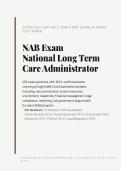
2026 /2027 EDITION | NAB CORE EXAM AL IGNED
TEST BANK
NAB Exam
National Long Term
Care Administrator
225 exam questions with 100% verified answers
covering all eight NAB Core Examination domains
including care and services, human resources,
environment, leadership, financial management, legal
compliance, marketing, and governance aligned with
the latest NAB blueprint.
225 Questions | 8 Sections | 100% Guaranteed
Care & Services (31%) | Human Resources (17%) | Environment (15%)
Leadership (11%) | Finance (12%) | Legal/Regulatory (14%)
C O M P R E H E N S I V E E X A M P R E PA R AT I O N | S TA N M U C I N I C S T U D Y G U I D E
STYLE
, NAB Exam | 2026/2027 Edition
225 Exam Questions with 100% Verified Answers | NAB Core Aligned
Section 1: Care and Services
Admissions, Assessment, Care Planning, Nursing, Physician, Pharmacy, Dietary, Activities, Social Services, Restorative Care, and Specialized Services
Q1: A new resident is admitted to your skilled nursing facility from the hospital with orders for physical therapy five
times per week and a complex wound care regimen. The interdisciplinary team meeting is scheduled for the fifth day after
admission. Which of the following is the MOST appropriate action regarding the initial care plan development?
A. Wait until the interdisciplinary team meeting on day five to begin developing the care plan, as CMS requires a comprehensive
assessment within the first 14 days
B. Develop an initial care plan within 48 hours of admission addressing immediate needs and modify it after the
comprehensive assessment is completed [CORRECT]
C. Document the physician orders only and wait for the Minimum Data Set (MDS) completion before initiating any care planning
activities
D. Delegate the initial care plan development to the charge nurse since the resident will be reassessed at the end of the 14-day
window
Correct Answer: B
Rationale: Under CMS Requirements of Participation at 42 CFR 483.21, facilities must develop a comprehensive care plan within 7 days
after completion of the comprehensive assessment. The initial care plan must be developed within 48 hours of admission to address
immediate needs and ensure safe care transitions. Option A is incorrect because waiting until day five delays necessary care coordination and
does not meet the 48-hour initial care plan requirement. Option C is incorrect because physician orders alone do not constitute a care plan,
and the MDS assessment must be coordinated with care planning activities, not sequential to them. Option D is incorrect because care plan
development requires interdisciplinary team involvement per F-Tag 641, not unilateral delegation to a single staff member.
Q2: A family member calls your facility to inquire about the admissions process for her mother who has advanced
Parkinson's disease and requires extensive assistance with activities of daily living. The family member asks whether the
facility can accommodate her mother's specialized needs before submitting a formal application. What is the MOST
appropriate response by the admissions coordinator?
A. Guarantee admission immediately since the facility is required to accept all referrals under the Americans with Disabilities Act
B. Explain the preadmission screening process and offer to schedule a visit so the team can evaluate whether the facility can
meet the resident's needs [CORRECT]
C. Inform the family that Medicare will not cover the stay because Parkinson's disease is a chronic condition not requiring skilled
care
D. Request that the family obtain a letter from the primary physician certifying the resident will not need any specialized equipment
Correct Answer: B
Rationale: The admissions process must include a preadmission screening and evaluation to determine whether the facility can adequately
meet the prospective resident's needs. Under 42 CFR 483.70, facilities must conduct a preadmission screening and annual resident review
(PASRR) to ensure appropriate placement. Option A is incorrect because while the ADA prohibits discrimination, facilities are not required
to admit individuals whose needs exceed the facility's capabilities or license scope. Option C is incorrect because Medicare coverage depends
on skilled nursing needs, not the diagnosis alone, and the admissions inquiry should focus on care matching rather than coverage
determination. Option D is incorrect because requesting a letter limiting equipment needs before evaluation is premature and potentially
exclusionary.
Q3: A resident is being transferred from your facility to an acute care hospital for emergency treatment. The hospital
calls requesting the resident's transfer summary. Which of the following documents MUST be included in the transfer
packet to comply with CMS requirements?
A. Only the physician's transfer order and the most recent MDS assessment
B. A brief summary note written by the charge nurse and the resident's dietary preferences
NAB Exam | 2026/2027 Edition | 225 Questions | Page 1
, C. The resident's complete medical record including all physician orders, nursing assessments, medication administration
records, and advance directives [CORRECT]
D. The facility's discharge planning checklist and the resident's financial account statement
Correct Answer: C
Rationale: Under 42 CFR 483.10, residents have the right to receive a complete and accurate transfer summary, and F-Tag 641 requires that
pertinent clinical information accompany the resident during transfers. The transfer summary must include current physician orders,
medication records, nursing assessments, and advance directives to ensure continuity of care. Option A is incorrect because the transfer
packet requires far more than just the physician's order and MDS. Option B is incorrect because a brief nurse summary and dietary
preferences are insufficient for safe care transition. Option D is incorrect because financial documents and internal checklists are not part of
the clinical transfer documentation required by CMS.
Q4: A resident who has been stable for several months suddenly becomes increasingly confused, refuses to eat, and has
lost 6 pounds over the past two weeks. The nursing staff has been documenting these changes in the progress notes. What
is the MOST appropriate action under the Resident Assessment Instrument (RAI) process?
A. Wait until the next scheduled quarterly assessment to evaluate the changes since the annual assessment was just completed two
months ago
B. Notify the family and request that they take the resident to the emergency room for evaluation
C. Increase the resident's calorie intake through supplements and monitor for another week before taking further action
D. Perform a Significant Change in Status Assessment (SCSA) using the RAI process to determine if the care plan needs to
be revised [CORRECT]
Correct Answer: D
Rationale: Under F-Tag 585, a Significant Change in Status Assessment must be triggered when a resident experiences a major decline or
improvement in physical, cognitive, or psychosocial function. The RAI process defines a significant change as one that affects multiple areas
of the resident's health status and requires reassessment rather than waiting for the next scheduled MDS. Option A is incorrect because
waiting for the quarterly assessment when significant changes have occurred violates CMS requirements for timely reassessment. Option B is
incorrect because the facility should first perform its own assessment before deciding whether outside emergency evaluation is necessary.
Option C is incorrect because while nutritional supplementation may be appropriate, it does not replace the required formal reassessment.
Q5: Under CMS Requirements of Participation, what is the maximum time allowed between completion of the
comprehensive assessment and completion of the comprehensive care plan?
A. 7 days [CORRECT]
B. 3 days
C. 14 days
D. 21 days
Correct Answer: A
Rationale: Under 42 CFR 483.21(b)(2), the facility must develop, review, and revise a comprehensive care plan within 7 days after
completion of the comprehensive assessment. F-Tag 641 requires that the care plan be comprehensive, person-centered, and developed by an
interdisciplinary team including the attending physician, registered nurse, and other appropriate staff. Option B is incorrect because 3 days is
not the regulatory timeframe for comprehensive care plan completion. Option C is incorrect because 14 days is the timeframe for completing
the comprehensive assessment itself, not the care plan. Option D is incorrect because 21 days exceeds the regulatory requirement and would
represent noncompliance.
Q6: Which of the following components is REQUIRED to be included in the Resident Assessment Instrument (RAI) as
part of the comprehensive assessment process under CMS regulations?
A. A review of the resident's bank account balances and financial power of attorney designations
B. An independent neuropsychological evaluation performed by a licensed clinical psychologist
C. The Minimum Data Set (MDS), Care Area Assessment (CAA) process, and utilization guidelines for the CAAs
[CORRECT]
D. A home inspection report from the resident's prior living environment
Correct Answer: C
Rationale: Under 42 CFR 483.20, the RAI consists of the Minimum Data Set (MDS), Care Area Assessment (CAA) process (formerly
Resident Assessment Protocols/CAPs), and the utilization guidelines. F-Tag 584 requires that the comprehensive assessment incorporate all
NAB Exam | 2026/2027 Edition | 225 Questions | Page 2
, three components to identify resident problems, strengths, and preferences for care planning. Option A is incorrect because financial
information is not part of the clinical RAI process. Option B is incorrect because while neuropsychological evaluations may be appropriate in
specific circumstances, they are not a required component of the standard RAI. Option D is incorrect because a home inspection from a prior
residence is not a required RAI element.
Q7: Which of the following statements about Minimum Data Set (MDS) quarterly assessment scheduling is MOST
accurate under CMS regulations?
A. The 10-day delay is acceptable as long as the assessments are completed within the same calendar quarter as the reference date
B. Quarterly assessments are optional if the resident's condition has not changed since the last assessment
C. The facility must complete assessments within a specified window of the scheduled reference date, and a 10-day delay
may constitute a regulatory deficiency under F-Tag 584 [CORRECT]
D. The MDS coordinator can extend the reference date by up to 30 days without documentation if staffing is insufficient
Correct Answer: C
Rationale: Under F-Tag 584 and the RAI User's Manual, comprehensive assessments must be completed within specific timeframes relative
to scheduled reference dates. Quarterly assessments have a required completion window, and failing to meet these deadlines can result in
regulatory citations and impact quality measures. Option A is incorrect because simply completing assessments within the same quarter does
not satisfy the specific scheduling requirements. Option B is incorrect because quarterly reassessments are mandatory regardless of whether
the resident's condition has changed. Option D is incorrect because reference dates cannot be unilaterally extended without proper
justification and documentation.
Q8: Under CMS regulations, which of the following best describes the requirement for who may complete the cognitive
status section of the Minimum Data Set (MDS)?
A. There is no regulatory concern because LPNs are authorized to complete all sections of the MDS under CMS guidelines
B. The LPN should have asked the resident's family members to complete the cognitive section instead of the CNA
C. The MDS assessment must be based on direct observation and assessment of the resident by qualified assessors, and
information gathered secondhand from CNAs may compromise accuracy under F-Tag 584 [CORRECT]
D. Only the attending physician is permitted to complete the cognitive status portion of the MDS
Correct Answer: C
Rationale: Under 42 CFR 483.20(a)(2), the comprehensive assessment must be conducted by qualified professionals using direct
observation and resident interview, not solely secondhand reports. F-Tag 584 requires that MDS data be accurate and based on validated
assessment techniques, with specific sections requiring particular assessor qualifications. Option A is incorrect because not all MDS sections
can be completed by LPNs, and the methodology of data collection is as important as the assessor's credential. Option B is incorrect because
while family input is valuable, it does not substitute for direct professional assessment. Option D is incorrect because physicians are not the
only professionals authorized to complete cognitive assessment sections.
Q9: Your facility has admitted a resident with a recent left hip fracture who is recovering from surgery. The MDS
assessment reveals that the resident has moderate cognitive impairment, requires extensive assistance with bed mobility
and transfers, and has a history of depression. According to the care planning process, which of the following represents
the BEST approach to developing this resident's care plan?
A. Focus the care plan exclusively on the physical rehabilitation needs since the hip fracture is the primary reason for admission
B. Defer cognitive and psychosocial care planning until the physical therapy goals have been achieved to avoid overwhelming the
resident
C. Develop an interdisciplinary care plan that addresses mobility recovery, cognitive support strategies, depression
management, and fall prevention measures [CORRECT]
D. Assign the social worker to independently develop the psychosocial components and the nursing team to develop the physical
components without a joint conference
Correct Answer: C
Rationale: Under F-Tag 641, the comprehensive care plan must be person-centered, interdisciplinary, and address all identified needs
including medical, nursing, mental health, and psychosocial domains. The care plan must reflect the resident's goals, preferences, and
strengths while addressing all areas of functional limitation. Option A is incorrect because focusing exclusively on physical needs ignores the
holistic, person-centered approach required by CMS. Option B is incorrect because deferring cognitive and psychosocial care planning
delays necessary interventions and violates the comprehensive care plan requirement. Option D is incorrect because care plans must be
developed through interdisciplinary collaboration, not in isolation by individual departments.
NAB Exam | 2026/2027 Edition | 225 Questions | Page 3
TEST BANK
NAB Exam
National Long Term
Care Administrator
225 exam questions with 100% verified answers
covering all eight NAB Core Examination domains
including care and services, human resources,
environment, leadership, financial management, legal
compliance, marketing, and governance aligned with
the latest NAB blueprint.
225 Questions | 8 Sections | 100% Guaranteed
Care & Services (31%) | Human Resources (17%) | Environment (15%)
Leadership (11%) | Finance (12%) | Legal/Regulatory (14%)
C O M P R E H E N S I V E E X A M P R E PA R AT I O N | S TA N M U C I N I C S T U D Y G U I D E
STYLE
, NAB Exam | 2026/2027 Edition
225 Exam Questions with 100% Verified Answers | NAB Core Aligned
Section 1: Care and Services
Admissions, Assessment, Care Planning, Nursing, Physician, Pharmacy, Dietary, Activities, Social Services, Restorative Care, and Specialized Services
Q1: A new resident is admitted to your skilled nursing facility from the hospital with orders for physical therapy five
times per week and a complex wound care regimen. The interdisciplinary team meeting is scheduled for the fifth day after
admission. Which of the following is the MOST appropriate action regarding the initial care plan development?
A. Wait until the interdisciplinary team meeting on day five to begin developing the care plan, as CMS requires a comprehensive
assessment within the first 14 days
B. Develop an initial care plan within 48 hours of admission addressing immediate needs and modify it after the
comprehensive assessment is completed [CORRECT]
C. Document the physician orders only and wait for the Minimum Data Set (MDS) completion before initiating any care planning
activities
D. Delegate the initial care plan development to the charge nurse since the resident will be reassessed at the end of the 14-day
window
Correct Answer: B
Rationale: Under CMS Requirements of Participation at 42 CFR 483.21, facilities must develop a comprehensive care plan within 7 days
after completion of the comprehensive assessment. The initial care plan must be developed within 48 hours of admission to address
immediate needs and ensure safe care transitions. Option A is incorrect because waiting until day five delays necessary care coordination and
does not meet the 48-hour initial care plan requirement. Option C is incorrect because physician orders alone do not constitute a care plan,
and the MDS assessment must be coordinated with care planning activities, not sequential to them. Option D is incorrect because care plan
development requires interdisciplinary team involvement per F-Tag 641, not unilateral delegation to a single staff member.
Q2: A family member calls your facility to inquire about the admissions process for her mother who has advanced
Parkinson's disease and requires extensive assistance with activities of daily living. The family member asks whether the
facility can accommodate her mother's specialized needs before submitting a formal application. What is the MOST
appropriate response by the admissions coordinator?
A. Guarantee admission immediately since the facility is required to accept all referrals under the Americans with Disabilities Act
B. Explain the preadmission screening process and offer to schedule a visit so the team can evaluate whether the facility can
meet the resident's needs [CORRECT]
C. Inform the family that Medicare will not cover the stay because Parkinson's disease is a chronic condition not requiring skilled
care
D. Request that the family obtain a letter from the primary physician certifying the resident will not need any specialized equipment
Correct Answer: B
Rationale: The admissions process must include a preadmission screening and evaluation to determine whether the facility can adequately
meet the prospective resident's needs. Under 42 CFR 483.70, facilities must conduct a preadmission screening and annual resident review
(PASRR) to ensure appropriate placement. Option A is incorrect because while the ADA prohibits discrimination, facilities are not required
to admit individuals whose needs exceed the facility's capabilities or license scope. Option C is incorrect because Medicare coverage depends
on skilled nursing needs, not the diagnosis alone, and the admissions inquiry should focus on care matching rather than coverage
determination. Option D is incorrect because requesting a letter limiting equipment needs before evaluation is premature and potentially
exclusionary.
Q3: A resident is being transferred from your facility to an acute care hospital for emergency treatment. The hospital
calls requesting the resident's transfer summary. Which of the following documents MUST be included in the transfer
packet to comply with CMS requirements?
A. Only the physician's transfer order and the most recent MDS assessment
B. A brief summary note written by the charge nurse and the resident's dietary preferences
NAB Exam | 2026/2027 Edition | 225 Questions | Page 1
, C. The resident's complete medical record including all physician orders, nursing assessments, medication administration
records, and advance directives [CORRECT]
D. The facility's discharge planning checklist and the resident's financial account statement
Correct Answer: C
Rationale: Under 42 CFR 483.10, residents have the right to receive a complete and accurate transfer summary, and F-Tag 641 requires that
pertinent clinical information accompany the resident during transfers. The transfer summary must include current physician orders,
medication records, nursing assessments, and advance directives to ensure continuity of care. Option A is incorrect because the transfer
packet requires far more than just the physician's order and MDS. Option B is incorrect because a brief nurse summary and dietary
preferences are insufficient for safe care transition. Option D is incorrect because financial documents and internal checklists are not part of
the clinical transfer documentation required by CMS.
Q4: A resident who has been stable for several months suddenly becomes increasingly confused, refuses to eat, and has
lost 6 pounds over the past two weeks. The nursing staff has been documenting these changes in the progress notes. What
is the MOST appropriate action under the Resident Assessment Instrument (RAI) process?
A. Wait until the next scheduled quarterly assessment to evaluate the changes since the annual assessment was just completed two
months ago
B. Notify the family and request that they take the resident to the emergency room for evaluation
C. Increase the resident's calorie intake through supplements and monitor for another week before taking further action
D. Perform a Significant Change in Status Assessment (SCSA) using the RAI process to determine if the care plan needs to
be revised [CORRECT]
Correct Answer: D
Rationale: Under F-Tag 585, a Significant Change in Status Assessment must be triggered when a resident experiences a major decline or
improvement in physical, cognitive, or psychosocial function. The RAI process defines a significant change as one that affects multiple areas
of the resident's health status and requires reassessment rather than waiting for the next scheduled MDS. Option A is incorrect because
waiting for the quarterly assessment when significant changes have occurred violates CMS requirements for timely reassessment. Option B is
incorrect because the facility should first perform its own assessment before deciding whether outside emergency evaluation is necessary.
Option C is incorrect because while nutritional supplementation may be appropriate, it does not replace the required formal reassessment.
Q5: Under CMS Requirements of Participation, what is the maximum time allowed between completion of the
comprehensive assessment and completion of the comprehensive care plan?
A. 7 days [CORRECT]
B. 3 days
C. 14 days
D. 21 days
Correct Answer: A
Rationale: Under 42 CFR 483.21(b)(2), the facility must develop, review, and revise a comprehensive care plan within 7 days after
completion of the comprehensive assessment. F-Tag 641 requires that the care plan be comprehensive, person-centered, and developed by an
interdisciplinary team including the attending physician, registered nurse, and other appropriate staff. Option B is incorrect because 3 days is
not the regulatory timeframe for comprehensive care plan completion. Option C is incorrect because 14 days is the timeframe for completing
the comprehensive assessment itself, not the care plan. Option D is incorrect because 21 days exceeds the regulatory requirement and would
represent noncompliance.
Q6: Which of the following components is REQUIRED to be included in the Resident Assessment Instrument (RAI) as
part of the comprehensive assessment process under CMS regulations?
A. A review of the resident's bank account balances and financial power of attorney designations
B. An independent neuropsychological evaluation performed by a licensed clinical psychologist
C. The Minimum Data Set (MDS), Care Area Assessment (CAA) process, and utilization guidelines for the CAAs
[CORRECT]
D. A home inspection report from the resident's prior living environment
Correct Answer: C
Rationale: Under 42 CFR 483.20, the RAI consists of the Minimum Data Set (MDS), Care Area Assessment (CAA) process (formerly
Resident Assessment Protocols/CAPs), and the utilization guidelines. F-Tag 584 requires that the comprehensive assessment incorporate all
NAB Exam | 2026/2027 Edition | 225 Questions | Page 2
, three components to identify resident problems, strengths, and preferences for care planning. Option A is incorrect because financial
information is not part of the clinical RAI process. Option B is incorrect because while neuropsychological evaluations may be appropriate in
specific circumstances, they are not a required component of the standard RAI. Option D is incorrect because a home inspection from a prior
residence is not a required RAI element.
Q7: Which of the following statements about Minimum Data Set (MDS) quarterly assessment scheduling is MOST
accurate under CMS regulations?
A. The 10-day delay is acceptable as long as the assessments are completed within the same calendar quarter as the reference date
B. Quarterly assessments are optional if the resident's condition has not changed since the last assessment
C. The facility must complete assessments within a specified window of the scheduled reference date, and a 10-day delay
may constitute a regulatory deficiency under F-Tag 584 [CORRECT]
D. The MDS coordinator can extend the reference date by up to 30 days without documentation if staffing is insufficient
Correct Answer: C
Rationale: Under F-Tag 584 and the RAI User's Manual, comprehensive assessments must be completed within specific timeframes relative
to scheduled reference dates. Quarterly assessments have a required completion window, and failing to meet these deadlines can result in
regulatory citations and impact quality measures. Option A is incorrect because simply completing assessments within the same quarter does
not satisfy the specific scheduling requirements. Option B is incorrect because quarterly reassessments are mandatory regardless of whether
the resident's condition has changed. Option D is incorrect because reference dates cannot be unilaterally extended without proper
justification and documentation.
Q8: Under CMS regulations, which of the following best describes the requirement for who may complete the cognitive
status section of the Minimum Data Set (MDS)?
A. There is no regulatory concern because LPNs are authorized to complete all sections of the MDS under CMS guidelines
B. The LPN should have asked the resident's family members to complete the cognitive section instead of the CNA
C. The MDS assessment must be based on direct observation and assessment of the resident by qualified assessors, and
information gathered secondhand from CNAs may compromise accuracy under F-Tag 584 [CORRECT]
D. Only the attending physician is permitted to complete the cognitive status portion of the MDS
Correct Answer: C
Rationale: Under 42 CFR 483.20(a)(2), the comprehensive assessment must be conducted by qualified professionals using direct
observation and resident interview, not solely secondhand reports. F-Tag 584 requires that MDS data be accurate and based on validated
assessment techniques, with specific sections requiring particular assessor qualifications. Option A is incorrect because not all MDS sections
can be completed by LPNs, and the methodology of data collection is as important as the assessor's credential. Option B is incorrect because
while family input is valuable, it does not substitute for direct professional assessment. Option D is incorrect because physicians are not the
only professionals authorized to complete cognitive assessment sections.
Q9: Your facility has admitted a resident with a recent left hip fracture who is recovering from surgery. The MDS
assessment reveals that the resident has moderate cognitive impairment, requires extensive assistance with bed mobility
and transfers, and has a history of depression. According to the care planning process, which of the following represents
the BEST approach to developing this resident's care plan?
A. Focus the care plan exclusively on the physical rehabilitation needs since the hip fracture is the primary reason for admission
B. Defer cognitive and psychosocial care planning until the physical therapy goals have been achieved to avoid overwhelming the
resident
C. Develop an interdisciplinary care plan that addresses mobility recovery, cognitive support strategies, depression
management, and fall prevention measures [CORRECT]
D. Assign the social worker to independently develop the psychosocial components and the nursing team to develop the physical
components without a joint conference
Correct Answer: C
Rationale: Under F-Tag 641, the comprehensive care plan must be person-centered, interdisciplinary, and address all identified needs
including medical, nursing, mental health, and psychosocial domains. The care plan must reflect the resident's goals, preferences, and
strengths while addressing all areas of functional limitation. Option A is incorrect because focusing exclusively on physical needs ignores the
holistic, person-centered approach required by CMS. Option B is incorrect because deferring cognitive and psychosocial care planning
delays necessary interventions and violates the comprehensive care plan requirement. Option D is incorrect because care plans must be
developed through interdisciplinary collaboration, not in isolation by individual departments.
NAB Exam | 2026/2027 Edition | 225 Questions | Page 3


