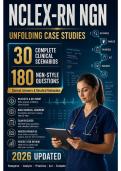
, NCLEX-RN NGN
Unfolding Case Studies
30 Complete Clinical Scenarios | 180 Questions
Correct Answers & Detailed Rationales | 2026 Updated
Clinical Judgment in Action
Recognize Cues • Analyze Cues • Prioritize Hypotheses
Generate Solutions • Take Action • Evaluate Outcomes
Independent educational practice resource. Original questions only. Not affiliated with or endorsed by NCSBN, Pearson VUE, or any board of nursing.
This is not a reproduction of live NCLEX content.
NCLEX-RN NGN Unfolding Case Studies | Original 2026-aligned practice Page 1
, How This Book Mirrors NGN Reasoning
Each case follows one client over time. Questions 1-2 use the initial exhibit, questions 3-4 integrate an updated clinical picture,
and questions 5-6 require action and reassessment. Interactive item styles are translated into explicit printable instructions
without changing the clinical-judgment task.
Function What the learner must do
Recognize cues Identify relevant and important data from multiple sources.
Analyze cues Connect findings to the client’s presentation and likely needs.
Prioritize hypotheses Rank the most urgent explanation, risk, or client problem.
Generate solutions Choose evidence-based interventions that address the priority.
Take action Implement the safest, highest-priority response.
Evaluate outcomes Compare observed results with expected improvement or deterioration.
Printable NGN formats used: matrix multiple response, select-all-that-apply, cloze, ordered response, bow-tie, trend, and
single-best-answer. Numeric laboratory data include a reference range when interpretation depends on it. Multi-key items may
earn partial credit on the live NCLEX; this book lists the complete key for study.
Suggested use: Hide the answer box, complete all six questions, then review why each keyed option fits and why unsafe alternatives fail. In real care,
current orders, local policy, jurisdictional scope, and the full clinical context apply.
NCLEX-RN NGN Unfolding Case Studies | Original 2026-aligned practice Page 2
, Case Study Index
Case Clinical scenario Primary client-needs area
1 Septic Shock From Pneumonia Physiological Adaptation
2 Acute Myocardial Infarction Physiological Adaptation
3 Acute Pulmonary Edema Physiological Adaptation
4 Pulmonary Embolism Reduction of Risk Potential
5 Acute Ischemic Stroke Management of Care
6 Increased Intracranial Pressure Physiological Adaptation
7 Diabetic Ketoacidosis Physiological Adaptation
8 Life-Threatening Hyperkalemia Reduction of Risk Potential
9 Upper Gastrointestinal Hemorrhage Physiological Adaptation
10 Acute Pancreatitis Basic Care and Comfort
11 Acute Liver Failure and Encephalopathy Physiological Adaptation
12 Spinal Cord Injury and Neurogenic Shock Physiological Adaptation
13 Major Burn With Inhalation Injury Physiological Adaptation
14 Acute Hemolytic Transfusion Reaction Safety and Infection Prevention and Control
15 Preeclampsia With Severe Features Health Promotion and Maintenance
16 Postpartum Hemorrhage Health Promotion and Maintenance
17 Umbilical Cord Prolapse Health Promotion and Maintenance
18 Neonatal Hypoglycemia Health Promotion and Maintenance
19 Epiglottitis Physiological Adaptation
20 Sickle Cell Acute Chest Syndrome Physiological Adaptation
21 Bacterial Meningitis Safety and Infection Prevention and Control
22 Status Epilepticus Physiological Adaptation
23 Myasthenic Crisis Physiological Adaptation
24 Suicidal Crisis Psychosocial Integrity
25 Serotonin Syndrome Pharmacological and Parenteral Therapies
26 Severe Alcohol Withdrawal Psychosocial Integrity
27 Digoxin Toxicity Pharmacological and Parenteral Therapies
28 Heparin-Induced Thrombocytopenia Pharmacological and Parenteral Therapies
29 Clostridioides difficile Colitis Safety and Infection Prevention and Control
30 Delegation and Client Deterioration Management of Care
NCLEX-RN NGN Unfolding Case Studies | Original 2026-aligned practice Page 3
Unfolding Case Studies
30 Complete Clinical Scenarios | 180 Questions
Correct Answers & Detailed Rationales | 2026 Updated
Clinical Judgment in Action
Recognize Cues • Analyze Cues • Prioritize Hypotheses
Generate Solutions • Take Action • Evaluate Outcomes
Independent educational practice resource. Original questions only. Not affiliated with or endorsed by NCSBN, Pearson VUE, or any board of nursing.
This is not a reproduction of live NCLEX content.
NCLEX-RN NGN Unfolding Case Studies | Original 2026-aligned practice Page 1
, How This Book Mirrors NGN Reasoning
Each case follows one client over time. Questions 1-2 use the initial exhibit, questions 3-4 integrate an updated clinical picture,
and questions 5-6 require action and reassessment. Interactive item styles are translated into explicit printable instructions
without changing the clinical-judgment task.
Function What the learner must do
Recognize cues Identify relevant and important data from multiple sources.
Analyze cues Connect findings to the client’s presentation and likely needs.
Prioritize hypotheses Rank the most urgent explanation, risk, or client problem.
Generate solutions Choose evidence-based interventions that address the priority.
Take action Implement the safest, highest-priority response.
Evaluate outcomes Compare observed results with expected improvement or deterioration.
Printable NGN formats used: matrix multiple response, select-all-that-apply, cloze, ordered response, bow-tie, trend, and
single-best-answer. Numeric laboratory data include a reference range when interpretation depends on it. Multi-key items may
earn partial credit on the live NCLEX; this book lists the complete key for study.
Suggested use: Hide the answer box, complete all six questions, then review why each keyed option fits and why unsafe alternatives fail. In real care,
current orders, local policy, jurisdictional scope, and the full clinical context apply.
NCLEX-RN NGN Unfolding Case Studies | Original 2026-aligned practice Page 2
, Case Study Index
Case Clinical scenario Primary client-needs area
1 Septic Shock From Pneumonia Physiological Adaptation
2 Acute Myocardial Infarction Physiological Adaptation
3 Acute Pulmonary Edema Physiological Adaptation
4 Pulmonary Embolism Reduction of Risk Potential
5 Acute Ischemic Stroke Management of Care
6 Increased Intracranial Pressure Physiological Adaptation
7 Diabetic Ketoacidosis Physiological Adaptation
8 Life-Threatening Hyperkalemia Reduction of Risk Potential
9 Upper Gastrointestinal Hemorrhage Physiological Adaptation
10 Acute Pancreatitis Basic Care and Comfort
11 Acute Liver Failure and Encephalopathy Physiological Adaptation
12 Spinal Cord Injury and Neurogenic Shock Physiological Adaptation
13 Major Burn With Inhalation Injury Physiological Adaptation
14 Acute Hemolytic Transfusion Reaction Safety and Infection Prevention and Control
15 Preeclampsia With Severe Features Health Promotion and Maintenance
16 Postpartum Hemorrhage Health Promotion and Maintenance
17 Umbilical Cord Prolapse Health Promotion and Maintenance
18 Neonatal Hypoglycemia Health Promotion and Maintenance
19 Epiglottitis Physiological Adaptation
20 Sickle Cell Acute Chest Syndrome Physiological Adaptation
21 Bacterial Meningitis Safety and Infection Prevention and Control
22 Status Epilepticus Physiological Adaptation
23 Myasthenic Crisis Physiological Adaptation
24 Suicidal Crisis Psychosocial Integrity
25 Serotonin Syndrome Pharmacological and Parenteral Therapies
26 Severe Alcohol Withdrawal Psychosocial Integrity
27 Digoxin Toxicity Pharmacological and Parenteral Therapies
28 Heparin-Induced Thrombocytopenia Pharmacological and Parenteral Therapies
29 Clostridioides difficile Colitis Safety and Infection Prevention and Control
30 Delegation and Client Deterioration Management of Care
NCLEX-RN NGN Unfolding Case Studies | Original 2026-aligned practice Page 3