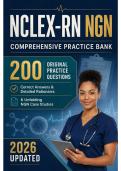
, NCLEX-RN NGN
Comprehensive Practice Bank
200 Original Questions, Answers & Rationales
Aligned to the 2026 NCLEX-RN Test Plan
Stand-alone clinical judgment items + six unfolding NGN case studies
Educational use only. This independent practice resource is not endorsed by or affiliated with NCSBN, Pearson VUE, or any board of nursing.
Questions are original and are not recalled NCLEX examination items.
Original NCLEX-RN NGN Practice Bank | 2026 Test Plan aligned Page 1
, How to Use This Bank
Complete each item before revealing the answer. For multiple-response items, select every option that applies. For
ordered-response items, arrange the listed actions from first to last. Matrix, cloze, bow-tie, and trend items are adapted to
a clear printable format while preserving the reasoning task.
Client Needs area Target emphasis
Management of Care 18%
Safety and Infection Prevention and Control 13%
Health Promotion and Maintenance 9%
Psychosocial Integrity 9%
Basic Care and Comfort 9%
Pharmacological and Parenteral Therapies 16%
Reduction of Risk Potential 12%
Physiological Adaptation 14%
Clinical judgment sequence: Recognize cues -> Analyze cues -> Prioritize hypotheses -> Generate solutions -> Take
action -> Evaluate outcomes.
Important: Numeric laboratory values include a reference range when interpretation depends on it. Exact exam delivery and scoring remain
controlled by NCSBN.
Original NCLEX-RN NGN Practice Bank | 2026 Test Plan aligned Page 2
, Part I - Stand-Alone Practice Items
1. Single Best Answer | Management of Care
A nurse in the medical-surgical unit is caring for a client with acute ischemic stroke. The assessment shows new unilateral
weakness and slurred speech. Which priority should guide the nurse’s response?
A. activate the stroke response and determine last-known-well time
B. schedule routine physical therapy
C. place a heating pad on the weak arm
D. wait for the provider to round
Correct answer: A
Rationale: The findings make it essential to activate the stroke response and determine last-known-well time. This addresses the
most immediate threat using airway, breathing, circulation, safety, and time-sensitive treatment principles. The other options delay
or do not address the priority problem.
2. Multiple Response - Select All That Apply | Management of Care
The nurse plans care for the client with acute ischemic stroke. Which actions or teaching points are appropriate? Select all
that apply.
A. maintain airway, check glucose, and prepare for rapid brain imaging
B. give oral fluids before a swallow screen
C. call emergency services for recurrent FAST symptoms
D. schedule routine physical therapy
E. wait for the provider to round
Correct answer: A and C
Rationale: Maintain airway, check glucose, and prepare for rapid brain imaging is an appropriate immediate action, and the client
should be taught to call emergency services for recurrent FAST symptoms. The nurse should not give oral fluids before a swallow
screen; the remaining options are unrelated, unsafe, or delay effective care.
3. Drop-Down Cloze (print adaptation) | Management of Care
Complete the sentence by choosing the best option: Based on new unilateral weakness and slurred speech, the nurse
should first _____.
A. activate the stroke response and determine last-known-well time
B. give oral fluids before a swallow screen
C. place a heating pad on the weak arm
D. wait for the provider to round
Correct answer: A
Rationale: The cue pattern is consistent with acute ischemic stroke; therefore, the nurse should activate the stroke response and
determine last-known-well time. The alternatives do not address the most urgent clinical need.
4. Evaluate Outcomes | Management of Care
Which finding best indicates that care for the client with acute ischemic stroke has been effective?
A. the client’s status stabilizes after the prescribed intervention
B. the nurse proceeds to give oral fluids before a swallow screen
C. the client develops worsening of the presenting cues
D. treatment is delayed while schedule routine physical therapy
Correct answer: A
Rationale: An effective intervention produces stabilization or resolution of the priority problem. Give oral fluids before a swallow
screen is unsafe, worsening cues indicate deterioration, and delayed treatment is not a therapeutic outcome.
5. Single Best Answer | Management of Care
Original NCLEX-RN NGN Practice Bank | 2026 Test Plan aligned Page 3
Comprehensive Practice Bank
200 Original Questions, Answers & Rationales
Aligned to the 2026 NCLEX-RN Test Plan
Stand-alone clinical judgment items + six unfolding NGN case studies
Educational use only. This independent practice resource is not endorsed by or affiliated with NCSBN, Pearson VUE, or any board of nursing.
Questions are original and are not recalled NCLEX examination items.
Original NCLEX-RN NGN Practice Bank | 2026 Test Plan aligned Page 1
, How to Use This Bank
Complete each item before revealing the answer. For multiple-response items, select every option that applies. For
ordered-response items, arrange the listed actions from first to last. Matrix, cloze, bow-tie, and trend items are adapted to
a clear printable format while preserving the reasoning task.
Client Needs area Target emphasis
Management of Care 18%
Safety and Infection Prevention and Control 13%
Health Promotion and Maintenance 9%
Psychosocial Integrity 9%
Basic Care and Comfort 9%
Pharmacological and Parenteral Therapies 16%
Reduction of Risk Potential 12%
Physiological Adaptation 14%
Clinical judgment sequence: Recognize cues -> Analyze cues -> Prioritize hypotheses -> Generate solutions -> Take
action -> Evaluate outcomes.
Important: Numeric laboratory values include a reference range when interpretation depends on it. Exact exam delivery and scoring remain
controlled by NCSBN.
Original NCLEX-RN NGN Practice Bank | 2026 Test Plan aligned Page 2
, Part I - Stand-Alone Practice Items
1. Single Best Answer | Management of Care
A nurse in the medical-surgical unit is caring for a client with acute ischemic stroke. The assessment shows new unilateral
weakness and slurred speech. Which priority should guide the nurse’s response?
A. activate the stroke response and determine last-known-well time
B. schedule routine physical therapy
C. place a heating pad on the weak arm
D. wait for the provider to round
Correct answer: A
Rationale: The findings make it essential to activate the stroke response and determine last-known-well time. This addresses the
most immediate threat using airway, breathing, circulation, safety, and time-sensitive treatment principles. The other options delay
or do not address the priority problem.
2. Multiple Response - Select All That Apply | Management of Care
The nurse plans care for the client with acute ischemic stroke. Which actions or teaching points are appropriate? Select all
that apply.
A. maintain airway, check glucose, and prepare for rapid brain imaging
B. give oral fluids before a swallow screen
C. call emergency services for recurrent FAST symptoms
D. schedule routine physical therapy
E. wait for the provider to round
Correct answer: A and C
Rationale: Maintain airway, check glucose, and prepare for rapid brain imaging is an appropriate immediate action, and the client
should be taught to call emergency services for recurrent FAST symptoms. The nurse should not give oral fluids before a swallow
screen; the remaining options are unrelated, unsafe, or delay effective care.
3. Drop-Down Cloze (print adaptation) | Management of Care
Complete the sentence by choosing the best option: Based on new unilateral weakness and slurred speech, the nurse
should first _____.
A. activate the stroke response and determine last-known-well time
B. give oral fluids before a swallow screen
C. place a heating pad on the weak arm
D. wait for the provider to round
Correct answer: A
Rationale: The cue pattern is consistent with acute ischemic stroke; therefore, the nurse should activate the stroke response and
determine last-known-well time. The alternatives do not address the most urgent clinical need.
4. Evaluate Outcomes | Management of Care
Which finding best indicates that care for the client with acute ischemic stroke has been effective?
A. the client’s status stabilizes after the prescribed intervention
B. the nurse proceeds to give oral fluids before a swallow screen
C. the client develops worsening of the presenting cues
D. treatment is delayed while schedule routine physical therapy
Correct answer: A
Rationale: An effective intervention produces stabilization or resolution of the priority problem. Give oral fluids before a swallow
screen is unsafe, worsening cues indicate deterioration, and delayed treatment is not a therapeutic outcome.
5. Single Best Answer | Management of Care
Original NCLEX-RN NGN Practice Bank | 2026 Test Plan aligned Page 3