

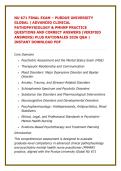
NU 671 FINAL EXAM – PURDUE UNIVERSITY
GLOBAL | ADVANCED CLINICAL
PATHOPHYSIOLOGY & PMHNP PRACTICE
QUESTIONS AND CORRECT ANSWERS (VERIFIED
ANSWERS) PLUS RATIONALES 2026 Q&A |
INSTANT DOWNLOAD PDF
Core Domains
• Psychiatric Assessment and the Mental Status Exam (MSE)
• Therapeutic Relationship and Communication
• Mood Disorders: Major Depressive Disorder and Bipolar
Disorder
• Anxiety, Trauma, and Stressor-Related Disorders
• Schizophrenia Spectrum and Psychotic Disorders
• Substance Use Disorders and Pharmacological Interventions
• Neurocognitive Disorders and Developmental Disorders
• Psychopharmacology: Antidepressants, Antipsychotics, Mood
Stabilizers
• Ethical, Legal, and Professional Standards in Psychiatric-
Mental Health Nursing
• Evidence-Based Psychotherapy and Treatment Planning
Introduction
This comprehensive assessment is designed to evaluate
graduate-level competency in advanced clinical pathophysiology
and psychiatric-mental health nurse practitioner (PMHNP)
practice, aligned with the Purdue University Global NU 671
,curriculum. The examination measures mastery of DSM-5
diagnostic criteria, psychopharmacological principles, therapeutic
communication, and evidence-based treatment planning. Through
a combination of direct multiple-choice questions and clinical
scenario-based items, candidates will demonstrate critical
thinking, diagnostic reasoning, and the ability to apply theoretical
knowledge to real-world patient encounters. Success on this
exam reflects a robust understanding of psychiatric disorders
across the lifespan and the clinical decision-making skills essential
for advanced practice nursing.
SECTION ONE: QUESTIONS 1 – 100
1. What is the primary purpose of the psychiatric
interview?
A. To establish a medication regimen for the patient
B. To gather information for diagnosis, build rapport, and develop
a treatment plan
C. To assess the patient's physical health status
D. To determine the patient's insurance coverage
B. To gather information for diagnosis, build rapport, and
develop a treatment plan
RATIONALE: The psychiatric interview serves multiple
interrelated purposes: collecting data for accurate diagnosis,
establishing a therapeutic alliance through rapport-building, and
collaboratively developing an individualized treatment plan. While
medication management (A) and physical health assessment (C)
may be components of care, they are not the primary objectives
of the interview itself.
2. The Mental Status Exam (MSE) is best described as:
,A. A diagnostic tool used to confirm a specific psychiatric disorder
B. A structured assessment of a patient's current psychological
functioning
C. A comprehensive medical history and physical examination
D. A screening tool for substance use disorders
B. A structured assessment of a patient's current
psychological functioning
RATIONALE: The MSE is a systematic, structured evaluation
that provides a snapshot of a patient's psychological functioning
at a specific point in time. It is not a standalone diagnostic tool
(A) but rather a component of the overall psychiatric assessment
that informs diagnosis and treatment planning.
3. Which of the following is NOT a main component of the
Mental Status Exam?
A. Appearance and behavior
B. Speech and thought process
C. Complete blood count (CBC)
D. Cognition and insight
C. Complete blood count (CBC)
RATIONALE: The MSE components include appearance,
behavior, speech, mood, affect, thought process, thought content,
cognition, insight, and judgment. A complete blood count (CBC) is
a laboratory test, not a component of the mental status
examination.
4. In the MSE, "mood" refers to:
A. The observable expression of emotion
B. The patient's sustained internal emotional state
C. The organization and flow of thoughts
D. The patient's awareness of their illness
, B. The patient's sustained internal emotional state
RATIONALE: Mood is defined as the patient's subjective,
sustained internal emotional state, which the patient reports.
Affect (A) is the observable expression of emotion. Thought
process (C) refers to the organization and flow of thoughts, and
insight (D) refers to awareness of illness.
5. "Affect" in the MSE refers to:
A. The patient's sustained internal emotional state
B. The observable expression of emotion
C. The themes present in thoughts
D. The ability to make appropriate decisions
B. The observable expression of emotion
RATIONALE: Affect is the observable, external expression of
emotion, including facial expression, vocal tone, and body
language. It is distinguished from mood, which is the patient's
internal, subjective emotional experience.
6. A patient speaks in a monotone voice with minimal
facial expression and no emotional reactivity. This finding
is best documented as:
A. Labile affect
B. Flat affect
C. Constricted affect
D. Inappropriate affect
B. Flat affect
RATIONALE: Flat affect is characterized by the near-complete
absence of emotional expression, including monotone voice and
lack of facial reactivity. Labile affect (A) involves rapid, shifting
emotional expressions. Constricted affect (C) is a reduced range
GLOBAL | ADVANCED CLINICAL
PATHOPHYSIOLOGY & PMHNP PRACTICE
QUESTIONS AND CORRECT ANSWERS (VERIFIED
ANSWERS) PLUS RATIONALES 2026 Q&A |
INSTANT DOWNLOAD PDF
Core Domains
• Psychiatric Assessment and the Mental Status Exam (MSE)
• Therapeutic Relationship and Communication
• Mood Disorders: Major Depressive Disorder and Bipolar
Disorder
• Anxiety, Trauma, and Stressor-Related Disorders
• Schizophrenia Spectrum and Psychotic Disorders
• Substance Use Disorders and Pharmacological Interventions
• Neurocognitive Disorders and Developmental Disorders
• Psychopharmacology: Antidepressants, Antipsychotics, Mood
Stabilizers
• Ethical, Legal, and Professional Standards in Psychiatric-
Mental Health Nursing
• Evidence-Based Psychotherapy and Treatment Planning
Introduction
This comprehensive assessment is designed to evaluate
graduate-level competency in advanced clinical pathophysiology
and psychiatric-mental health nurse practitioner (PMHNP)
practice, aligned with the Purdue University Global NU 671
,curriculum. The examination measures mastery of DSM-5
diagnostic criteria, psychopharmacological principles, therapeutic
communication, and evidence-based treatment planning. Through
a combination of direct multiple-choice questions and clinical
scenario-based items, candidates will demonstrate critical
thinking, diagnostic reasoning, and the ability to apply theoretical
knowledge to real-world patient encounters. Success on this
exam reflects a robust understanding of psychiatric disorders
across the lifespan and the clinical decision-making skills essential
for advanced practice nursing.
SECTION ONE: QUESTIONS 1 – 100
1. What is the primary purpose of the psychiatric
interview?
A. To establish a medication regimen for the patient
B. To gather information for diagnosis, build rapport, and develop
a treatment plan
C. To assess the patient's physical health status
D. To determine the patient's insurance coverage
B. To gather information for diagnosis, build rapport, and
develop a treatment plan
RATIONALE: The psychiatric interview serves multiple
interrelated purposes: collecting data for accurate diagnosis,
establishing a therapeutic alliance through rapport-building, and
collaboratively developing an individualized treatment plan. While
medication management (A) and physical health assessment (C)
may be components of care, they are not the primary objectives
of the interview itself.
2. The Mental Status Exam (MSE) is best described as:
,A. A diagnostic tool used to confirm a specific psychiatric disorder
B. A structured assessment of a patient's current psychological
functioning
C. A comprehensive medical history and physical examination
D. A screening tool for substance use disorders
B. A structured assessment of a patient's current
psychological functioning
RATIONALE: The MSE is a systematic, structured evaluation
that provides a snapshot of a patient's psychological functioning
at a specific point in time. It is not a standalone diagnostic tool
(A) but rather a component of the overall psychiatric assessment
that informs diagnosis and treatment planning.
3. Which of the following is NOT a main component of the
Mental Status Exam?
A. Appearance and behavior
B. Speech and thought process
C. Complete blood count (CBC)
D. Cognition and insight
C. Complete blood count (CBC)
RATIONALE: The MSE components include appearance,
behavior, speech, mood, affect, thought process, thought content,
cognition, insight, and judgment. A complete blood count (CBC) is
a laboratory test, not a component of the mental status
examination.
4. In the MSE, "mood" refers to:
A. The observable expression of emotion
B. The patient's sustained internal emotional state
C. The organization and flow of thoughts
D. The patient's awareness of their illness
, B. The patient's sustained internal emotional state
RATIONALE: Mood is defined as the patient's subjective,
sustained internal emotional state, which the patient reports.
Affect (A) is the observable expression of emotion. Thought
process (C) refers to the organization and flow of thoughts, and
insight (D) refers to awareness of illness.
5. "Affect" in the MSE refers to:
A. The patient's sustained internal emotional state
B. The observable expression of emotion
C. The themes present in thoughts
D. The ability to make appropriate decisions
B. The observable expression of emotion
RATIONALE: Affect is the observable, external expression of
emotion, including facial expression, vocal tone, and body
language. It is distinguished from mood, which is the patient's
internal, subjective emotional experience.
6. A patient speaks in a monotone voice with minimal
facial expression and no emotional reactivity. This finding
is best documented as:
A. Labile affect
B. Flat affect
C. Constricted affect
D. Inappropriate affect
B. Flat affect
RATIONALE: Flat affect is characterized by the near-complete
absence of emotional expression, including monotone voice and
lack of facial reactivity. Labile affect (A) involves rapid, shifting
emotional expressions. Constricted affect (C) is a reduced range


