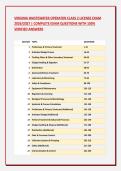
VIRGINIA WASTEWATER OPERATOR CLASS 2 LICENSE EXAM
2026/2027 | COMPLETE EXAM QUESTIONS WITH 100%
VERIFIED ANSWERS
SECTION TOPIC QUESTIONS
1 Preliminary & Primary Treatment 1-15
2 Activated Sludge Process 16-45
3 Trickling Filters & Other Secondary Treatment 46-50
4 Sludge Handling & Digestion 51-57
5 Disinfection 58-65
6 Advanced/Tertiary Treatment 66-70
7 Laboratory & Monitoring 71-85
8 Safety & Compliance 86-100
9 Equipment & Maintenance 101-110
10 Regulatory & Licensing 111-120
11 Biological Processes & Microbiology 121-130
12 Hydraulic & Process Calculations 131-140
13 Preliminary & Primary Treatment (Additional) 141-150
14 Activated Sludge (Additional) 151-160
15 Tertiary Treatment & Advanced Processes 161-170
16 Sludge Handling & Disposal (Additional) 171-180
17 Disinfection (Additional) 181-190
18 Odor & Corrosion Control 191-200
19 Collection Systems & Pumping 201-210
20 Safety (Additional) 211-220
21 Instrumentation & Control 221-230
,22 Process Control 231-240
23 Water Quality & Permit Compliance 241-250
24 Clarifier Operation & Problems 251-260
25 Activated Sludge Process Control 261-270
26 Odor Control (Additional) 271-275
27 Sludge Handling (Additional) 276-280
28 Laboratory Procedures 281-290
29 Stormwater & Receiving Water 291-295
30 Collection System Maintenance 296-300
31 Plant Startup & Troubleshooting 301-310
32 Coagulation & Flocculation 311-315
33 Water Reuse & Conservation 316-320
34 Metering & Sampling 321-325
35 Pump & Motor Operation 326-330
36 Chemical Handling 331-335
37 Safety & Regulations (Additional) 336-340
38 General Regulatory 341-345
39 Final Regulatory & General Knowledge 346-350
,SECTION 1: PRELIMINARY AND PRIMARY TREATMENT
Question 1
What is the primary purpose of preliminary treatment in a wastewater
treatment plant?
A) To remove dissolved organic compounds through biological oxidation
B) To remove large debris and grit to protect downstream equipment
C) To destroy pathogenic organisms using chemical disinfection
D) To convert ammonia into nitrate through nitrification
E) To reduce total suspended solids to below 5 mg/L
CORRECT ANSWER: B) To remove large debris and grit to protect
downstream equipment
Rationale: Preliminary treatment removes coarse materials like rags,
sticks, and grit to prevent damage and clogging of downstream
equipment such as pumps and pipes . Option A describes secondary
treatment, Option C describes disinfection, Option D describes
nitrification, and Option E describes advanced treatment.
Question 2
In a primary clarifier, what is the typical detention time?
A) 30 minutes
B) 1 to 2 hours
C) 4 to 6 hours
D) 8 to 12 hours
E) 24 hours
CORRECT ANSWER: B) 1 to 2 hours
, Rationale: Most primary clarifiers have a detention time of 1 to 2 hours,
allowing sufficient time for settleable solids to separate from the
wastewater . Option A is too short for effective settling, Options C and D
are more typical of secondary clarifiers, and Option E is characteristic of
lagoon systems.
Question 3
What type of solids are primarily removed by primary clarifiers?
A) Dissolved solids
B) Settleable solids
C) Volatile solids only
D) Colloidal solids
E) All suspended solids
CORRECT ANSWER: B) Settleable solids
Rationale: Primary clarifiers remove settleable solids through gravity
separation . Dissolved solids (A) pass through primary treatment,
volatile solids (C) are a component but not the primary target, colloidal
solids (D) typically require chemical addition, and primary treatment
cannot remove all suspended solids.
Question 4
What term describes the small floating solids that rise to the surface in
primary clarifiers?
A) Grit
B) Scum
C) Floc
2026/2027 | COMPLETE EXAM QUESTIONS WITH 100%
VERIFIED ANSWERS
SECTION TOPIC QUESTIONS
1 Preliminary & Primary Treatment 1-15
2 Activated Sludge Process 16-45
3 Trickling Filters & Other Secondary Treatment 46-50
4 Sludge Handling & Digestion 51-57
5 Disinfection 58-65
6 Advanced/Tertiary Treatment 66-70
7 Laboratory & Monitoring 71-85
8 Safety & Compliance 86-100
9 Equipment & Maintenance 101-110
10 Regulatory & Licensing 111-120
11 Biological Processes & Microbiology 121-130
12 Hydraulic & Process Calculations 131-140
13 Preliminary & Primary Treatment (Additional) 141-150
14 Activated Sludge (Additional) 151-160
15 Tertiary Treatment & Advanced Processes 161-170
16 Sludge Handling & Disposal (Additional) 171-180
17 Disinfection (Additional) 181-190
18 Odor & Corrosion Control 191-200
19 Collection Systems & Pumping 201-210
20 Safety (Additional) 211-220
21 Instrumentation & Control 221-230
,22 Process Control 231-240
23 Water Quality & Permit Compliance 241-250
24 Clarifier Operation & Problems 251-260
25 Activated Sludge Process Control 261-270
26 Odor Control (Additional) 271-275
27 Sludge Handling (Additional) 276-280
28 Laboratory Procedures 281-290
29 Stormwater & Receiving Water 291-295
30 Collection System Maintenance 296-300
31 Plant Startup & Troubleshooting 301-310
32 Coagulation & Flocculation 311-315
33 Water Reuse & Conservation 316-320
34 Metering & Sampling 321-325
35 Pump & Motor Operation 326-330
36 Chemical Handling 331-335
37 Safety & Regulations (Additional) 336-340
38 General Regulatory 341-345
39 Final Regulatory & General Knowledge 346-350
,SECTION 1: PRELIMINARY AND PRIMARY TREATMENT
Question 1
What is the primary purpose of preliminary treatment in a wastewater
treatment plant?
A) To remove dissolved organic compounds through biological oxidation
B) To remove large debris and grit to protect downstream equipment
C) To destroy pathogenic organisms using chemical disinfection
D) To convert ammonia into nitrate through nitrification
E) To reduce total suspended solids to below 5 mg/L
CORRECT ANSWER: B) To remove large debris and grit to protect
downstream equipment
Rationale: Preliminary treatment removes coarse materials like rags,
sticks, and grit to prevent damage and clogging of downstream
equipment such as pumps and pipes . Option A describes secondary
treatment, Option C describes disinfection, Option D describes
nitrification, and Option E describes advanced treatment.
Question 2
In a primary clarifier, what is the typical detention time?
A) 30 minutes
B) 1 to 2 hours
C) 4 to 6 hours
D) 8 to 12 hours
E) 24 hours
CORRECT ANSWER: B) 1 to 2 hours
, Rationale: Most primary clarifiers have a detention time of 1 to 2 hours,
allowing sufficient time for settleable solids to separate from the
wastewater . Option A is too short for effective settling, Options C and D
are more typical of secondary clarifiers, and Option E is characteristic of
lagoon systems.
Question 3
What type of solids are primarily removed by primary clarifiers?
A) Dissolved solids
B) Settleable solids
C) Volatile solids only
D) Colloidal solids
E) All suspended solids
CORRECT ANSWER: B) Settleable solids
Rationale: Primary clarifiers remove settleable solids through gravity
separation . Dissolved solids (A) pass through primary treatment,
volatile solids (C) are a component but not the primary target, colloidal
solids (D) typically require chemical addition, and primary treatment
cannot remove all suspended solids.
Question 4
What term describes the small floating solids that rise to the surface in
primary clarifiers?
A) Grit
B) Scum
C) Floc