Nurs 5338 Mod 2 Pretest Comprehensive Resource To Help You Ace 2026-2027 Exams
Includes Frequently Tested Questions With ELABORATED 100% Correct COMPLETE
SOLUTIONS Guaranteed Pass First Attempt!! Current Update!!
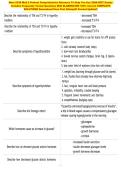
Describe the relationship of TSH and T3/T4 in hyperthy- - decreased TSH
roidism - increased T3/T4
Describe the relationship of TSH and T3/T4 in hypothy- - increased TSH
roidism - decreased T3/T4
1. weight gain (inability to use fat stores for ATP produc-
tion)
2. cold (already lowered body temp)
Describe symptoms of hypothyroidism 3. slow heart rate (bradycardia)
4. slowed nervous system (fatigue, brain fog, & depres-
sion)
5. lose outer third of eyebrow (slow hair cell mitosis)
1. weight loss (burning through glucose and fat stores)
2. hot, flushed face (already have relatively high body
temp)
Describe symptoms of hyperthyroidism 3. fast, irregular heart rate and blood pressure
4. agitation, irritability, trouble sleeping
5. frequent bowel movements and diarrhea
6. exophthalmos (bulging eyes)
*Caused by untreated hypoglycemia (overuse of insulin)*,
Describe the Somogyi ettect a dip in blood sugars causes a compensatory glucagon
release causing hyperglycemia in the morning
- glucagon
- epinephrine
Which hormones cause an increase in glucose?
- growth hormone
- cortisol
- increased insulin secretion
Describe how an elevated glucose attects hormones - insulin decreases glucagon levels
- growth hormone decreases
Describe how decreased glucose attects hormones
1/8
, - increased glucagon
- increased epinephrine
this is when the patient becomes hyperglycemic between
5-6 am because of a nighttime release of growth hor-
Describe "Dawn Phenomenon" mone. The treatment: give more insulin for the overnight
period. For instance, give NPH at 10 pm. The diagnosis is
made by checking blood glucose during the night.
- cause the elevation of glucose
During the Dawn Phenomenon, growth hormone will
- as glucose levels rise, growth hormone decreases
(glucose level is decreased when too much insulin is tak-
en)
Increase in
The Somogyi Ettect causes - glucagon
- glucose
- epinephrine
Eventually causing glucose levels to rise
weight in pounds
What formula is used to calculate BMI?
height (squared) in inches x 703
In the general population, pharmacologic treatment
should be initiated when blood pressure is 150/90 mm
The JNC 8 recommends to treat BP of 60 y/o
Hg or higher in adults 60 years and older, or 140/90 mm
Hg or higher in adults younger than 60 years.
In patients with hypertension and diabetes JNC 8 recom- when blood pressure is 140/90 mm Hg or higher, regard-
mends treatment of BP begin less of age.
a thiazide diuretic, calcium channel blocker, ACE inhibitor,
JNC 8 recommends initial antihypertensive treatment or ARB in the general nonblack population or a thiazide
should include diuretic or calcium channel blocker in the general black
population.
2/8
Includes Frequently Tested Questions With ELABORATED 100% Correct COMPLETE
SOLUTIONS Guaranteed Pass First Attempt!! Current Update!!
Describe the relationship of TSH and T3/T4 in hyperthy- - decreased TSH
roidism - increased T3/T4
Describe the relationship of TSH and T3/T4 in hypothy- - increased TSH
roidism - decreased T3/T4
1. weight gain (inability to use fat stores for ATP produc-
tion)
2. cold (already lowered body temp)
Describe symptoms of hypothyroidism 3. slow heart rate (bradycardia)
4. slowed nervous system (fatigue, brain fog, & depres-
sion)
5. lose outer third of eyebrow (slow hair cell mitosis)
1. weight loss (burning through glucose and fat stores)
2. hot, flushed face (already have relatively high body
temp)
Describe symptoms of hyperthyroidism 3. fast, irregular heart rate and blood pressure
4. agitation, irritability, trouble sleeping
5. frequent bowel movements and diarrhea
6. exophthalmos (bulging eyes)
*Caused by untreated hypoglycemia (overuse of insulin)*,
Describe the Somogyi ettect a dip in blood sugars causes a compensatory glucagon
release causing hyperglycemia in the morning
- glucagon
- epinephrine
Which hormones cause an increase in glucose?
- growth hormone
- cortisol
- increased insulin secretion
Describe how an elevated glucose attects hormones - insulin decreases glucagon levels
- growth hormone decreases
Describe how decreased glucose attects hormones
1/8
, - increased glucagon
- increased epinephrine
this is when the patient becomes hyperglycemic between
5-6 am because of a nighttime release of growth hor-
Describe "Dawn Phenomenon" mone. The treatment: give more insulin for the overnight
period. For instance, give NPH at 10 pm. The diagnosis is
made by checking blood glucose during the night.
- cause the elevation of glucose
During the Dawn Phenomenon, growth hormone will
- as glucose levels rise, growth hormone decreases
(glucose level is decreased when too much insulin is tak-
en)
Increase in
The Somogyi Ettect causes - glucagon
- glucose
- epinephrine
Eventually causing glucose levels to rise
weight in pounds
What formula is used to calculate BMI?
height (squared) in inches x 703
In the general population, pharmacologic treatment
should be initiated when blood pressure is 150/90 mm
The JNC 8 recommends to treat BP of 60 y/o
Hg or higher in adults 60 years and older, or 140/90 mm
Hg or higher in adults younger than 60 years.
In patients with hypertension and diabetes JNC 8 recom- when blood pressure is 140/90 mm Hg or higher, regard-
mends treatment of BP begin less of age.
a thiazide diuretic, calcium channel blocker, ACE inhibitor,
JNC 8 recommends initial antihypertensive treatment or ARB in the general nonblack population or a thiazide
should include diuretic or calcium channel blocker in the general black
population.
2/8