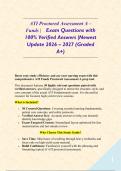
Boost your study efficiency and ace your nursing exam with this
comprehensive ATI Funds Proctored Assessment A prep tool.
This document features 30 highly relevant questions paired with
verified answers, specifically designed to mirror the structure, style, and
core concepts of the actual ATI Fundamentals exam. It is the perfect
resource for focused, high-yield review sessions.
What is Included?
• 30 Curated Questions: Covering essential nursing fundamentals,
patient care concepts, and safety protocols.
• Verified Answer Key: Accurate answers to help you instantly
identify knowledge gaps.
• Exam-Targeted Content: Streamlined layout optimized for fast
memorization and last-minute review.
Why Choose This Study Guide?
• Save Time: Skip hours of scrolling through heavy textbooks and
focus only on high-yield exam material.
• Build Confidence: Familiarize yourself with the phrasing and
formatting typical of ATI proctored assessments.
1
, • Improve Performance: Repetition with authentic style questions is
proven to boost retention and increase your ATI proficiency level.
Question 1
A nurse is caring for an older adult client who has a fractured hip and will require
rehabilitative care. The client's family asks the nurse for information about this type of
care. Which of the following explanations should the nurse provide?
• Correct Answer:✅ This service began with the client's admission to the hospital.
• Rationale: Discharge planning and rehabilitation goals should be initiated
immediately upon acute care admission. Proactive planning ensures continuity of
care, sets baseline dynamic goals, and coordinates the interprofessional team early to
optimize the client's functional recovery.
Question 2
A nurse is discharging a client who came to the outpatient clinic with an ankle sprain.
Which of the following statements should the nurse identify as an indication that the
client understands the discharge instructions?
• Correct Answer:✅ "I'll apply ice to my ankle today and tomorrow."
• Rationale: This follows the classic RICE (Rest, Ice, Compression, Elevation)
protocol for acute soft tissue injury management. Applying cold therapy for the first
24 to 48 hours induces vasoconstriction, which effectively limits localized edema,
decreases inflammation, and numbs pain.
Question 3
A nurse is planning care for an older adult client who is at risk for developing pressure
ulcers. Which of the following interventions should the nurse use to help maintain the
integrity of the client's skin?
• Correct Answer:✅ Use a transfer device to lift the client up in bed.
• Rationale: Utilizing ergonomic transfer or friction-reducing lift assistive devices
prevents dragging the client's body across bed sheets. This eliminates shear and
friction forces, which are principal physical causes of epithelial breakdown and
pressure injury development.
2
comprehensive ATI Funds Proctored Assessment A prep tool.
This document features 30 highly relevant questions paired with
verified answers, specifically designed to mirror the structure, style, and
core concepts of the actual ATI Fundamentals exam. It is the perfect
resource for focused, high-yield review sessions.
What is Included?
• 30 Curated Questions: Covering essential nursing fundamentals,
patient care concepts, and safety protocols.
• Verified Answer Key: Accurate answers to help you instantly
identify knowledge gaps.
• Exam-Targeted Content: Streamlined layout optimized for fast
memorization and last-minute review.
Why Choose This Study Guide?
• Save Time: Skip hours of scrolling through heavy textbooks and
focus only on high-yield exam material.
• Build Confidence: Familiarize yourself with the phrasing and
formatting typical of ATI proctored assessments.
1
, • Improve Performance: Repetition with authentic style questions is
proven to boost retention and increase your ATI proficiency level.
Question 1
A nurse is caring for an older adult client who has a fractured hip and will require
rehabilitative care. The client's family asks the nurse for information about this type of
care. Which of the following explanations should the nurse provide?
• Correct Answer:✅ This service began with the client's admission to the hospital.
• Rationale: Discharge planning and rehabilitation goals should be initiated
immediately upon acute care admission. Proactive planning ensures continuity of
care, sets baseline dynamic goals, and coordinates the interprofessional team early to
optimize the client's functional recovery.
Question 2
A nurse is discharging a client who came to the outpatient clinic with an ankle sprain.
Which of the following statements should the nurse identify as an indication that the
client understands the discharge instructions?
• Correct Answer:✅ "I'll apply ice to my ankle today and tomorrow."
• Rationale: This follows the classic RICE (Rest, Ice, Compression, Elevation)
protocol for acute soft tissue injury management. Applying cold therapy for the first
24 to 48 hours induces vasoconstriction, which effectively limits localized edema,
decreases inflammation, and numbs pain.
Question 3
A nurse is planning care for an older adult client who is at risk for developing pressure
ulcers. Which of the following interventions should the nurse use to help maintain the
integrity of the client's skin?
• Correct Answer:✅ Use a transfer device to lift the client up in bed.
• Rationale: Utilizing ergonomic transfer or friction-reducing lift assistive devices
prevents dragging the client's body across bed sheets. This eliminates shear and
friction forces, which are principal physical causes of epithelial breakdown and
pressure injury development.
2