
1|Page
,2|Page
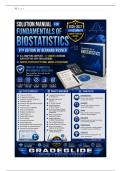
Solution Manual for Fundamentals of
Biostatistics 8th Edition by Bernard Rosner |
All Chapters Complete | A+ Graded Answers
with Step-by-Step Explanations | Master
Hypothesis Testing, ANOVA & Regression
This comprehensive Solution Manual for Fundamentals
of Biostatistics, 8th Edition by Bernard Rosner provides
detailed step-by-step solutions to all textbook exercises.
Covering all chapters including descriptive statistics,
probability distributions, hypothesis testing (one-sample,
two-sample, and categorical data), nonparametric
methods, regression and correlation, ANOVA, and
epidemiologic study designs. Each problem is solved
with clear explanations, formulas, and calculations.
Perfect for public health, medical, biology, and life
sciences students. A+ graded solutions verified by
experts. Save time studying and ace your exams with
this essential study companion. Instant digital download
available.
Table of Contents for Multiple-Choice Questions
Chapter 1: General Overview – Questions 1–100
Chapter 2: Descriptive Statistics – Questions 101–200
Chapter 3: Probability – Questions 201–300
Chapter 4: Discrete Probability Distributions – Questions 301–400
Chapter 5: Continuous Probability Distributions – Questions 401–500
Chapter 6: Estimation – Questions 501–600
Chapter 7: Hypothesis Testing: One-Sample Inference – Questions 601–700
Chapter 8: Hypothesis Testing: Two-Sample Inference – Questions 701–800
Chapter 9: Nonparametric Methods – Questions 801–900
, 3|Page
Chapter 10: Hypothesis Testing: Categorical Data – Questions 901–1000
Chapter 11: Regression and Correlation Methods – Questions 1001–1100
Chapter 12: Multisample Inference – Questions 1101–1200
Chapter 13: Design and Analysis Techniques for Epidemiologic Studies –
Questions 1201–1300
Chapter 14: Hypothesis Testing: Person-Time Data – Questions 1301–1400
Chapter 1: General Overview (Questions 1–100)
1. What is the primary goal of biostatistics?
a) To collect data without analysis
b) To apply statistical methods to analyze data in biological and medical research
c) To design laboratory equipment
d) To perform clinical surgeries
b) To apply statistical methods to analyze data in biological and medical
research
Rationale: Biostatistics integrates statistical principles with biological and
medical contexts to draw valid conclusions from research data, supporting
evidence-based decision-making in health sciences.
2. What is a population in biostatistics?
a) A subset of individuals selected for a study
b) The complete set of measurements or individuals of interest
c) A single measurement from an experiment
d) A group of researchers
b) The complete set of measurements or individuals of interest
Rationale: The population includes all possible observations relevant to a
research question, from which a sample is drawn for practical study.
3. What is a sample?
a) The entire group under study
b) A subset of the population selected for analysis
c) A type of statistical test
d) A measure of disease frequency
b) A subset of the population selected for analysis
Rationale: Samples are smaller, manageable subsets used to estimate
population parameters because studying entire populations is often impractical.
4. What is a parameter?
a) A numerical summary of sample data
b) A numerical summary of a population
c) A type of study design
d) A measure of variability
, 4|Page
b) A numerical summary of a population
Rationale: Parameters describe fixed but often unknown population
characteristics, such as the true mean or proportion.
5. What is a statistic?
a) A numerical summary of a population
b) A numerical summary of a sample
c) A type of bias
d) A clinical trial phase
b) A numerical summary of a sample
Rationale: Statistics are calculated from sample data and used to estimate
unknown population parameters.
6. Which study design looks backward in time?
a) Prospective cohort study
b) Retrospective case-control study
c) Randomized controlled trial
d) Cross-sectional study
b) Retrospective case-control study
Rationale: Retrospective studies examine past exposures or risk factors in
relation to current disease status.
7. Which study design follows participants forward in time?
a) Retrospective study
b) Prospective cohort study
c) Case report
d) Ecological study
b) Prospective cohort study
Rationale: Prospective studies track participants over time to observe incident
outcomes and establish temporal associations.
8. What distinguishes an experiment from an observational study?
a) Experiments do not involve human subjects
b) Experiments actively assign treatments or interventions
c) Observational studies are always longitudinal
d) Experiments cannot be randomized
b) Experiments actively assign treatments or interventions
Rationale: Experimental designs, especially randomized controlled trials,
involve investigator-initiated interventions to assess causality.
9. What is incidence?
a) Total existing cases at a time point
b) New cases occurring over a specified period
c) Deaths due to disease
d) Disease severity score
b) New cases occurring over a specified period
Rationale: Incidence measures the rate of new disease onset, reflecting risk in
the population.
,2|Page
Solution Manual for Fundamentals of
Biostatistics 8th Edition by Bernard Rosner |
All Chapters Complete | A+ Graded Answers
with Step-by-Step Explanations | Master
Hypothesis Testing, ANOVA & Regression
This comprehensive Solution Manual for Fundamentals
of Biostatistics, 8th Edition by Bernard Rosner provides
detailed step-by-step solutions to all textbook exercises.
Covering all chapters including descriptive statistics,
probability distributions, hypothesis testing (one-sample,
two-sample, and categorical data), nonparametric
methods, regression and correlation, ANOVA, and
epidemiologic study designs. Each problem is solved
with clear explanations, formulas, and calculations.
Perfect for public health, medical, biology, and life
sciences students. A+ graded solutions verified by
experts. Save time studying and ace your exams with
this essential study companion. Instant digital download
available.
Table of Contents for Multiple-Choice Questions
Chapter 1: General Overview – Questions 1–100
Chapter 2: Descriptive Statistics – Questions 101–200
Chapter 3: Probability – Questions 201–300
Chapter 4: Discrete Probability Distributions – Questions 301–400
Chapter 5: Continuous Probability Distributions – Questions 401–500
Chapter 6: Estimation – Questions 501–600
Chapter 7: Hypothesis Testing: One-Sample Inference – Questions 601–700
Chapter 8: Hypothesis Testing: Two-Sample Inference – Questions 701–800
Chapter 9: Nonparametric Methods – Questions 801–900
, 3|Page
Chapter 10: Hypothesis Testing: Categorical Data – Questions 901–1000
Chapter 11: Regression and Correlation Methods – Questions 1001–1100
Chapter 12: Multisample Inference – Questions 1101–1200
Chapter 13: Design and Analysis Techniques for Epidemiologic Studies –
Questions 1201–1300
Chapter 14: Hypothesis Testing: Person-Time Data – Questions 1301–1400
Chapter 1: General Overview (Questions 1–100)
1. What is the primary goal of biostatistics?
a) To collect data without analysis
b) To apply statistical methods to analyze data in biological and medical research
c) To design laboratory equipment
d) To perform clinical surgeries
b) To apply statistical methods to analyze data in biological and medical
research
Rationale: Biostatistics integrates statistical principles with biological and
medical contexts to draw valid conclusions from research data, supporting
evidence-based decision-making in health sciences.
2. What is a population in biostatistics?
a) A subset of individuals selected for a study
b) The complete set of measurements or individuals of interest
c) A single measurement from an experiment
d) A group of researchers
b) The complete set of measurements or individuals of interest
Rationale: The population includes all possible observations relevant to a
research question, from which a sample is drawn for practical study.
3. What is a sample?
a) The entire group under study
b) A subset of the population selected for analysis
c) A type of statistical test
d) A measure of disease frequency
b) A subset of the population selected for analysis
Rationale: Samples are smaller, manageable subsets used to estimate
population parameters because studying entire populations is often impractical.
4. What is a parameter?
a) A numerical summary of sample data
b) A numerical summary of a population
c) A type of study design
d) A measure of variability
, 4|Page
b) A numerical summary of a population
Rationale: Parameters describe fixed but often unknown population
characteristics, such as the true mean or proportion.
5. What is a statistic?
a) A numerical summary of a population
b) A numerical summary of a sample
c) A type of bias
d) A clinical trial phase
b) A numerical summary of a sample
Rationale: Statistics are calculated from sample data and used to estimate
unknown population parameters.
6. Which study design looks backward in time?
a) Prospective cohort study
b) Retrospective case-control study
c) Randomized controlled trial
d) Cross-sectional study
b) Retrospective case-control study
Rationale: Retrospective studies examine past exposures or risk factors in
relation to current disease status.
7. Which study design follows participants forward in time?
a) Retrospective study
b) Prospective cohort study
c) Case report
d) Ecological study
b) Prospective cohort study
Rationale: Prospective studies track participants over time to observe incident
outcomes and establish temporal associations.
8. What distinguishes an experiment from an observational study?
a) Experiments do not involve human subjects
b) Experiments actively assign treatments or interventions
c) Observational studies are always longitudinal
d) Experiments cannot be randomized
b) Experiments actively assign treatments or interventions
Rationale: Experimental designs, especially randomized controlled trials,
involve investigator-initiated interventions to assess causality.
9. What is incidence?
a) Total existing cases at a time point
b) New cases occurring over a specified period
c) Deaths due to disease
d) Disease severity score
b) New cases occurring over a specified period
Rationale: Incidence measures the rate of new disease onset, reflecting risk in
the population.


