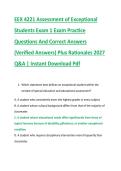
EEX 4221 Assessment of Exceptional
Students Exam 1 Exam Practice
Questions And Correct Answers
(Verified Answers) Plus Rationales 2027
Q&A | Instant Download Pdf
1. Which statement best defines an exceptional student within the
context of special education and educational assessment?
A. A student who consistently earns the highest grades in every subject
B. A student whose cultural background differs from that of the majority of
classmates
C. A student whose educational needs differ significantly from those of
typical learners because of disability, giftedness, or another exceptional
condition
D. A student who requires disciplinary intervention more frequently than
classmates
,Rationale: Exceptional learners include students whose cognitive, physical,
sensory, behavioral, emotional, communication, or academic
characteristics require educational services or adaptations beyond those
typically provided in the general classroom.
2. What is the primary purpose of assessing exceptional students in an
educational setting?
A. To permanently label students according to their disabilities
B. To identify educational needs and guide appropriate instructional,
intervention, and support decisions
C. To determine which students should be excluded from general education
D. To rank students according to intelligence
Rationale: Assessment should provide information that helps educators
understand a student's strengths and needs and use that information to
plan effective instruction, interventions, accommodations, and services.
3. Which characteristic distinguishes a norm-referenced assessment
from a criterion-referenced assessment?
A. A norm-referenced assessment compares performance with
predetermined mastery standards only.
B. A norm-referenced assessment interprets an individual's performance in
relation to the performance of a reference group.
C. A norm-referenced assessment cannot be administered to exceptional
,students.
D. A norm-referenced assessment does not require standardized
administration.
Rationale: Norm-referenced tests interpret scores by comparing an
individual's performance with that of a norm group, whereas criterion-
referenced assessments determine performance relative to specified
knowledge or skill criteria.
4. A teacher administers an assessment to determine whether a student
has mastered 80% of the objectives taught during a mathematics unit.
What type of assessment is this?
A. Norm-referenced assessment
B. Criterion-referenced assessment
C. Projective assessment
D. Personality inventory
Rationale: The student's performance is being evaluated against
predetermined instructional criteria rather than compared with the
performance of a normative sample.
5. Which principle is most important when selecting an assessment for
an exceptional student?
, A. The assessment should always be the most difficult available.
B. The assessment should be administered identically regardless of the
student's disability.
C. The assessment should be appropriate for the student's characteristics,
purpose of assessment, and educational context.
D. The assessment should measure only academic achievement.
Rationale: Appropriate assessment requires consideration of the student's
age, disability, language, communication abilities, developmental
characteristics, and the specific decisions the assessment is intended to
support.
6. A student's assessment results are interpreted by comparing the
student's score with scores obtained by a representative sample of
students of the same age. Which type of score interpretation is being
used?
A. Curriculum-based measurement
B. Criterion-referenced interpretation
C. Norm-referenced interpretation
D. Informal observation
Rationale: Norm-referenced interpretation compares an individual's
performance with that of a standardized reference group, often using age,
grade, or other demographic characteristics.
Students Exam 1 Exam Practice
Questions And Correct Answers
(Verified Answers) Plus Rationales 2027
Q&A | Instant Download Pdf
1. Which statement best defines an exceptional student within the
context of special education and educational assessment?
A. A student who consistently earns the highest grades in every subject
B. A student whose cultural background differs from that of the majority of
classmates
C. A student whose educational needs differ significantly from those of
typical learners because of disability, giftedness, or another exceptional
condition
D. A student who requires disciplinary intervention more frequently than
classmates
,Rationale: Exceptional learners include students whose cognitive, physical,
sensory, behavioral, emotional, communication, or academic
characteristics require educational services or adaptations beyond those
typically provided in the general classroom.
2. What is the primary purpose of assessing exceptional students in an
educational setting?
A. To permanently label students according to their disabilities
B. To identify educational needs and guide appropriate instructional,
intervention, and support decisions
C. To determine which students should be excluded from general education
D. To rank students according to intelligence
Rationale: Assessment should provide information that helps educators
understand a student's strengths and needs and use that information to
plan effective instruction, interventions, accommodations, and services.
3. Which characteristic distinguishes a norm-referenced assessment
from a criterion-referenced assessment?
A. A norm-referenced assessment compares performance with
predetermined mastery standards only.
B. A norm-referenced assessment interprets an individual's performance in
relation to the performance of a reference group.
C. A norm-referenced assessment cannot be administered to exceptional
,students.
D. A norm-referenced assessment does not require standardized
administration.
Rationale: Norm-referenced tests interpret scores by comparing an
individual's performance with that of a norm group, whereas criterion-
referenced assessments determine performance relative to specified
knowledge or skill criteria.
4. A teacher administers an assessment to determine whether a student
has mastered 80% of the objectives taught during a mathematics unit.
What type of assessment is this?
A. Norm-referenced assessment
B. Criterion-referenced assessment
C. Projective assessment
D. Personality inventory
Rationale: The student's performance is being evaluated against
predetermined instructional criteria rather than compared with the
performance of a normative sample.
5. Which principle is most important when selecting an assessment for
an exceptional student?
, A. The assessment should always be the most difficult available.
B. The assessment should be administered identically regardless of the
student's disability.
C. The assessment should be appropriate for the student's characteristics,
purpose of assessment, and educational context.
D. The assessment should measure only academic achievement.
Rationale: Appropriate assessment requires consideration of the student's
age, disability, language, communication abilities, developmental
characteristics, and the specific decisions the assessment is intended to
support.
6. A student's assessment results are interpreted by comparing the
student's score with scores obtained by a representative sample of
students of the same age. Which type of score interpretation is being
used?
A. Curriculum-based measurement
B. Criterion-referenced interpretation
C. Norm-referenced interpretation
D. Informal observation
Rationale: Norm-referenced interpretation compares an individual's
performance with that of a standardized reference group, often using age,
grade, or other demographic characteristics.