

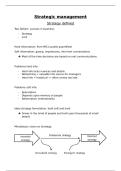
Strategic management
Strategy defined
Two fathers’ success in business:
- Strategy
- Luck
Hard information: from MIS (usually quantified)
Soft information: gossip, impressions, info from conversations
Most of the time decisions are based on oral communications
Problems hard info:
- Hard info lacks nuances and details
- Networking = valuable info source for managers
- Hard info = historical -> often comes too late
Problems soft info:
- Speculative
- Depends upon memory of people
- Deformation (intentionally)
Ideal strategy formulation: both soft and hard
Grows in the mind of people and built upon thousands of small
details
Mintzberg’s vision on strategy:
,Strategy as emergent process:
- Fallacy of prediction (future unknown)
- fallacy of detachment (impossible to divorce formulation from
implementation)
- fallacy of formalization (formalization inhibits flexibility, spontaneity,
intuition and learning)
Alvin Toffler:
If you don’t have a strategy, you will be part of somebody else’s strategy.
Definition strategic management:
- The meaningful positioning within an environment of a company,
brand, or product(group)
- Within a well-defined time span
- Different possible ways
The creation of a sustainable competitive advantage
Three questions strategy formulation:
- Goals?
- Environment?
- Use of resources?
Final goal:
To determine the way in which the company can reinforce and sustain its
competitive advantage in a competitive environment.
Different elements:
- What do I want to do?
- What can I do?
- What should I do?
What not to do = most difficult
Risk spreading = weak excuse
Build a competitive advantage in limited number of activities
, The strategic triangle:
Steering elements:
- Mission
- Business definition
- Goals and objectives
Environment:
- Opportunities?
- Risks?
Action?
Resources:
- Competence management
- Creating a learning environment
The strategy cycle:
Strategy defined
Two fathers’ success in business:
- Strategy
- Luck
Hard information: from MIS (usually quantified)
Soft information: gossip, impressions, info from conversations
Most of the time decisions are based on oral communications
Problems hard info:
- Hard info lacks nuances and details
- Networking = valuable info source for managers
- Hard info = historical -> often comes too late
Problems soft info:
- Speculative
- Depends upon memory of people
- Deformation (intentionally)
Ideal strategy formulation: both soft and hard
Grows in the mind of people and built upon thousands of small
details
Mintzberg’s vision on strategy:
,Strategy as emergent process:
- Fallacy of prediction (future unknown)
- fallacy of detachment (impossible to divorce formulation from
implementation)
- fallacy of formalization (formalization inhibits flexibility, spontaneity,
intuition and learning)
Alvin Toffler:
If you don’t have a strategy, you will be part of somebody else’s strategy.
Definition strategic management:
- The meaningful positioning within an environment of a company,
brand, or product(group)
- Within a well-defined time span
- Different possible ways
The creation of a sustainable competitive advantage
Three questions strategy formulation:
- Goals?
- Environment?
- Use of resources?
Final goal:
To determine the way in which the company can reinforce and sustain its
competitive advantage in a competitive environment.
Different elements:
- What do I want to do?
- What can I do?
- What should I do?
What not to do = most difficult
Risk spreading = weak excuse
Build a competitive advantage in limited number of activities
, The strategic triangle:
Steering elements:
- Mission
- Business definition
- Goals and objectives
Environment:
- Opportunities?
- Risks?
Action?
Resources:
- Competence management
- Creating a learning environment
The strategy cycle:


