

Utah Master Esthetics State Board Written Exam q
Utah Master Esthetics State Board Written Exam
Study online at https://quizlet.com/_hn2w3b
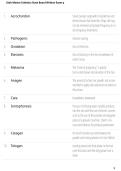
1. Acrochordon Small, benign outgrowth of epidermal and
dermal tissue that looks like a flap; skin tag.
Can be removed using high-frequency or ra-
dio-frequency treatments
2. Pathogenic disease causing
3. Oxidation loss of electrons
4. Elastosis loss of elasticity in the skin; breakdown of
elastic tissue
5. Melasma The "mask of pregnancy," a patchy
tan-to-dark brown discoloration of the face.
6. Anagen The period of active hair growth; not recom-
mended to apply lash extensions to lashes in
this phase
7. Cata breakdown, downward
8. Iontophoresis Process of infusing water-soluble products
into the skin with the use of electric current,
such as the use of the positive and negative
poles of a galvanic machine. Used in mi-
crocurrent devices for product penetration
9. Catagen the brief transition period between the
growth and resting phases of a hair follicle
10. Telogen (resting phase) the final phase in the hair
cycle that lasts until the fully grown hair is
shed.
1
, Utah Master Esthetics State Board Written Exam q
Utah Master Esthetics State Board Written Exam
Study online at https://quizlet.com/_hn2w3b
11. Cataphoresis Process of fusing an acidic (positive) prod-
uct into deeper tissues using galvanic current
from the positive pole toward the negative
pole.
12. Cushing's disease Hormonal disease in which too much corti-
sone is produced, resulting in the thinning
and bruising of the skin
13. Galvanic Low-level direct current used in facial treat-
ments; produces an electrochemical effect
14. Estrogen Hormone responsible for collagen produc-
tion
15. Why should the technician wear personal To avoid cross-infection and exposure to clin-
protective equipment while performing ical waste
microdermabrasion?
16. Phytotherapy The use of plants and their properties for
therapeutic purposes
17. Electrodessication surgically drying out and destroying tissue
though the use of high-frequency electric
current (also known as fulguration)
18. Non-ablative (i.e. IPL and LED) which type of light treatment penetrates the
epidermis, usually without affecting it, to treat
the papillary dermis below?
19. 50% Maximum percentage of AHAs that can be
used by an esthetician
20. Azulene
2
, Utah Master Esthetics State Board Written Exam q
Utah Master Esthetics State Board Written Exam
Study online at https://quizlet.com/_hn2w3b
Derived from the chamomile plant and char-
acterized by its deep blue color; has anti-in-
flammatory and soothing properties. Good
for sensitive skin
21. Clay Used in body muds to draw out impurities
22. Auricular nodes Lymph nodes near the ear
23. MLD Manual Lymphatic Drainage; requires the
use of light pressure; related to the circula-
tory system; contraindications include heart
failure, kidney disease, acute conditions due
to bacterial or viral infection
24. circulatory system the organs and tissues involved in circulating
blood and lymph through the body
25. Edema Swelling caused by the collection of fluid in
connective tissue
26. Aseptic technique Precautions taken to prevent contamination.
Ex: wearing gloves, handling tools properly,
etc.
27. 165 degrees Temperature that herbal wraps should be
heated to by a hydrocolator
28. Ultrasonic Blade Hydrating and exfoliating treatment that may
be used prior to more aggressive exfoliation
29. Rhytidectomy surgical removal of wrinkles, also called a face
lift
3
Utah Master Esthetics State Board Written Exam
Study online at https://quizlet.com/_hn2w3b
1. Acrochordon Small, benign outgrowth of epidermal and
dermal tissue that looks like a flap; skin tag.
Can be removed using high-frequency or ra-
dio-frequency treatments
2. Pathogenic disease causing
3. Oxidation loss of electrons
4. Elastosis loss of elasticity in the skin; breakdown of
elastic tissue
5. Melasma The "mask of pregnancy," a patchy
tan-to-dark brown discoloration of the face.
6. Anagen The period of active hair growth; not recom-
mended to apply lash extensions to lashes in
this phase
7. Cata breakdown, downward
8. Iontophoresis Process of infusing water-soluble products
into the skin with the use of electric current,
such as the use of the positive and negative
poles of a galvanic machine. Used in mi-
crocurrent devices for product penetration
9. Catagen the brief transition period between the
growth and resting phases of a hair follicle
10. Telogen (resting phase) the final phase in the hair
cycle that lasts until the fully grown hair is
shed.
1
, Utah Master Esthetics State Board Written Exam q
Utah Master Esthetics State Board Written Exam
Study online at https://quizlet.com/_hn2w3b
11. Cataphoresis Process of fusing an acidic (positive) prod-
uct into deeper tissues using galvanic current
from the positive pole toward the negative
pole.
12. Cushing's disease Hormonal disease in which too much corti-
sone is produced, resulting in the thinning
and bruising of the skin
13. Galvanic Low-level direct current used in facial treat-
ments; produces an electrochemical effect
14. Estrogen Hormone responsible for collagen produc-
tion
15. Why should the technician wear personal To avoid cross-infection and exposure to clin-
protective equipment while performing ical waste
microdermabrasion?
16. Phytotherapy The use of plants and their properties for
therapeutic purposes
17. Electrodessication surgically drying out and destroying tissue
though the use of high-frequency electric
current (also known as fulguration)
18. Non-ablative (i.e. IPL and LED) which type of light treatment penetrates the
epidermis, usually without affecting it, to treat
the papillary dermis below?
19. 50% Maximum percentage of AHAs that can be
used by an esthetician
20. Azulene
2
, Utah Master Esthetics State Board Written Exam q
Utah Master Esthetics State Board Written Exam
Study online at https://quizlet.com/_hn2w3b
Derived from the chamomile plant and char-
acterized by its deep blue color; has anti-in-
flammatory and soothing properties. Good
for sensitive skin
21. Clay Used in body muds to draw out impurities
22. Auricular nodes Lymph nodes near the ear
23. MLD Manual Lymphatic Drainage; requires the
use of light pressure; related to the circula-
tory system; contraindications include heart
failure, kidney disease, acute conditions due
to bacterial or viral infection
24. circulatory system the organs and tissues involved in circulating
blood and lymph through the body
25. Edema Swelling caused by the collection of fluid in
connective tissue
26. Aseptic technique Precautions taken to prevent contamination.
Ex: wearing gloves, handling tools properly,
etc.
27. 165 degrees Temperature that herbal wraps should be
heated to by a hydrocolator
28. Ultrasonic Blade Hydrating and exfoliating treatment that may
be used prior to more aggressive exfoliation
29. Rhytidectomy surgical removal of wrinkles, also called a face
lift
3


