

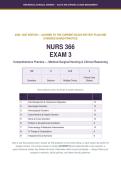
BSN MEDICAL-SURGICAL NURSING — ACUTE AND CHRONIC ILLNESS MANAGEMENT
EDITION — ALIGNED TO THE CURRENT NCLEX-RN TEST PLAN AND
EVIDENCE-BASED PRACTICE
NURS 366
EXAM 3
Comprehensive Practice — Medical-Surgical Nursing & Clinical Reasoning
100 9 A–D 5
Clinical Case
Questions Sections Multiple Choice Studies
Nine sections mirror the Exam 3 content domains:
Secti
on Domain Items
1 Pain Management & Temperature Regulation 12
2 Neurological Disorders 15
3 Hematological Disorders 12
4 Gastrointestinal & Hepatic Disorders 12
5 Renal & Urinary Disorders 10
6 Pediatric & Developmental Conditions 8
7 Pharmacology & Medication Administration 15
8 IV Therapy & Complications 8
9 Integrated Clinical Scenarios 8
How to use this practice exam: answer all 100 questions in one timed sitting, or work section by section for
targeted review. The correct answer is marked [CORRECT] and explained after every question; a
quick-reference answer key follows the exam. Rationales reflect current standards — always follow your
program's materials, facility policies, and latest clinical guidelines.
, BSN MEDICAL-SURGICAL NURSING — ACUTE AND CHRONIC ILLNESS MANAGEMENT
This is an independent study aid prepared for review purposes. It is not affiliated with or endorsed by any
university, and it is not medical advice. Values such as medication doses and laboratory thresholds reflect
common reference standards used in NCLEX-style preparation and may differ from specific institutional
protocols.
, Section 1: Pain Management & Temperature Regulation
Pain Types, Pharmacology, Temperature Control (12 questions)
Q1. A patient with long-standing diabetes describes burning, tingling pain in both feet that is worse at night.
This pain is best classified as:
A. neuropathic pain — arising from abnormal processing or damage to the nervous system itself
[CORRECT]
B. visceral nociceptive pain from organ distention
C. somatic nociceptive pain from bone and muscle injury
D. referred pain from another body region
Correct Answer: A
Rationale: Burning, tingling, shooting pain in a nerve distribution is the hallmark of neuropathic pain. Nociceptive pain
(somatic or visceral) arises from tissue injury by normal nociceptor activation, and referral patterns do not fit symmetric
stocking-distribution symptoms.
Q2. Which pairing correctly differentiates the major types of nociceptors?
A. All nociceptors respond only to chemical stimuli such as histamine and bradykinin
B. Mechanical nociceptors respond to intense pressure and deformation; thermal nociceptors respond to
extreme heat and cold; polymodal nociceptors respond to mechanical, thermal, AND chemical stimuli
[CORRECT]
C. Thermal nociceptors respond only to cold, never to heat
D. Mechanical nociceptors are activated only by emotional stress
Correct Answer: B
Rationale: The classic division is mechanical, thermal, and polymodal (responding to all three stimulus types, including
chemical mediators like bradykinin, prostaglandins, and histamine). The distractors overstate or misassign stimulus
specificity.
Q3. During a pain interview using PQRST, the nurse asks, 'Tell me what the pain feels like — burning,
stabbing, aching?' Which element of PQRST is being assessed?
A. Region
B. Severity
C. Quality [CORRECT]
D. Timing
Correct Answer: C
Rationale: PQRST = Precipitating/Palliating factors, Quality, Region/Radiation, Severity, Timing. Descriptors such as
burning or stabbing characterize Quality — information that also helps distinguish neuropathic from nociceptive pain.
Q4. Before administering a scheduled dose of intravenous morphine, which assessment is the PRIORITY?
A. Deep tendon reflexes
B. Bowel sounds in all four quadrants
C. Peripheral pulses and capillary refill
D. Respiratory rate and sedation level [CORRECT]
Correct Answer: D
Rationale: Opioid-induced respiratory depression is the most dangerous adverse effect, and increasing sedation
precedes it — assess respiratory rate and sedation (e.g., POSS scale) before each dose. The other assessments
address real but non-lethal opioid effects such as constipation.
NURS 366 Exam 3 — Comprehensive Practice (2026/2027) Page 3
EDITION — ALIGNED TO THE CURRENT NCLEX-RN TEST PLAN AND
EVIDENCE-BASED PRACTICE
NURS 366
EXAM 3
Comprehensive Practice — Medical-Surgical Nursing & Clinical Reasoning
100 9 A–D 5
Clinical Case
Questions Sections Multiple Choice Studies
Nine sections mirror the Exam 3 content domains:
Secti
on Domain Items
1 Pain Management & Temperature Regulation 12
2 Neurological Disorders 15
3 Hematological Disorders 12
4 Gastrointestinal & Hepatic Disorders 12
5 Renal & Urinary Disorders 10
6 Pediatric & Developmental Conditions 8
7 Pharmacology & Medication Administration 15
8 IV Therapy & Complications 8
9 Integrated Clinical Scenarios 8
How to use this practice exam: answer all 100 questions in one timed sitting, or work section by section for
targeted review. The correct answer is marked [CORRECT] and explained after every question; a
quick-reference answer key follows the exam. Rationales reflect current standards — always follow your
program's materials, facility policies, and latest clinical guidelines.
, BSN MEDICAL-SURGICAL NURSING — ACUTE AND CHRONIC ILLNESS MANAGEMENT
This is an independent study aid prepared for review purposes. It is not affiliated with or endorsed by any
university, and it is not medical advice. Values such as medication doses and laboratory thresholds reflect
common reference standards used in NCLEX-style preparation and may differ from specific institutional
protocols.
, Section 1: Pain Management & Temperature Regulation
Pain Types, Pharmacology, Temperature Control (12 questions)
Q1. A patient with long-standing diabetes describes burning, tingling pain in both feet that is worse at night.
This pain is best classified as:
A. neuropathic pain — arising from abnormal processing or damage to the nervous system itself
[CORRECT]
B. visceral nociceptive pain from organ distention
C. somatic nociceptive pain from bone and muscle injury
D. referred pain from another body region
Correct Answer: A
Rationale: Burning, tingling, shooting pain in a nerve distribution is the hallmark of neuropathic pain. Nociceptive pain
(somatic or visceral) arises from tissue injury by normal nociceptor activation, and referral patterns do not fit symmetric
stocking-distribution symptoms.
Q2. Which pairing correctly differentiates the major types of nociceptors?
A. All nociceptors respond only to chemical stimuli such as histamine and bradykinin
B. Mechanical nociceptors respond to intense pressure and deformation; thermal nociceptors respond to
extreme heat and cold; polymodal nociceptors respond to mechanical, thermal, AND chemical stimuli
[CORRECT]
C. Thermal nociceptors respond only to cold, never to heat
D. Mechanical nociceptors are activated only by emotional stress
Correct Answer: B
Rationale: The classic division is mechanical, thermal, and polymodal (responding to all three stimulus types, including
chemical mediators like bradykinin, prostaglandins, and histamine). The distractors overstate or misassign stimulus
specificity.
Q3. During a pain interview using PQRST, the nurse asks, 'Tell me what the pain feels like — burning,
stabbing, aching?' Which element of PQRST is being assessed?
A. Region
B. Severity
C. Quality [CORRECT]
D. Timing
Correct Answer: C
Rationale: PQRST = Precipitating/Palliating factors, Quality, Region/Radiation, Severity, Timing. Descriptors such as
burning or stabbing characterize Quality — information that also helps distinguish neuropathic from nociceptive pain.
Q4. Before administering a scheduled dose of intravenous morphine, which assessment is the PRIORITY?
A. Deep tendon reflexes
B. Bowel sounds in all four quadrants
C. Peripheral pulses and capillary refill
D. Respiratory rate and sedation level [CORRECT]
Correct Answer: D
Rationale: Opioid-induced respiratory depression is the most dangerous adverse effect, and increasing sedation
precedes it — assess respiratory rate and sedation (e.g., POSS scale) before each dose. The other assessments
address real but non-lethal opioid effects such as constipation.
NURS 366 Exam 3 — Comprehensive Practice (2026/2027) Page 3


