

TCEQ WASTEWATER OPERATOR CERTIFICATION — CLASS B
EDITION — ALIGNED TO CURRENT TCEQ EXAM CONTENT
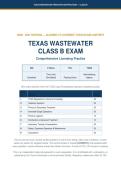
TEXAS WASTEWATER
CLASS B EXAM
Comprehensive Licensing Practice
200 3 Hours 70% TCEQ
Time Limit Administering
Questions (Simulated) Passing Score Agency
Nine exam sections mirror the TCEQ Class B wastewater operator competency areas:
Secti
on Domain Items
1 TCEQ Regulations & General Knowledge 25
2 Collection Systems 20
3 Primary & Secondary Treatment 35
4 Activated Sludge Operations 30
5 Ponds & Lagoons 15
6 Disinfection & Advanced Treatment 15
7 Laboratory Testing & Interpretation 20
8 Safety, Equipment Operation & Maintenance 20
9 Calculations 20
How to use this exam: answer all 200 questions in one 3-hour sitting under exam conditions, or work
section by section for targeted review. The correct answer is marked [CORRECT] and explained after
every question; a quick-reference answer key follows the exam. A score of 70% (140 correct) is passing.
This is an independent study aid prepared for exam preparation. It is not affiliated with, endorsed by, or
published by the Texas Commission on Environmental Quality. Regulatory references reflect 30 TAC
, TCEQ WASTEWATER OPERATOR CERTIFICATION — CLASS B
Chapters 30 and 217 and the Texas Water Code as updated for 2026/2027.
, Section 1: TCEQ Regulations & General Knowledge
Texas Water Code, Licensing, Pollution Control (25 questions)
Q1. Which state agency is primarily responsible for enforcing water pollution control laws and regulating
wastewater treatment in Texas?
A. Texas Commission on Environmental Quality (TCEQ) [CORRECT]
B. Texas Water Development Board
C. U.S. Environmental Protection Agency, Region 6
D. Railroad Commission of Texas
Correct Answer: A
Rationale: TCEQ is the state agency charged with implementing and enforcing Texas pollution control laws, including
wastewater discharge permits. The TWDB handles water supply planning, EPA is the federal partner that delegated the
discharge permit program to Texas, and the Railroad Commission regulates oil and gas.
Q2. Chapter 26 of the Texas Water Code was enacted primarily to:
A. establish water rights for agricultural irrigation
B. protect the quality of water in the state by authorizing control of pollutant discharges [CORRECT]
C. set retail water and sewer rates for utilities
D. regulate construction of flood-control dams
Correct Answer: B
Rationale: Chapter 26 is the state water quality statute — it authorizes TCEQ to set and enforce water quality standards
and permit discharges. Rates, water rights, and dam safety are handled under other statutes and agencies.
Q3. Before a new wastewater treatment facility may lawfully discharge treated effluent into a creek in Texas,
the owner must:
A. register the discharge with the Texas Water Development Board
B. obtain a construction permit from EPA Region 6
C. obtain a Texas Pollutant Discharge Elimination System (TPDES) permit from TCEQ [CORRECT]
D. publish a legal notice in the local newspaper and wait 30 days
Correct Answer: C
Rationale: Discharges to waters of the state require a TPDES permit (or other wastewater discharge permit) issued by
TCEQ. Public notice may be part of permitting, but the permit itself is the legal requirement; TWDB and EPA are not the
permitting authority.
Q4. In wastewater terminology, an organism described as pathogenic is one that is:
A. able to digest organic waste without oxygen
B. naturally present in all wastewater
C. resistant to chlorine disinfection
D. capable of causing disease [CORRECT]
Correct Answer: D
Rationale: Pathogenic means disease-producing. Many pathogens (bacteria, viruses, protozoa) occur in domestic
sewage, which is why disinfection and good worker hygiene are essential. The other options describe unrelated
properties.
Texas Wastewater Class B Exam — Comprehensive Licensing Practice (2026/2027) Page 3
, Q5. Under 30 TAC Section 30.350, the chief operator of a facility classified as Class B must hold a license
that is:
A. equal to or higher than the facility classification (Class B or Class A) [CORRECT]
B. Class C or higher, as long as the operator has five years of experience
C. any license class, provided an operator-in-training is also on staff
D. Class D with a temporary upgrade on file with TCEQ
Correct Answer: A
Rationale: TCEQ rule requires the chief operator's license class to be at least equal to the facility's classification, so a
Class B facility requires a Class B or Class A chief operator. Experience alone does not substitute for the required license
grade.
Q6. A wastewater treatment facility must be operated by the licensed chief operator (or an operator holding
the required license level or higher) at a minimum of:
A. one day per week
B. five days per week, with that operator reachable by telephone or pager seven days per week
[CORRECT]
C. three days per week
D. seven days per week with 24-hour on-site staffing
Correct Answer: B
Rationale: 30 TAC Section 30.350(j) requires operation at least five days per week by a properly licensed operator, who
must also be available by telephone or pager seven days a week. Continuous staffing is required only when shift
operation is necessary.
Q7. When shift operation of a facility is necessary, each shift must be run by an operator-in-charge licensed
at:
A. any license level
B. the same level as the facility or higher only
C. not less than one level below the category of the facility [CORRECT]
D. two levels below the facility, if supervised by telephone
Correct Answer: C
Rationale: Under Section 30.350(k), shift operators-in-charge must hold a license no more than one level below the
facility category, so every operating shift has qualified process-control authority.
Q8. Under TCEQ licensing rules, a licensed wastewater treatment facility operator:
A. may operate collection systems only if also holding a collection system license
B. may operate a public drinking water treatment plant
C. may never supervise collection system maintenance activities
D. may perform both treatment facility and collection system operation and maintenance duties
[CORRECT]
Correct Answer: D
Rationale: 30 TAC Section 30.350(m) allows a wastewater treatment operator license to cover both treatment and
collection duties. The reverse is not true for collection-only licensees, and drinking water systems require water operator
licenses.
Texas Wastewater Class B Exam — Comprehensive Licensing Practice (2026/2027) Page 4
EDITION — ALIGNED TO CURRENT TCEQ EXAM CONTENT
TEXAS WASTEWATER
CLASS B EXAM
Comprehensive Licensing Practice
200 3 Hours 70% TCEQ
Time Limit Administering
Questions (Simulated) Passing Score Agency
Nine exam sections mirror the TCEQ Class B wastewater operator competency areas:
Secti
on Domain Items
1 TCEQ Regulations & General Knowledge 25
2 Collection Systems 20
3 Primary & Secondary Treatment 35
4 Activated Sludge Operations 30
5 Ponds & Lagoons 15
6 Disinfection & Advanced Treatment 15
7 Laboratory Testing & Interpretation 20
8 Safety, Equipment Operation & Maintenance 20
9 Calculations 20
How to use this exam: answer all 200 questions in one 3-hour sitting under exam conditions, or work
section by section for targeted review. The correct answer is marked [CORRECT] and explained after
every question; a quick-reference answer key follows the exam. A score of 70% (140 correct) is passing.
This is an independent study aid prepared for exam preparation. It is not affiliated with, endorsed by, or
published by the Texas Commission on Environmental Quality. Regulatory references reflect 30 TAC
, TCEQ WASTEWATER OPERATOR CERTIFICATION — CLASS B
Chapters 30 and 217 and the Texas Water Code as updated for 2026/2027.
, Section 1: TCEQ Regulations & General Knowledge
Texas Water Code, Licensing, Pollution Control (25 questions)
Q1. Which state agency is primarily responsible for enforcing water pollution control laws and regulating
wastewater treatment in Texas?
A. Texas Commission on Environmental Quality (TCEQ) [CORRECT]
B. Texas Water Development Board
C. U.S. Environmental Protection Agency, Region 6
D. Railroad Commission of Texas
Correct Answer: A
Rationale: TCEQ is the state agency charged with implementing and enforcing Texas pollution control laws, including
wastewater discharge permits. The TWDB handles water supply planning, EPA is the federal partner that delegated the
discharge permit program to Texas, and the Railroad Commission regulates oil and gas.
Q2. Chapter 26 of the Texas Water Code was enacted primarily to:
A. establish water rights for agricultural irrigation
B. protect the quality of water in the state by authorizing control of pollutant discharges [CORRECT]
C. set retail water and sewer rates for utilities
D. regulate construction of flood-control dams
Correct Answer: B
Rationale: Chapter 26 is the state water quality statute — it authorizes TCEQ to set and enforce water quality standards
and permit discharges. Rates, water rights, and dam safety are handled under other statutes and agencies.
Q3. Before a new wastewater treatment facility may lawfully discharge treated effluent into a creek in Texas,
the owner must:
A. register the discharge with the Texas Water Development Board
B. obtain a construction permit from EPA Region 6
C. obtain a Texas Pollutant Discharge Elimination System (TPDES) permit from TCEQ [CORRECT]
D. publish a legal notice in the local newspaper and wait 30 days
Correct Answer: C
Rationale: Discharges to waters of the state require a TPDES permit (or other wastewater discharge permit) issued by
TCEQ. Public notice may be part of permitting, but the permit itself is the legal requirement; TWDB and EPA are not the
permitting authority.
Q4. In wastewater terminology, an organism described as pathogenic is one that is:
A. able to digest organic waste without oxygen
B. naturally present in all wastewater
C. resistant to chlorine disinfection
D. capable of causing disease [CORRECT]
Correct Answer: D
Rationale: Pathogenic means disease-producing. Many pathogens (bacteria, viruses, protozoa) occur in domestic
sewage, which is why disinfection and good worker hygiene are essential. The other options describe unrelated
properties.
Texas Wastewater Class B Exam — Comprehensive Licensing Practice (2026/2027) Page 3
, Q5. Under 30 TAC Section 30.350, the chief operator of a facility classified as Class B must hold a license
that is:
A. equal to or higher than the facility classification (Class B or Class A) [CORRECT]
B. Class C or higher, as long as the operator has five years of experience
C. any license class, provided an operator-in-training is also on staff
D. Class D with a temporary upgrade on file with TCEQ
Correct Answer: A
Rationale: TCEQ rule requires the chief operator's license class to be at least equal to the facility's classification, so a
Class B facility requires a Class B or Class A chief operator. Experience alone does not substitute for the required license
grade.
Q6. A wastewater treatment facility must be operated by the licensed chief operator (or an operator holding
the required license level or higher) at a minimum of:
A. one day per week
B. five days per week, with that operator reachable by telephone or pager seven days per week
[CORRECT]
C. three days per week
D. seven days per week with 24-hour on-site staffing
Correct Answer: B
Rationale: 30 TAC Section 30.350(j) requires operation at least five days per week by a properly licensed operator, who
must also be available by telephone or pager seven days a week. Continuous staffing is required only when shift
operation is necessary.
Q7. When shift operation of a facility is necessary, each shift must be run by an operator-in-charge licensed
at:
A. any license level
B. the same level as the facility or higher only
C. not less than one level below the category of the facility [CORRECT]
D. two levels below the facility, if supervised by telephone
Correct Answer: C
Rationale: Under Section 30.350(k), shift operators-in-charge must hold a license no more than one level below the
facility category, so every operating shift has qualified process-control authority.
Q8. Under TCEQ licensing rules, a licensed wastewater treatment facility operator:
A. may operate collection systems only if also holding a collection system license
B. may operate a public drinking water treatment plant
C. may never supervise collection system maintenance activities
D. may perform both treatment facility and collection system operation and maintenance duties
[CORRECT]
Correct Answer: D
Rationale: 30 TAC Section 30.350(m) allows a wastewater treatment operator license to cover both treatment and
collection duties. The reverse is not true for collection-only licensees, and drinking water systems require water operator
licenses.
Texas Wastewater Class B Exam — Comprehensive Licensing Practice (2026/2027) Page 4


