

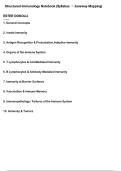
Structured Immunology Notebook (Syllabus → Janeway Mapping)
ESTER DOKOLLI
⸻
1. General Concepts
2. Innate Immunity
3. Antigen Recognition & Presentation,Adaptive immunity
4. Organs of the Immune System
5. T Lymphocytes & Cell-Mediated Immunity
6. B Lymphocytes & Antibody-Mediated Immunity
7. Immunity at Barrier Surfaces
8. Vaccination & Immune Memory
9. Immunopathology / Failures of the Immune System
10. Immunity & Tumors
, GENERAL CONCEPTS
• Immunity : the resistance to infectious disease
• Immune system:the collection of cells,tissues and molecules that mediate resistance to infections
• Immune response: the coordinated reaction of cells and molecules to infectious microbes comprises
• Immunology: the study of the immune system, including its responses to microbial pathogens,
damaged tissues and its role in disease.The immune system does more than provide protection
against infections.It prevents the growth of tumors, cancers by stimulating immune responses against
tumor cells, also participate in the clearance of dead cells and initiate tissue repair.
INNATE IMMUNITY
Is the first line of defense provided by epithelial barriers of the skin, mucosal tissues,cells and natural
antibiotics present in epithelia, all of which function to block the entry of microbes. If microbes reach
epithelia and enter the tissues or circulation, they are attacked by phagocytes, specialized lymphocytes.
In addition to providing early defense, innate responses enhance adaptive immune responses against
the infectious agent.
ADAPTIVE IMMUNITY
Consists of lymphocytes and their products, such as antibodies.Important for defense against infectious
microbes that are pathogenic for humans (capable of causing disease) and may have evolved to resist
innate immunity.The cells of adaptive immunity express receptors that specifically recognize a variety of
molecules produced by microbes as well as noninfectious substances. Any substance that is recognized
by lymphocytes or antibodies is called an antigen.Adaptive immune responses often use the cells and
molecules of the innate immune system to eliminate microbes, and adaptive immunity functions to
enhance these antimicrobial mechanisms of innate immunity.
, INNATE IMMUNITY
Most microbial invaders can be detected and destroyed within minutes or hours by its defense
mechanisms, using a limited number of proteins and receptors to detect infection and to distinguish
pathogens and host tissues.An infection starts when a pathogen reaches one of the host's anatomic
barriers. Some mechanisms start acting immediately,including several preformed soluble molecules
present in extracellular fluid, blood, and epithelial secretions,which can either kill the pathogen or
weaken its effect. Antimicrobial enzymes such as lysozyme digest bacterial cell walls, antimicrobial
peptides such as defensins-lyse bacterial membranes directly; and a system of plasma proteins known as
the complement system targets pathogens both for lysis and for phagocytosis.If these fail, innate
immune cells become activated by pattern-recognition receptors (PRRs) that detect molecules called
pathogen-associated molecular patterns (PAMPs).
Epithelial Barrier— is the frontline defense that separates the internal environment from the
outside,preventing invasion of pathogens. It has three main elements:
1.Physical barrier
•Epithelial cells are joined by tight junctions, desmosomes.
•Continuous renewal: damaged cells are shed and replaced, limiting colonization by microbes.
2.Chemical barrier
•Antimicrobial substances are secreted directly
•Lysozyme: breaks bacterial cell walls (present in saliva, tears, mucus).
•Acidic pH: stomach acid.
•Mucus: traps microbes,preventing them from reaching epithelial cells.
3.Biological barrier (microbiota)
•Produce substances (bacteriocins, short-chain fatty acids) that suppress invaders.
•Also “train” the immune system to tolerate harmless antigens while reacting strongly to pathogens
The innate system recognizes structures shared by microbes and respond to microbial molecules,that
stimulate innate immunity by pathogen-associated molecular patterns (PAMPs). The receptors that
recognize these structures are called pattern recognition receptors.This system recognizes molecules
released from damaged or necrotic host cells: damage-associated molecular patterns (DAMPs).The
responses to DAMPs serve to eliminate the damaged cells and to initiate tissue repair.The innate system
is very careful not to attack our healthy cells. BECAUSE OF
1.Receptor specificity-PRRs (pattern recognition receptors) recognize microbial patterns.
2.Location of receptors-Some receptors recognize DNA or RNA.To prevent this, they are placed in
“safe compartments,” like endosomes, where normal host nucleic acids don’t reach.
3.Regulatory molecules on host cells-Our healthy cells have “don’t attack me” signals.
, Components of Innate Immunity—Phagocytes: Neutrophils and Monocytes
The two types of phagocytes are blood cells recruited to sites of infection, where they recognize and
phagocytose microbes for intracellular killing.
• Neutrophils - The most abundant leukocytes in the blood (4,000-10,000 per µL).In response to
infections,the production of neutrophils from the bone marrow increases rapidly by cytokines.
Neutrophils engulf bacteria and fungi into phagosomes,which fuse with granules containing digestive
enzymes and reactive oxygen species, destroying microbes.They express receptors for products of
complement activation and for antibodies that coat microbes,enhancing phagocytosis and transducing
activating signals that enhance their ability to kill phagocytosed microbes.They live for only a few hours
in tissues,so they don’t provide prolonged defense.Neutrophils develop through the myeloid lineage.
• Monocytes-Less abundant in the blood (500-1,000 per µL),with a horseshoe-shaped nucleus.They
ingest microbes in blood and tissues.During inflammatory reactions, enter extravascular tissues and
differentiate into macrophages,which survive for long periodes.Some macrophages that reside in brain,
liver,lungs derive from progenitors in the yolk sac or fetal liver.In adults and during inflammatory
reactions:precursors in the bone marrow give rise to circulating monocytes, which enter peripheral
tissues, mature to form macrophages.When a microbe penetrate in tissues-Macrophages are activated
by microbial products binding to TLRs and by cytokines,producing proteins that mediate inflammatory
functions of cells.
Macrophages may be activated by two pathways:
• Classical activation-induced by innate immune signals—TLRs,cytokine IFN-γ, produced in both
innate and adaptive immune responses.They are called M1 and are involved in destroying microbes
and in triggering inflammation.
• Alternative activation-occurs in the absence of strong TLR signals and is induced by the cytokines IL-4
and IL-13. These macrophages called M2,are important for tissue repair and to terminate
inflammation.
Antigen-Presenting Cells (APCs)
APCs are immune cells that can capture antigens, process and display them on their surface bound to
MHC molecules for recognition by T lymphocytes.They connect innate immunity (detecting microbes)
with adaptive immunity (activating T cells).
• Dendritic cells-capture protein antigens of microbes entering through the epithelia and transport
them to regional lymph nodes, where the antigen-bearing DC display portions of the antigens for
recognition by T lymphocytes.
ESTER DOKOLLI
⸻
1. General Concepts
2. Innate Immunity
3. Antigen Recognition & Presentation,Adaptive immunity
4. Organs of the Immune System
5. T Lymphocytes & Cell-Mediated Immunity
6. B Lymphocytes & Antibody-Mediated Immunity
7. Immunity at Barrier Surfaces
8. Vaccination & Immune Memory
9. Immunopathology / Failures of the Immune System
10. Immunity & Tumors
, GENERAL CONCEPTS
• Immunity : the resistance to infectious disease
• Immune system:the collection of cells,tissues and molecules that mediate resistance to infections
• Immune response: the coordinated reaction of cells and molecules to infectious microbes comprises
• Immunology: the study of the immune system, including its responses to microbial pathogens,
damaged tissues and its role in disease.The immune system does more than provide protection
against infections.It prevents the growth of tumors, cancers by stimulating immune responses against
tumor cells, also participate in the clearance of dead cells and initiate tissue repair.
INNATE IMMUNITY
Is the first line of defense provided by epithelial barriers of the skin, mucosal tissues,cells and natural
antibiotics present in epithelia, all of which function to block the entry of microbes. If microbes reach
epithelia and enter the tissues or circulation, they are attacked by phagocytes, specialized lymphocytes.
In addition to providing early defense, innate responses enhance adaptive immune responses against
the infectious agent.
ADAPTIVE IMMUNITY
Consists of lymphocytes and their products, such as antibodies.Important for defense against infectious
microbes that are pathogenic for humans (capable of causing disease) and may have evolved to resist
innate immunity.The cells of adaptive immunity express receptors that specifically recognize a variety of
molecules produced by microbes as well as noninfectious substances. Any substance that is recognized
by lymphocytes or antibodies is called an antigen.Adaptive immune responses often use the cells and
molecules of the innate immune system to eliminate microbes, and adaptive immunity functions to
enhance these antimicrobial mechanisms of innate immunity.
, INNATE IMMUNITY
Most microbial invaders can be detected and destroyed within minutes or hours by its defense
mechanisms, using a limited number of proteins and receptors to detect infection and to distinguish
pathogens and host tissues.An infection starts when a pathogen reaches one of the host's anatomic
barriers. Some mechanisms start acting immediately,including several preformed soluble molecules
present in extracellular fluid, blood, and epithelial secretions,which can either kill the pathogen or
weaken its effect. Antimicrobial enzymes such as lysozyme digest bacterial cell walls, antimicrobial
peptides such as defensins-lyse bacterial membranes directly; and a system of plasma proteins known as
the complement system targets pathogens both for lysis and for phagocytosis.If these fail, innate
immune cells become activated by pattern-recognition receptors (PRRs) that detect molecules called
pathogen-associated molecular patterns (PAMPs).
Epithelial Barrier— is the frontline defense that separates the internal environment from the
outside,preventing invasion of pathogens. It has three main elements:
1.Physical barrier
•Epithelial cells are joined by tight junctions, desmosomes.
•Continuous renewal: damaged cells are shed and replaced, limiting colonization by microbes.
2.Chemical barrier
•Antimicrobial substances are secreted directly
•Lysozyme: breaks bacterial cell walls (present in saliva, tears, mucus).
•Acidic pH: stomach acid.
•Mucus: traps microbes,preventing them from reaching epithelial cells.
3.Biological barrier (microbiota)
•Produce substances (bacteriocins, short-chain fatty acids) that suppress invaders.
•Also “train” the immune system to tolerate harmless antigens while reacting strongly to pathogens
The innate system recognizes structures shared by microbes and respond to microbial molecules,that
stimulate innate immunity by pathogen-associated molecular patterns (PAMPs). The receptors that
recognize these structures are called pattern recognition receptors.This system recognizes molecules
released from damaged or necrotic host cells: damage-associated molecular patterns (DAMPs).The
responses to DAMPs serve to eliminate the damaged cells and to initiate tissue repair.The innate system
is very careful not to attack our healthy cells. BECAUSE OF
1.Receptor specificity-PRRs (pattern recognition receptors) recognize microbial patterns.
2.Location of receptors-Some receptors recognize DNA or RNA.To prevent this, they are placed in
“safe compartments,” like endosomes, where normal host nucleic acids don’t reach.
3.Regulatory molecules on host cells-Our healthy cells have “don’t attack me” signals.
, Components of Innate Immunity—Phagocytes: Neutrophils and Monocytes
The two types of phagocytes are blood cells recruited to sites of infection, where they recognize and
phagocytose microbes for intracellular killing.
• Neutrophils - The most abundant leukocytes in the blood (4,000-10,000 per µL).In response to
infections,the production of neutrophils from the bone marrow increases rapidly by cytokines.
Neutrophils engulf bacteria and fungi into phagosomes,which fuse with granules containing digestive
enzymes and reactive oxygen species, destroying microbes.They express receptors for products of
complement activation and for antibodies that coat microbes,enhancing phagocytosis and transducing
activating signals that enhance their ability to kill phagocytosed microbes.They live for only a few hours
in tissues,so they don’t provide prolonged defense.Neutrophils develop through the myeloid lineage.
• Monocytes-Less abundant in the blood (500-1,000 per µL),with a horseshoe-shaped nucleus.They
ingest microbes in blood and tissues.During inflammatory reactions, enter extravascular tissues and
differentiate into macrophages,which survive for long periodes.Some macrophages that reside in brain,
liver,lungs derive from progenitors in the yolk sac or fetal liver.In adults and during inflammatory
reactions:precursors in the bone marrow give rise to circulating monocytes, which enter peripheral
tissues, mature to form macrophages.When a microbe penetrate in tissues-Macrophages are activated
by microbial products binding to TLRs and by cytokines,producing proteins that mediate inflammatory
functions of cells.
Macrophages may be activated by two pathways:
• Classical activation-induced by innate immune signals—TLRs,cytokine IFN-γ, produced in both
innate and adaptive immune responses.They are called M1 and are involved in destroying microbes
and in triggering inflammation.
• Alternative activation-occurs in the absence of strong TLR signals and is induced by the cytokines IL-4
and IL-13. These macrophages called M2,are important for tissue repair and to terminate
inflammation.
Antigen-Presenting Cells (APCs)
APCs are immune cells that can capture antigens, process and display them on their surface bound to
MHC molecules for recognition by T lymphocytes.They connect innate immunity (detecting microbes)
with adaptive immunity (activating T cells).
• Dendritic cells-capture protein antigens of microbes entering through the epithelia and transport
them to regional lymph nodes, where the antigen-bearing DC display portions of the antigens for
recognition by T lymphocytes.


