

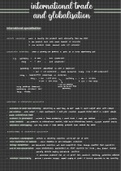
absolute advantage : when a country can produce more efficiently than the other
↳ can produce more with same amount of resources
↳ can produce same amount with less resources
comparative advantage : when a country can produce a good at a lower opportunity cost
4 cars 400 chemicals
e.
g germany
=
.
,
I chemicals
Italy car 200
=
,
germany
-
absolute advantage in cars d chemicals
I car =
100 chemicals
,
fewer resources ( Italy 1 car = 200 chemicals )
Haly
-
comparative advantage in chemicals
Italy 200 Chem 100 Chem
I car =
germany l car =
- -
4 car = 800 Chem
) 4 car = 400 Chem
I cur can produce
chemicals than
Italy produce chemicals more
germany produce cars germany
they trade
advantages of international specialisation
-
economies of scale and efficiency :
specialising in what they do best leads to more output while costs reduce
-
job creation :
more output = more investments = more jobs created .
requires skilled labour so higher wages
-
more international trade
to government a trade increasing taxes high
-
revenue : income =
more =
gov revenue & profits
.
Wider markets :
sell products to international market , helps build international brands , increase market shares
buy cheap & high quality products from around the world
sovereignty
- :
consumer can
disadvantages of international specialisation
structural unemployment workers declining industries will be put out of work
- :
in
-
over -
exploitation of resources :
cause depletion of non -
renewable resources
-
foreign competition :
non specialised industries will have competition from foreign countries that specialises
-
risk of over -
specialisation :
more international dependence on other countries for trade any global change
,
greatly affects highly specialised countries
↳ petroleum demand fall as oil prices fall , countries
exporting petroleum affected
-
strategic vulnerability
:
political 1 economic changes impact supply of goods & services available to the country
, multinational corporations ( MNCs ) :
businesses which have their operations , factories d assembly plants in more
than one country Starbucks adidas
e.
g .
,
advantages disadvantages
creates opportunities for home country transfer
marketing capital to host countries cause
- .
,
products produced in home country unfavourable balance of payments
throughout the world .
may not create jobs if employs labour from
-
create employment opportunities other countries , due to lower cost I better skill
-
aids & encourages economic growth & development .
investments in foreign countries more profitable ,
-
maintain balance of payments from exports may neglect its industrial & economic dev .
-
provides employment & training h hhtries .
domestic businesses may not be able
-
tranter of skills d expertise to compete with MNC 's
contributes to GDP spending act ethically socially responsible
.
-
through may not or in a
↳ from local suppliers or capital investment way ,
take advantage of weaker countries
-
competition from MNCs is incentive for domestic .
may be accused of imposing their culture
firms to improve competitiveness & efficiency .
profits earned may be remitted back to home
-
extend consumer & business choice country
brings efficient business practices technologies d '
of transfer other tax avoidance
make use pricing 1
-
,
standards from countries , influence Industries measures to reduce the profits in which they
-
source of significant tax revenues pay tax to gov in host country
→ the use of trade barriers by government to restrict international market
Free trade & Protection access a competition
↳ no restrictions for trade between economies
advantages disadvantages
-
allows countries to benefit from specialisation
.
reduce opportunities for growth in LE Dcs ,
cant
↳ or else ,
have to produce everything themselves , compete with larger firms
cost increase while output decrease .
threaten jobs in developed economies ,
lose
-
increase consumer choice market shares as new firms enter market
-
increase competition &
efficiency
.
rapid resource depletion a climate change
-
new business opportunities , sell goods overseas .
exploitation of workers & environment
.
enables firms to benefit from the best workforces ,
-
income inequality ,
rich gets richer
resources & technologies from around the world
-
increase economic interdependency , fosters
cooperation ,
reduces international conflicts
↳ can produce more with same amount of resources
↳ can produce same amount with less resources
comparative advantage : when a country can produce a good at a lower opportunity cost
4 cars 400 chemicals
e.
g germany
=
.
,
I chemicals
Italy car 200
=
,
germany
-
absolute advantage in cars d chemicals
I car =
100 chemicals
,
fewer resources ( Italy 1 car = 200 chemicals )
Haly
-
comparative advantage in chemicals
Italy 200 Chem 100 Chem
I car =
germany l car =
- -
4 car = 800 Chem
) 4 car = 400 Chem
I cur can produce
chemicals than
Italy produce chemicals more
germany produce cars germany
they trade
advantages of international specialisation
-
economies of scale and efficiency :
specialising in what they do best leads to more output while costs reduce
-
job creation :
more output = more investments = more jobs created .
requires skilled labour so higher wages
-
more international trade
to government a trade increasing taxes high
-
revenue : income =
more =
gov revenue & profits
.
Wider markets :
sell products to international market , helps build international brands , increase market shares
buy cheap & high quality products from around the world
sovereignty
- :
consumer can
disadvantages of international specialisation
structural unemployment workers declining industries will be put out of work
- :
in
-
over -
exploitation of resources :
cause depletion of non -
renewable resources
-
foreign competition :
non specialised industries will have competition from foreign countries that specialises
-
risk of over -
specialisation :
more international dependence on other countries for trade any global change
,
greatly affects highly specialised countries
↳ petroleum demand fall as oil prices fall , countries
exporting petroleum affected
-
strategic vulnerability
:
political 1 economic changes impact supply of goods & services available to the country
, multinational corporations ( MNCs ) :
businesses which have their operations , factories d assembly plants in more
than one country Starbucks adidas
e.
g .
,
advantages disadvantages
creates opportunities for home country transfer
marketing capital to host countries cause
- .
,
products produced in home country unfavourable balance of payments
throughout the world .
may not create jobs if employs labour from
-
create employment opportunities other countries , due to lower cost I better skill
-
aids & encourages economic growth & development .
investments in foreign countries more profitable ,
-
maintain balance of payments from exports may neglect its industrial & economic dev .
-
provides employment & training h hhtries .
domestic businesses may not be able
-
tranter of skills d expertise to compete with MNC 's
contributes to GDP spending act ethically socially responsible
.
-
through may not or in a
↳ from local suppliers or capital investment way ,
take advantage of weaker countries
-
competition from MNCs is incentive for domestic .
may be accused of imposing their culture
firms to improve competitiveness & efficiency .
profits earned may be remitted back to home
-
extend consumer & business choice country
brings efficient business practices technologies d '
of transfer other tax avoidance
make use pricing 1
-
,
standards from countries , influence Industries measures to reduce the profits in which they
-
source of significant tax revenues pay tax to gov in host country
→ the use of trade barriers by government to restrict international market
Free trade & Protection access a competition
↳ no restrictions for trade between economies
advantages disadvantages
-
allows countries to benefit from specialisation
.
reduce opportunities for growth in LE Dcs ,
cant
↳ or else ,
have to produce everything themselves , compete with larger firms
cost increase while output decrease .
threaten jobs in developed economies ,
lose
-
increase consumer choice market shares as new firms enter market
-
increase competition &
efficiency
.
rapid resource depletion a climate change
-
new business opportunities , sell goods overseas .
exploitation of workers & environment
.
enables firms to benefit from the best workforces ,
-
income inequality ,
rich gets richer
resources & technologies from around the world
-
increase economic interdependency , fosters
cooperation ,
reduces international conflicts


