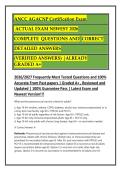
ANCC AGACNP Certification Exam
ACTUAL EXAM NEWEST 2026
COMPLETE QUESTIONS AND CORRECT
DETAILED ANSWERS
(VERIFIED ANSWERS) |ALREADY
GRADED A+
2026/2027 Frequently Most Tested Questions and 100%
Accurate From Past papers | Graded A+ , Reviewed and
Updated | 100% Guarantee Pass | Latest Exam and
Newest Version!!!
What are the pneumococcal vaccine criteria for adults?
a. Age 19-64: smokers, asthma, COPD, diabetes, alcohol use, immunocompromised, or in
a long-term care facility. Age 65+: PPSV23 and PCV13.
b. Age 19-64: all adults regardless of risk factors. Age 65+: PPSV23 only.
c. Age 19-64: only immunocompromised adults. Age 65+: PCV13 only.
d. Age 19-64: only adults with chronic lung disease. Age 65+: no vaccination needed.
✔️ Correct Answer: A
Rationale: Pneumococcal vaccines protect against invasive pneumococcal disease and
pneumonia. Adults with chronic illnesses, lifestyle risks, or immunocompromise are
prioritized for vaccination before age 65. After 65, dual vaccination with PPSV23 and
PCV13 is recommended for enhanced protection. Option B is incorrect as not all adults
require vaccination before age 65. Option C is incorrect as it omits other high-risk
groups. Option D is incorrect as vaccination is recommended for all adults over 65.
,NCLEX focus: Immunizations. DIF: Knowledge. REF: Infectious Disease Prevention. OBJ:
Identify pneumococcal vaccine criteria. TOP: Health Promotion and Maintenance.
How often should a physical exam be performed?
a. Once from ages 11-21, every 5-6 years from 20-59, every 2 years from 60+
b. Annually for all adults
c. Every 3 years for adults 18-50, annually after 50
d. Only when symptomatic
✔️ Correct Answer: A
Rationale: Preventive care frequency varies by age to balance early detection of diseases
and efficient resource use. Younger adults require fewer exams, while older adults
benefit from more frequent evaluations due to increased health risks. Option B is
incorrect as annual exams for all adults are not evidence-based. Option C is incorrect as
the intervals are not standard. Option D is incorrect as preventive exams are important
for early detection. NCLEX focus: Preventive care. DIF: Knowledge. REF: Health
Maintenance. OBJ: Identify physical exam frequency. TOP: Health Promotion and
Maintenance.
When should lipid panels be checked?
a. Start at age 20, every 5 years unless LDL > 200 mg/dL
b. Start at age 30, every 10 years
c. Start at age 40, every 2 years
d. Only if family history of heart disease
✔️ Correct Answer: A
Rationale: Lipid screening helps identify individuals at risk for cardiovascular disease.
Early detection allows for lifestyle interventions or pharmacologic therapy to reduce
long-term morbidity and mortality. Option B is incorrect as screening should start earlier.
Option C is incorrect as screening intervals are longer. Option D is incorrect as universal
screening is recommended. NCLEX focus: Cardiovascular risk assessment. DIF:
,Knowledge. REF: Lipid Management. OBJ: Identify lipid screening guidelines. TOP: Health
Promotion and Maintenance.
When should mammography and prostate cancer screening begin?
a. Mammography: 40-50; Prostate: 40 if African American with family history, otherwise
50
b. Mammography: 50; Prostate: 55 for all men
c. Mammography: 35; Prostate: 45 for all men
d. Mammography: 45; Prostate: 50 for all men
✔️ Correct Answer: A
Rationale: Early detection through age-appropriate screening improves cancer survival.
Risk stratification ensures higher-risk populations receive earlier screening for timely
intervention. Option B is incorrect as mammography can start at 40. Option C is incorrect
as screening starts later. Option D is incorrect as risk-based screening is recommended.
NCLEX focus: Cancer screening. DIF: Knowledge. REF: Cancer Prevention. OBJ: Identify
screening guidelines. TOP: Health Promotion and Maintenance.
When should a baseline ECG be performed?
a. At age 40
b. At age 50
c. At age 30
d. Only if symptomatic
✔️ Correct Answer: A
Rationale: Baseline ECGs at midlife help detect asymptomatic cardiac abnormalities and
establish a reference for future cardiac evaluations. Option B is incorrect as screening
starts earlier. Option C is incorrect as screening typically starts at 40. Option D is
incorrect as baseline screening is recommended. NCLEX focus: Cardiac assessment. DIF:
Knowledge. REF: Cardiovascular Screening. OBJ: Identify ECG screening guidelines. TOP:
Health Promotion and Maintenance.
, When should colorectal cancer screening begin?
a. Start at age 50; FOBT annually and colonoscopy every 10 years
b. Start at age 40; FOBT every 2 years
c. Start at age 60; colonoscopy every 5 years
d. Start at age 45; only colonoscopy
✔️ Correct Answer: A
Rationale: Early screening improves detection and prevention of colorectal cancer. FOBT
detects occult blood, while colonoscopy allows visualization and polyp removal, reducing
cancer incidence. Option B is incorrect as screening starts at 50. Option C is incorrect as
screening starts earlier. Option D is incorrect as multiple screening options exist. NCLEX
focus: Cancer screening. DIF: Knowledge. REF: Colorectal Cancer Prevention. OBJ: Identify
screening guidelines. TOP: Health Promotion and Maintenance.
When should glaucoma testing start?
a. At age 40 and yearly
b. At age 50 and every 2 years
c. At age 60 and every 5 years
d. Only if symptomatic
✔️ Correct Answer: A
Rationale: Early detection of glaucoma through annual eye exams can prevent
progressive vision loss, as the disease is often asymptomatic until advanced stages.
Option B is incorrect as testing should start at 40. Option C is incorrect as testing should
be yearly. Option D is incorrect as screening is recommended for early detection. NCLEX
focus: Vision screening. DIF: Knowledge. REF: Eye Health. OBJ: Identify glaucoma
screening guidelines. TOP: Health Promotion and Maintenance.
When is the herpes zoster vaccine recommended?
ACTUAL EXAM NEWEST 2026
COMPLETE QUESTIONS AND CORRECT
DETAILED ANSWERS
(VERIFIED ANSWERS) |ALREADY
GRADED A+
2026/2027 Frequently Most Tested Questions and 100%
Accurate From Past papers | Graded A+ , Reviewed and
Updated | 100% Guarantee Pass | Latest Exam and
Newest Version!!!
What are the pneumococcal vaccine criteria for adults?
a. Age 19-64: smokers, asthma, COPD, diabetes, alcohol use, immunocompromised, or in
a long-term care facility. Age 65+: PPSV23 and PCV13.
b. Age 19-64: all adults regardless of risk factors. Age 65+: PPSV23 only.
c. Age 19-64: only immunocompromised adults. Age 65+: PCV13 only.
d. Age 19-64: only adults with chronic lung disease. Age 65+: no vaccination needed.
✔️ Correct Answer: A
Rationale: Pneumococcal vaccines protect against invasive pneumococcal disease and
pneumonia. Adults with chronic illnesses, lifestyle risks, or immunocompromise are
prioritized for vaccination before age 65. After 65, dual vaccination with PPSV23 and
PCV13 is recommended for enhanced protection. Option B is incorrect as not all adults
require vaccination before age 65. Option C is incorrect as it omits other high-risk
groups. Option D is incorrect as vaccination is recommended for all adults over 65.
,NCLEX focus: Immunizations. DIF: Knowledge. REF: Infectious Disease Prevention. OBJ:
Identify pneumococcal vaccine criteria. TOP: Health Promotion and Maintenance.
How often should a physical exam be performed?
a. Once from ages 11-21, every 5-6 years from 20-59, every 2 years from 60+
b. Annually for all adults
c. Every 3 years for adults 18-50, annually after 50
d. Only when symptomatic
✔️ Correct Answer: A
Rationale: Preventive care frequency varies by age to balance early detection of diseases
and efficient resource use. Younger adults require fewer exams, while older adults
benefit from more frequent evaluations due to increased health risks. Option B is
incorrect as annual exams for all adults are not evidence-based. Option C is incorrect as
the intervals are not standard. Option D is incorrect as preventive exams are important
for early detection. NCLEX focus: Preventive care. DIF: Knowledge. REF: Health
Maintenance. OBJ: Identify physical exam frequency. TOP: Health Promotion and
Maintenance.
When should lipid panels be checked?
a. Start at age 20, every 5 years unless LDL > 200 mg/dL
b. Start at age 30, every 10 years
c. Start at age 40, every 2 years
d. Only if family history of heart disease
✔️ Correct Answer: A
Rationale: Lipid screening helps identify individuals at risk for cardiovascular disease.
Early detection allows for lifestyle interventions or pharmacologic therapy to reduce
long-term morbidity and mortality. Option B is incorrect as screening should start earlier.
Option C is incorrect as screening intervals are longer. Option D is incorrect as universal
screening is recommended. NCLEX focus: Cardiovascular risk assessment. DIF:
,Knowledge. REF: Lipid Management. OBJ: Identify lipid screening guidelines. TOP: Health
Promotion and Maintenance.
When should mammography and prostate cancer screening begin?
a. Mammography: 40-50; Prostate: 40 if African American with family history, otherwise
50
b. Mammography: 50; Prostate: 55 for all men
c. Mammography: 35; Prostate: 45 for all men
d. Mammography: 45; Prostate: 50 for all men
✔️ Correct Answer: A
Rationale: Early detection through age-appropriate screening improves cancer survival.
Risk stratification ensures higher-risk populations receive earlier screening for timely
intervention. Option B is incorrect as mammography can start at 40. Option C is incorrect
as screening starts later. Option D is incorrect as risk-based screening is recommended.
NCLEX focus: Cancer screening. DIF: Knowledge. REF: Cancer Prevention. OBJ: Identify
screening guidelines. TOP: Health Promotion and Maintenance.
When should a baseline ECG be performed?
a. At age 40
b. At age 50
c. At age 30
d. Only if symptomatic
✔️ Correct Answer: A
Rationale: Baseline ECGs at midlife help detect asymptomatic cardiac abnormalities and
establish a reference for future cardiac evaluations. Option B is incorrect as screening
starts earlier. Option C is incorrect as screening typically starts at 40. Option D is
incorrect as baseline screening is recommended. NCLEX focus: Cardiac assessment. DIF:
Knowledge. REF: Cardiovascular Screening. OBJ: Identify ECG screening guidelines. TOP:
Health Promotion and Maintenance.
, When should colorectal cancer screening begin?
a. Start at age 50; FOBT annually and colonoscopy every 10 years
b. Start at age 40; FOBT every 2 years
c. Start at age 60; colonoscopy every 5 years
d. Start at age 45; only colonoscopy
✔️ Correct Answer: A
Rationale: Early screening improves detection and prevention of colorectal cancer. FOBT
detects occult blood, while colonoscopy allows visualization and polyp removal, reducing
cancer incidence. Option B is incorrect as screening starts at 50. Option C is incorrect as
screening starts earlier. Option D is incorrect as multiple screening options exist. NCLEX
focus: Cancer screening. DIF: Knowledge. REF: Colorectal Cancer Prevention. OBJ: Identify
screening guidelines. TOP: Health Promotion and Maintenance.
When should glaucoma testing start?
a. At age 40 and yearly
b. At age 50 and every 2 years
c. At age 60 and every 5 years
d. Only if symptomatic
✔️ Correct Answer: A
Rationale: Early detection of glaucoma through annual eye exams can prevent
progressive vision loss, as the disease is often asymptomatic until advanced stages.
Option B is incorrect as testing should start at 40. Option C is incorrect as testing should
be yearly. Option D is incorrect as screening is recommended for early detection. NCLEX
focus: Vision screening. DIF: Knowledge. REF: Eye Health. OBJ: Identify glaucoma
screening guidelines. TOP: Health Promotion and Maintenance.
When is the herpes zoster vaccine recommended?