

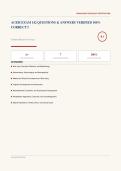
BRAIN INJURY SPECIALIST CERTIFICATION
ACBIS EXAM 142 QUESTIONS & ANSWERS VERIFIED 100%
CORRECT!!
A+
Complete Blueprint Coverage
A+ 7 100%
QUESTIONS VERIFIED EXAM DOMAINS COVERED RATIONALES INCLUDED
CATEGORIES
Brain Injury Overview, Definitions, and Epidemiology
Neuroanatomy, Neuroimaging, and Neuroplasticity
Medical and Physical Consequences of Brain Injury
Cognitive Consequences and Assessment
Neurobehavioral, Psychiatric, and Psychosocial Consequences
Rehabilitation Approaches, Outcomes, and Care Management
Special Populations, Families, Ethics, and Cultural Issues
STUVIAACTUALEXAM
,SECTION: BRAIN INJURY OVERVIEW, DEFINITIONS, AND EPIDEMIOLOGY
Q1.
A rehabilitation specialist is reviewing a new patient's history. The patient sustained a brain injury from a hypoxic event following cardiac
arrest, with no external trauma to the head. How should this injury be classified?
A. Acquired brain injury (ABI) that is non-traumatic
B. Traumatic brain injury (TBI) because all brain injuries are traumatic
C. Congenital brain injury present from birth
D. Progressive neurodegenerative disease only
Correct Answer: A
Rationale:
Hypoxic-ischemic injury without external mechanical force is classified as non-traumatic acquired brain injury. TBI requires external trauma; congenital and
progressive neurodegenerative conditions are distinct.
Q2.
A clinician is educating a family about the Glasgow Coma Scale (GCS) score recorded at the scene. The patient's best eye, verbal, and motor
responses totaled 9. How is this severity typically categorized?
A. Moderate brain injury
B. Mild brain injury
C. Severe brain injury
D. No brain injury
Correct Answer: A
Rationale:
GCS 9-12 is conventionally classified as moderate. Mild is typically 13-15; severe is 8 or less.
Q3.
During a community education session the specialist cites the leading cause of traumatic brain injury in older adults in the United States.
Which cause is most accurate?
A. Falls
B. Motor-vehicle crashes exclusively
C. Assaults as the primary mechanism
D. Sports-related concussions only
Correct Answer: A
Rationale:
Falls are the leading cause of TBI among older adults. Motor-vehicle crashes are more prominent in younger age groups; assaults and sports contribute smaller
proportions overall.
Q4.
A patient is described as having a 'mild' TBI. The specialist knows that loss of consciousness, if present, must have been limited to which
duration to remain within common mild-TBI criteria?
A. Less than 30 minutes
B. Between 1 and 6 hours
C. More than 24 hours
D. Any duration is still considered mild
Correct Answer: A
Rationale:
Common definitions of mild TBI limit loss of consciousness to under 30 minutes. Longer periods typically move the injury into moderate or severe categories.
Q5.
The specialist is explaining the concept of the 'silent epidemic' of brain injury to a new staff member. What does this phrase primarily
emphasize?
A. Many brain injuries go unrecognized or are under-reported, leading to unmet needs
B. Brain injury occurs only in silence without any external signs
C. All brain injuries are immediately obvious and therefore not silent
D. The term refers exclusively to disorders of consciousness
Correct Answer: A
Rationale:
The 'silent epidemic' highlights that many TBIs, especially mild ones, are not identified or reported, resulting in individuals who do not receive needed services.
, Q6.
A facility is preparing for accreditation under standards that emphasize community integration for persons with disabilities. Which landmark
legal decision is most closely associated with the right to receive services in the least restrictive community setting?
A. Olmstead v. L.C.
B. Brown v. Board of Education
C. Roe v. Wade
D. Miranda v. Arizona
Correct Answer: A
Rationale:
The Olmstead decision affirmed that unjustified segregation of persons with disabilities constitutes discrimination and supports community-based services when
appropriate.
Q7.
A patient remains in a vegetative state 4 weeks after a severe TBI. The specialist is asked about the timeline for the term 'persistent
vegetative state.' When is the term typically applied?
A. When the vegetative state has continued for approximately 1 month
B. Immediately after the injury regardless of duration
C. Only after 1 year in all cases
D. Only if the patient shows intermittent awareness
Correct Answer: A
Rationale:
By common convention a vegetative state lasting about 1 month is termed persistent. Longer durations may be called permanent under specific criteria.
Q8.
The Model Systems of Care for TBI are funded to provide which combination of services?
A. Coordinated acute care, rehabilitation, and long-term follow-up research and services
B. Only emergency department evaluation without rehabilitation
C. Outpatient counseling exclusively
D. Military-only trauma care
Correct Answer: A
Rationale:
TBI Model Systems offer comprehensive, coordinated care from acute hospitalization through rehabilitation and longitudinal research follow-up.
Q9.
A specialist is reviewing incidence data. Which age group has historically shown one of the highest rates of TBI-related emergency
department visits?
A. Young children (0-4 years) and older adolescents/young adults
B. Only middle-aged adults 40-50 years
C. Only adults over 80 with no other peaks
D. School-age children 8-10 years exclusively
Correct Answer: A
Rationale:
Incidence peaks in early childhood and again in late adolescence/young adulthood, with another elevation in older adults due to falls.
Q10.
A patient with a history of multiple concussions is concerned about long-term risk. The specialist discusses the potential for which progressive
neurodegenerative condition associated with repetitive brain trauma?
A. Chronic traumatic encephalopathy (CTE)
B. Amyotrophic lateral sclerosis exclusively
C. Multiple sclerosis as the primary risk
D. Huntington's disease
Correct Answer: A
Rationale:
CTE has been linked to repetitive head trauma. While research continues, it is the condition most specifically associated with this history in current literature.
ACBIS EXAM 142 QUESTIONS & ANSWERS VERIFIED 100% C... STUVIAACTUALEXAM
ACBIS EXAM 142 QUESTIONS & ANSWERS VERIFIED 100%
CORRECT!!
A+
Complete Blueprint Coverage
A+ 7 100%
QUESTIONS VERIFIED EXAM DOMAINS COVERED RATIONALES INCLUDED
CATEGORIES
Brain Injury Overview, Definitions, and Epidemiology
Neuroanatomy, Neuroimaging, and Neuroplasticity
Medical and Physical Consequences of Brain Injury
Cognitive Consequences and Assessment
Neurobehavioral, Psychiatric, and Psychosocial Consequences
Rehabilitation Approaches, Outcomes, and Care Management
Special Populations, Families, Ethics, and Cultural Issues
STUVIAACTUALEXAM
,SECTION: BRAIN INJURY OVERVIEW, DEFINITIONS, AND EPIDEMIOLOGY
Q1.
A rehabilitation specialist is reviewing a new patient's history. The patient sustained a brain injury from a hypoxic event following cardiac
arrest, with no external trauma to the head. How should this injury be classified?
A. Acquired brain injury (ABI) that is non-traumatic
B. Traumatic brain injury (TBI) because all brain injuries are traumatic
C. Congenital brain injury present from birth
D. Progressive neurodegenerative disease only
Correct Answer: A
Rationale:
Hypoxic-ischemic injury without external mechanical force is classified as non-traumatic acquired brain injury. TBI requires external trauma; congenital and
progressive neurodegenerative conditions are distinct.
Q2.
A clinician is educating a family about the Glasgow Coma Scale (GCS) score recorded at the scene. The patient's best eye, verbal, and motor
responses totaled 9. How is this severity typically categorized?
A. Moderate brain injury
B. Mild brain injury
C. Severe brain injury
D. No brain injury
Correct Answer: A
Rationale:
GCS 9-12 is conventionally classified as moderate. Mild is typically 13-15; severe is 8 or less.
Q3.
During a community education session the specialist cites the leading cause of traumatic brain injury in older adults in the United States.
Which cause is most accurate?
A. Falls
B. Motor-vehicle crashes exclusively
C. Assaults as the primary mechanism
D. Sports-related concussions only
Correct Answer: A
Rationale:
Falls are the leading cause of TBI among older adults. Motor-vehicle crashes are more prominent in younger age groups; assaults and sports contribute smaller
proportions overall.
Q4.
A patient is described as having a 'mild' TBI. The specialist knows that loss of consciousness, if present, must have been limited to which
duration to remain within common mild-TBI criteria?
A. Less than 30 minutes
B. Between 1 and 6 hours
C. More than 24 hours
D. Any duration is still considered mild
Correct Answer: A
Rationale:
Common definitions of mild TBI limit loss of consciousness to under 30 minutes. Longer periods typically move the injury into moderate or severe categories.
Q5.
The specialist is explaining the concept of the 'silent epidemic' of brain injury to a new staff member. What does this phrase primarily
emphasize?
A. Many brain injuries go unrecognized or are under-reported, leading to unmet needs
B. Brain injury occurs only in silence without any external signs
C. All brain injuries are immediately obvious and therefore not silent
D. The term refers exclusively to disorders of consciousness
Correct Answer: A
Rationale:
The 'silent epidemic' highlights that many TBIs, especially mild ones, are not identified or reported, resulting in individuals who do not receive needed services.
, Q6.
A facility is preparing for accreditation under standards that emphasize community integration for persons with disabilities. Which landmark
legal decision is most closely associated with the right to receive services in the least restrictive community setting?
A. Olmstead v. L.C.
B. Brown v. Board of Education
C. Roe v. Wade
D. Miranda v. Arizona
Correct Answer: A
Rationale:
The Olmstead decision affirmed that unjustified segregation of persons with disabilities constitutes discrimination and supports community-based services when
appropriate.
Q7.
A patient remains in a vegetative state 4 weeks after a severe TBI. The specialist is asked about the timeline for the term 'persistent
vegetative state.' When is the term typically applied?
A. When the vegetative state has continued for approximately 1 month
B. Immediately after the injury regardless of duration
C. Only after 1 year in all cases
D. Only if the patient shows intermittent awareness
Correct Answer: A
Rationale:
By common convention a vegetative state lasting about 1 month is termed persistent. Longer durations may be called permanent under specific criteria.
Q8.
The Model Systems of Care for TBI are funded to provide which combination of services?
A. Coordinated acute care, rehabilitation, and long-term follow-up research and services
B. Only emergency department evaluation without rehabilitation
C. Outpatient counseling exclusively
D. Military-only trauma care
Correct Answer: A
Rationale:
TBI Model Systems offer comprehensive, coordinated care from acute hospitalization through rehabilitation and longitudinal research follow-up.
Q9.
A specialist is reviewing incidence data. Which age group has historically shown one of the highest rates of TBI-related emergency
department visits?
A. Young children (0-4 years) and older adolescents/young adults
B. Only middle-aged adults 40-50 years
C. Only adults over 80 with no other peaks
D. School-age children 8-10 years exclusively
Correct Answer: A
Rationale:
Incidence peaks in early childhood and again in late adolescence/young adulthood, with another elevation in older adults due to falls.
Q10.
A patient with a history of multiple concussions is concerned about long-term risk. The specialist discusses the potential for which progressive
neurodegenerative condition associated with repetitive brain trauma?
A. Chronic traumatic encephalopathy (CTE)
B. Amyotrophic lateral sclerosis exclusively
C. Multiple sclerosis as the primary risk
D. Huntington's disease
Correct Answer: A
Rationale:
CTE has been linked to repetitive head trauma. While research continues, it is the condition most specifically associated with this history in current literature.
ACBIS EXAM 142 QUESTIONS & ANSWERS VERIFIED 100% C... STUVIAACTUALEXAM


