

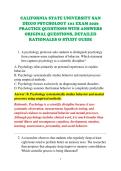
CALIFORNIA STATE UNIVERSITY SAN
DIEGO PSYCHOLOGY 101 EXAM 2026
PRACTICE QUESTIONS WITH ANSWERS
ORIGINAL QUESTIONS, DETAILED
RATIONALES & STUDY GUIDE
1. A psychology professor asks students to distinguish psychology
from common-sense explanations of behavior. Which statement
best captures psychology as a scientific discipline?
A. Psychology relies primarily on personal experiences to explain
behavior.
B. Psychology systematically studies behavior and mental processes
using empirical methods.
C. Psychology focuses exclusively on diagnosing mental disorders.
D. Psychology assumes that human behavior is completely predictable.
Answer: B. Psychology systematically studies behavior and mental
processes using empirical methods.
Rationale: Psychology is a scientific discipline because it uses
systematic observation, measurement, hypothesis testing, and
empirical evidence to understand behavior and mental processes.
Although psychology includes clinical work, it is much broader than
mental illness and encompasses cognition, development, emotion,
learning, neuroscience, personality, and social behavior.
2. A researcher observes that students who regularly sleep at least
eight hours tend to perform better on memory tests. The researcher
then proposes that adequate sleep improves memory consolidation.
Which scientific process is being illustrated?
1
,A. Forming a hypothesis from an observation
B. Rejecting operational definitions
C. Establishing a placebo effect
D. Conducting naturalistic observation without interpretation
Answer: A. Forming a hypothesis from an observation
Rationale: An observation can lead researchers to develop a testable
hypothesis. The proposed relationship between adequate sleep and
memory consolidation can subsequently be tested experimentally. A
hypothesis must be capable of being supported or contradicted by
empirical evidence.
3. A psychologist wants to investigate whether listening to music
while studying affects examination performance. The psychologist
randomly assigns students to either study with music or study in
silence and then compares their test scores. What is the
independent variable?
A. Students' examination scores
B. Students' memory ability
C. Whether students study with music or silence
D. The number of students participating
Answer: C. Whether students study with music or silence
Rationale: The independent variable is the factor deliberately
manipulated by the researcher. Here, the researcher controls whether
participants study with music or silence. Examination performance is
the dependent variable because it is measured to determine whether
the manipulation produced an effect.
2
, 4. In the same study, the researcher measures students' scores on a
standardized examination after the study session. What is the
dependent variable?
A. Music exposure
B. Study condition
C. Examination performance
D. Random assignment
Answer: C. Examination performance
Rationale: The dependent variable is the outcome that researchers
measure. Because the researcher is testing whether music affects
examination performance, the examination score serves as the
dependent variable.
5. A researcher defines "academic stress" as the number of stress-
related symptoms reported on a standardized questionnaire. What
does this definition represent?
A. Random sampling
B. An operational definition
C. A confounding variable
D. A correlation coefficient
Answer: B. An operational definition
Rationale: An operational definition explains precisely how an
abstract concept will be measured or manipulated. "Academic stress"
is a theoretical concept, whereas the specific questionnaire score
provides a measurable operational definition that allows researchers to
study the concept empirically.
3
, 6. A psychologist finds that students who spend more hours
exercising each week tend to report lower stress levels. The
correlation is −0.72. What does this result indicate?
A. Exercise causes exactly 72% less stress.
B. There is a relatively strong negative relationship between exercise
and reported stress.
C. There is no relationship between exercise and stress.
D. Stress causes students to exercise more.
Answer: B. There is a relatively strong negative relationship
between exercise and reported stress.
Rationale: A correlation of −0.72 indicates a fairly strong inverse
relationship: as exercise increases, reported stress tends to decrease.
However, correlation does not establish causation. Other variables
could explain the association.
7. A researcher discovers that people who own more books tend to
have higher educational attainment. Which conclusion is
scientifically appropriate?
A. Owning books necessarily causes higher educational attainment.
B. Higher education necessarily causes people to purchase books.
C. The variables are associated, but causation cannot be established from
correlation alone.
D. The correlation proves that books improve intelligence.
Answer: C. The variables are associated, but causation cannot be
established from correlation alone.
Rationale: Correlational research identifies relationships between
variables but does not establish cause and effect. A third variable, such
as socioeconomic status or access to education, could contribute to
both book ownership and educational attainment.
4
DIEGO PSYCHOLOGY 101 EXAM 2026
PRACTICE QUESTIONS WITH ANSWERS
ORIGINAL QUESTIONS, DETAILED
RATIONALES & STUDY GUIDE
1. A psychology professor asks students to distinguish psychology
from common-sense explanations of behavior. Which statement
best captures psychology as a scientific discipline?
A. Psychology relies primarily on personal experiences to explain
behavior.
B. Psychology systematically studies behavior and mental processes
using empirical methods.
C. Psychology focuses exclusively on diagnosing mental disorders.
D. Psychology assumes that human behavior is completely predictable.
Answer: B. Psychology systematically studies behavior and mental
processes using empirical methods.
Rationale: Psychology is a scientific discipline because it uses
systematic observation, measurement, hypothesis testing, and
empirical evidence to understand behavior and mental processes.
Although psychology includes clinical work, it is much broader than
mental illness and encompasses cognition, development, emotion,
learning, neuroscience, personality, and social behavior.
2. A researcher observes that students who regularly sleep at least
eight hours tend to perform better on memory tests. The researcher
then proposes that adequate sleep improves memory consolidation.
Which scientific process is being illustrated?
1
,A. Forming a hypothesis from an observation
B. Rejecting operational definitions
C. Establishing a placebo effect
D. Conducting naturalistic observation without interpretation
Answer: A. Forming a hypothesis from an observation
Rationale: An observation can lead researchers to develop a testable
hypothesis. The proposed relationship between adequate sleep and
memory consolidation can subsequently be tested experimentally. A
hypothesis must be capable of being supported or contradicted by
empirical evidence.
3. A psychologist wants to investigate whether listening to music
while studying affects examination performance. The psychologist
randomly assigns students to either study with music or study in
silence and then compares their test scores. What is the
independent variable?
A. Students' examination scores
B. Students' memory ability
C. Whether students study with music or silence
D. The number of students participating
Answer: C. Whether students study with music or silence
Rationale: The independent variable is the factor deliberately
manipulated by the researcher. Here, the researcher controls whether
participants study with music or silence. Examination performance is
the dependent variable because it is measured to determine whether
the manipulation produced an effect.
2
, 4. In the same study, the researcher measures students' scores on a
standardized examination after the study session. What is the
dependent variable?
A. Music exposure
B. Study condition
C. Examination performance
D. Random assignment
Answer: C. Examination performance
Rationale: The dependent variable is the outcome that researchers
measure. Because the researcher is testing whether music affects
examination performance, the examination score serves as the
dependent variable.
5. A researcher defines "academic stress" as the number of stress-
related symptoms reported on a standardized questionnaire. What
does this definition represent?
A. Random sampling
B. An operational definition
C. A confounding variable
D. A correlation coefficient
Answer: B. An operational definition
Rationale: An operational definition explains precisely how an
abstract concept will be measured or manipulated. "Academic stress"
is a theoretical concept, whereas the specific questionnaire score
provides a measurable operational definition that allows researchers to
study the concept empirically.
3
, 6. A psychologist finds that students who spend more hours
exercising each week tend to report lower stress levels. The
correlation is −0.72. What does this result indicate?
A. Exercise causes exactly 72% less stress.
B. There is a relatively strong negative relationship between exercise
and reported stress.
C. There is no relationship between exercise and stress.
D. Stress causes students to exercise more.
Answer: B. There is a relatively strong negative relationship
between exercise and reported stress.
Rationale: A correlation of −0.72 indicates a fairly strong inverse
relationship: as exercise increases, reported stress tends to decrease.
However, correlation does not establish causation. Other variables
could explain the association.
7. A researcher discovers that people who own more books tend to
have higher educational attainment. Which conclusion is
scientifically appropriate?
A. Owning books necessarily causes higher educational attainment.
B. Higher education necessarily causes people to purchase books.
C. The variables are associated, but causation cannot be established from
correlation alone.
D. The correlation proves that books improve intelligence.
Answer: C. The variables are associated, but causation cannot be
established from correlation alone.
Rationale: Correlational research identifies relationships between
variables but does not establish cause and effect. A third variable, such
as socioeconomic status or access to education, could contribute to
both book ownership and educational attainment.
4


