

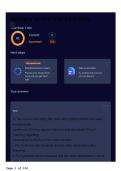
Don't give up now! Trust the process.
Your time: 1 min
Correct 0
0%
Incorrect 100
Next steps
100 missed terms
Practice terms in Learn Take a new test
Practice your missed terms Try another test to boost
more until you get them your confidence.
right.
Your answers
1 of 100
Term
19. The nurse is instructing the client with hypothyroidism who takes
levothyroxine
(Synthroid) 100 mcg, digoxin (Lanoxin) and simvastatin (Zocor).
Teaching regarding
medications is effective if the client will take:
1. The Synthroid with breakfast and the other medications after
breakfast.
2. The Synthroid before breakfast and the other medications 4 hours
later.
Page 1 of 134
, 3. All medications together 1 hour after eating breakfast.
4. All medications before going to bed.
The Client with Diabetes Mellitus
Give this one a try later!
2. Synthroid (levothyroxine) must be given at the same time each day on an
empty stomach, preferably 1/2 to 1 hour before breakfast. Other medications
may impair
the action of levothyroxine (Synthroid) absorption; the client should separate
doses of
other medications by 4 to 5 hours.
CN: Pharmacological and parenteral therapies; CL: Evaluate
The Client with Diabetes Mellitus
3. SSKI should be diluted well in milk, water, juice, or a carbonated beverage
before administration to help disguise the strong, bitter taste. Also, this drug is
irritating
to mucosa if taken undiluted. The client should sip the diluted preparation through a
drinking straw to help prevent staining of the teeth. Pouring the solution over ice
chips
will not sufficiently dilute the SSKI or cover the taste. Antacids are not used to dilute
or
cover the taste of SSKI. Mixing in a puree would put the SSKI in contact with the
teeth.
CN: Pharmacological and parenteral therapies; CL: Apply
2. PTU is a prototype of thioamide antithyroid drugs. It inhibits production of
thyroid hormones and peripheral conversion of T4 to the more active T3. A client
taking
this antithyroid drug should be able to sleep and rest well at night since the level of
thyroid hormones is reduced in the blood. Excess energy throughout the day, loss
of
weight and perspiring through the day are symptoms of hyperthyroidism indicating
Page 2 of 134
, the
drug has not produced its outcome.
CN: Pharmacological and parenteral therapies; CL: Evaluate.
2. A relaxed environment is an essential component of ulcer healing. Nurses can
help clients understand the importance of relaxation and explore with them ways to
balance work and family demands to promote healing. Being involved with his work
may prevent boredom; however, this client is upset and argumentative. Not keeping
up
with his job will probably increase the client's stress level, but the nurse's response is
best if it is based on the fact that a relaxed environment is an essential component
of
ulcer healing. Nurses cannot set limits on a client's behavior; clients must make the
decision to make lifestyle changes.
CN: Basic care and comfort; CL: Apply
Don't know?
2 of 100
Term
41. The nurse should instruct the client with a platelet count of 31,000/
μL (31 ×
109/L) to:
1. Pad sharp surfaces to avoid minor trauma when walking.
2. Assess for spontaneous petechiae in the extremities.
3. Keep the room darkened.
4. Check for blood in the urine.
Give this one a try later!
Page 3 of 134
, . A client with a platelet count of 30,000 to 50,000/μL (30 to 50 × 109/L) is
susceptible to bruising with minor trauma. Padding areas that the client might
bump,
scratch, or hit may help prevent minor trauma. A platelet count of 15,000 to
30,000/μL
(15 to 30 × 109/L) may result in spontaneous petechiae and bruising, especially
on the
extremities. Padding measures would still be used, but the focus would be on
assessing
for new spontaneous petechiae. Keeping the room dark does not help the
client with a
low platelet count. With a count below 20,000/μL (20 × 109/L), the client is at
risk for
spontaneous bleeding from the mucous membranes and intracranial bleeding.
CN: Reduction of risk potential; CL: Synthesize
2, 3, 5, 6. The client who is experiencing upper GI bleeding is at risk for
developing hypovolemic shock from blood loss. Therefore, the signs and symptoms
the
nurse should expect to find are those related to hypovolemia, including decreased
urine
output, tachycardia, rapid respirations, and thirst. The client's skin would be cool and
clammy, not dry and flushed. The client would also be likely to develop
hypotension,
which would lead to a narrowing pulse pressure, not a widening pulse pressure.
CN: Physiological adaptation; CL: Analyze
3. Treatment of mild ophthalmopathy that may accompany thyrotoxicosis includes
measures such as wearing sunglasses to protect the eyes from corneal irritation.
Treatment of ophthalmopathy should be performed in consultation with an
ophthalmologist. Massaging the eyes will not help to protect the cornea. An
ophthalmic
anesthetic is used to examine and possibly treat a painful eye, not protect the
cornea.
Covering the eyes with moist gauze pads is not a satisfactory nursing measure to
protect
the eyes of a client with exophthalmos because treatment is not focused on
Page 4 of 134
Your time: 1 min
Correct 0
0%
Incorrect 100
Next steps
100 missed terms
Practice terms in Learn Take a new test
Practice your missed terms Try another test to boost
more until you get them your confidence.
right.
Your answers
1 of 100
Term
19. The nurse is instructing the client with hypothyroidism who takes
levothyroxine
(Synthroid) 100 mcg, digoxin (Lanoxin) and simvastatin (Zocor).
Teaching regarding
medications is effective if the client will take:
1. The Synthroid with breakfast and the other medications after
breakfast.
2. The Synthroid before breakfast and the other medications 4 hours
later.
Page 1 of 134
, 3. All medications together 1 hour after eating breakfast.
4. All medications before going to bed.
The Client with Diabetes Mellitus
Give this one a try later!
2. Synthroid (levothyroxine) must be given at the same time each day on an
empty stomach, preferably 1/2 to 1 hour before breakfast. Other medications
may impair
the action of levothyroxine (Synthroid) absorption; the client should separate
doses of
other medications by 4 to 5 hours.
CN: Pharmacological and parenteral therapies; CL: Evaluate
The Client with Diabetes Mellitus
3. SSKI should be diluted well in milk, water, juice, or a carbonated beverage
before administration to help disguise the strong, bitter taste. Also, this drug is
irritating
to mucosa if taken undiluted. The client should sip the diluted preparation through a
drinking straw to help prevent staining of the teeth. Pouring the solution over ice
chips
will not sufficiently dilute the SSKI or cover the taste. Antacids are not used to dilute
or
cover the taste of SSKI. Mixing in a puree would put the SSKI in contact with the
teeth.
CN: Pharmacological and parenteral therapies; CL: Apply
2. PTU is a prototype of thioamide antithyroid drugs. It inhibits production of
thyroid hormones and peripheral conversion of T4 to the more active T3. A client
taking
this antithyroid drug should be able to sleep and rest well at night since the level of
thyroid hormones is reduced in the blood. Excess energy throughout the day, loss
of
weight and perspiring through the day are symptoms of hyperthyroidism indicating
Page 2 of 134
, the
drug has not produced its outcome.
CN: Pharmacological and parenteral therapies; CL: Evaluate.
2. A relaxed environment is an essential component of ulcer healing. Nurses can
help clients understand the importance of relaxation and explore with them ways to
balance work and family demands to promote healing. Being involved with his work
may prevent boredom; however, this client is upset and argumentative. Not keeping
up
with his job will probably increase the client's stress level, but the nurse's response is
best if it is based on the fact that a relaxed environment is an essential component
of
ulcer healing. Nurses cannot set limits on a client's behavior; clients must make the
decision to make lifestyle changes.
CN: Basic care and comfort; CL: Apply
Don't know?
2 of 100
Term
41. The nurse should instruct the client with a platelet count of 31,000/
μL (31 ×
109/L) to:
1. Pad sharp surfaces to avoid minor trauma when walking.
2. Assess for spontaneous petechiae in the extremities.
3. Keep the room darkened.
4. Check for blood in the urine.
Give this one a try later!
Page 3 of 134
, . A client with a platelet count of 30,000 to 50,000/μL (30 to 50 × 109/L) is
susceptible to bruising with minor trauma. Padding areas that the client might
bump,
scratch, or hit may help prevent minor trauma. A platelet count of 15,000 to
30,000/μL
(15 to 30 × 109/L) may result in spontaneous petechiae and bruising, especially
on the
extremities. Padding measures would still be used, but the focus would be on
assessing
for new spontaneous petechiae. Keeping the room dark does not help the
client with a
low platelet count. With a count below 20,000/μL (20 × 109/L), the client is at
risk for
spontaneous bleeding from the mucous membranes and intracranial bleeding.
CN: Reduction of risk potential; CL: Synthesize
2, 3, 5, 6. The client who is experiencing upper GI bleeding is at risk for
developing hypovolemic shock from blood loss. Therefore, the signs and symptoms
the
nurse should expect to find are those related to hypovolemia, including decreased
urine
output, tachycardia, rapid respirations, and thirst. The client's skin would be cool and
clammy, not dry and flushed. The client would also be likely to develop
hypotension,
which would lead to a narrowing pulse pressure, not a widening pulse pressure.
CN: Physiological adaptation; CL: Analyze
3. Treatment of mild ophthalmopathy that may accompany thyrotoxicosis includes
measures such as wearing sunglasses to protect the eyes from corneal irritation.
Treatment of ophthalmopathy should be performed in consultation with an
ophthalmologist. Massaging the eyes will not help to protect the cornea. An
ophthalmic
anesthetic is used to examine and possibly treat a painful eye, not protect the
cornea.
Covering the eyes with moist gauze pads is not a satisfactory nursing measure to
protect
the eyes of a client with exophthalmos because treatment is not focused on
Page 4 of 134


