

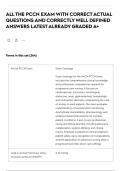
ALL THE PCCN EXAM WITH CORRECT ACTUAL
QUESTIONS AND CORRECTLY WELL DEFINED
ANSWERS LATEST ALREADY GRADED A+
Terms in this set (364)
All the PCCN Exam Exam Coverage
Exam coverage for the AACN PCCN Exam
includes the comprehensive clinical knowledge
and professional competencies required for
progressive care nursing. It focuses on
cardiovascular, pulmonary, neurological,
endocrine, renal, gastrointestinal, hematologic,
and multisystem disorders, emphasizing the care
of acutely ill adult patients. The exam evaluates
understanding of hemodynamic monitoring,
dysrhythmia interpretation, pharmacology, and
evidence-based interventions for complex
patient conditions. It also covers professional
caring and ethical practice, including advocacy,
collaboration, systems thinking, and clinical
inquiry. Emphasis is placed on clinical judgment,
patient safety, early recognition of complications,
and the application of advanced nursing skills in
progressive and step-down care settings.
what is normal Pulmonary artery 5-12 mmHg
occlusion pressure (PAOP)?
, The nurse observes that the fluid volume overload.
patient's jugular veins distend in the
semi-upright position to more than
5 cm above the sternal angle. This is
an indication of:
The resistance against which the systemic vascular resistance.
left ventricle must pump to eject its
volume is:
When the tricuspid valve is open, right ventricle.
central venous pressure reflects the
filling pressure in the:
Tachycardia is dangerous for the compromised cardiac output.
patient with ischemic heart disease
because of:
During initial examination of a central cyanosis.
critical care patient, the nurse
observes wide and convex nails
and bulbous fingertips. This is
evidence of:
Priorities for palpation of the estimating edema.
patient with cardiovascular disease checking capillary refill
include: checking for DVT
arterial pulses
QUESTIONS AND CORRECTLY WELL DEFINED
ANSWERS LATEST ALREADY GRADED A+
Terms in this set (364)
All the PCCN Exam Exam Coverage
Exam coverage for the AACN PCCN Exam
includes the comprehensive clinical knowledge
and professional competencies required for
progressive care nursing. It focuses on
cardiovascular, pulmonary, neurological,
endocrine, renal, gastrointestinal, hematologic,
and multisystem disorders, emphasizing the care
of acutely ill adult patients. The exam evaluates
understanding of hemodynamic monitoring,
dysrhythmia interpretation, pharmacology, and
evidence-based interventions for complex
patient conditions. It also covers professional
caring and ethical practice, including advocacy,
collaboration, systems thinking, and clinical
inquiry. Emphasis is placed on clinical judgment,
patient safety, early recognition of complications,
and the application of advanced nursing skills in
progressive and step-down care settings.
what is normal Pulmonary artery 5-12 mmHg
occlusion pressure (PAOP)?
, The nurse observes that the fluid volume overload.
patient's jugular veins distend in the
semi-upright position to more than
5 cm above the sternal angle. This is
an indication of:
The resistance against which the systemic vascular resistance.
left ventricle must pump to eject its
volume is:
When the tricuspid valve is open, right ventricle.
central venous pressure reflects the
filling pressure in the:
Tachycardia is dangerous for the compromised cardiac output.
patient with ischemic heart disease
because of:
During initial examination of a central cyanosis.
critical care patient, the nurse
observes wide and convex nails
and bulbous fingertips. This is
evidence of:
Priorities for palpation of the estimating edema.
patient with cardiovascular disease checking capillary refill
include: checking for DVT
arterial pulses


