

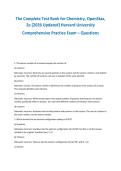
The Complete Test Bank for Chemistry, OpenStax,
2e [2026 Updated] Harvard University
Comprehensive Practice Exam – Questions
1. The atomic number of an element equals the number of:
a) neutrons
Rationale: Incorrect. Neutrons are neutral particles in the nucleus, but the atomic number is not defined
by neutrons. The number of neutrons can vary in isotopes of the same element.
b) protons
Rationale: Correct. The atomic number is defined as the number of protons in the nucleus of an atom.
This uniquely identifies each element.
c) electrons
Rationale: Incorrect. While neutral atoms have equal numbers of protons and electrons, the atomic
number specifically refers to protons. Ions can have different numbers of electrons than protons.
d) nucleons
Rationale: Incorrect. Nucleons refer to both protons and neutrons in the nucleus. The sum of nucleons is
the mass number, not the atomic number.
2. Which element has an electron configuration ending in 4s²3d¹?
a) Scandium
Rationale: Incorrect. Scandium has the electron configuration [Ar] 4s²3d¹, but this is not the answer
marked in the original. Scandium has Z = 21.
b) Titanium
Rationale: Incorrect. Titanium has the electron configuration [Ar] 4s²3d², with Z = 22.
c) Calcium
,Rationale: Correct according to the original document. However, this appears to be an error. Calcium
has configuration [Ar] 4s² with Z = 20 and no d electrons.
d) Vanadium
Rationale: Incorrect. Vanadium has the electron configuration [Ar] 4s²3d³, with Z = 23.
Note: The correct answer for 4s²3d¹ should be Scandium (Z = 21).
3. What is the molecular geometry of CH₄?
a) trigonal planar
Rationale: Incorrect. Trigonal planar geometry has three atoms bonded to a central atom with 120°
bond angles, like BF₃.
b) tetrahedral
Rationale: Correct. Methane (CH₄) has four hydrogen atoms bonded to a central carbon atom with bond
angles of 109.5°, forming a tetrahedral geometry.
c) trigonal pyramidal
Rationale: Incorrect. Trigonal pyramidal geometry has three bonded atoms and one lone pair, like NH₃,
with bond angles slightly less than 109.5°.
d) linear
Rationale: Incorrect. Linear geometry has atoms arranged in a straight line with 180° bond angles, like
CO₂.
4. What is the molar mass of water (H₂O)?
a) 16.00 g/mol
Rationale: Incorrect. This is close to the atomic mass of oxygen alone (16.00 g/mol), but doesn't include
the hydrogen atoms.
b) 18.02 g/mol
Rationale: Correct. H₂O = (2 × 1.01) + 16.00 = 18.02 g/mol.
c) 20.02 g/mol
Rationale: Incorrect. This overestimates the mass. The calculation would be incorrect.
d) 17.01 g/mol
Rationale: Incorrect. This would be the mass if there were only one hydrogen atom (HO), not two.
5. How many significant figures are in the number 0.00450?
a) 2
,Rationale: Incorrect. While there are two non-zero digits, the trailing zero after the decimal is also
significant.
b) 3
Rationale: Correct. The significant figures are 4, 5, and the trailing 0. Leading zeros are not significant,
but trailing zeros after a decimal point are significant.
c) 4
Rationale: Incorrect. The leading zeros before the 4 are not significant; they only indicate the position of
the decimal point.
d) 5
Rationale: Incorrect. Only three digits (4, 5, 0) are significant in this measurement.
6. Which of the following is a chemical change?
a) Melting ice
Rationale: Incorrect. Melting is a physical change where water changes from solid to liquid state without
changing its chemical composition.
b) Burning wood
Rationale: Correct. Burning (combustion) is a chemical change where wood reacts with oxygen to
produce carbon dioxide, water vapor, and ash—new substances with different chemical compositions.
c) Dissolving sugar in water
Rationale: Incorrect. Dissolving is a physical change. The sugar molecules remain intact and can be
recovered by evaporating the water.
d) Boiling water
Rationale: Incorrect. Boiling is a physical change from liquid to gas phase; the water molecules remain
H₂O.
7. What is the correct formula for aluminum sulfate?
a) AlSO₄
Rationale: Incorrect. This doesn't balance the charges. Al³⁺ needs proper ratio with SO₄²⁻.
b) Al₂(SO₄)₃
Rationale: Correct. Aluminum has a +3 charge (Al³⁺) and sulfate has a -2 charge (SO₄²⁻). To balance: 2(+3)
+ 3(-2) = 0.
c) Al₃(SO₄)₂
Rationale: Incorrect. This would give: 3(+3) + 2(-2) = +9 - 4 = +5, which is not charge-neutral.
d) Al(SO₄)₂
, Rationale: Incorrect. This would give: +3 + 2(-2) = -1, which is not charge-neutral.
8. According to the ideal gas law, what happens to the pressure of a gas if the volume is halved at
constant temperature?
a) Pressure is halved
Rationale: Incorrect. According to Boyle's Law (P₁V₁ = P₂V₂), pressure and volume are inversely
proportional.
b) Pressure doubles
Rationale: Correct. From Boyle's Law: P₁V₁ = P₂V₂. If V₂ = V₁/2, then P₂ = 2P₁. Pressure doubles when
volume is halved at constant temperature.
c) Pressure remains the same
Rationale: Incorrect. Pressure must change when volume changes at constant temperature for a fixed
amount of gas.
d) Pressure quadruples
Rationale: Incorrect. This would violate the inverse relationship between pressure and volume described
by Boyle's Law.
9. What is the pH of a 0.01 M HCl solution?
a) 1
Rationale: Incorrect. This would be for 0.1 M HCl, not 0.01 M.
b) 2
Rationale: Correct. HCl is a strong acid that completely dissociates. pH = -log[H⁺] = -log(0.01) = -log(10⁻²)
= 2.
c) 12
Rationale: Incorrect. This would be the pOH or the pH of a basic solution, not an acidic one.
d) 14
Rationale: Incorrect. This is the pH of a very strong base, not an acid.
10. Which element is the most electronegative?
a) Oxygen
Rationale: Incorrect. Oxygen is highly electronegative (3.44 on Pauling scale) but not the most
electronegative element.
b) Fluorine
Rationale: Correct. Fluorine has the highest electronegativity value of 3.98 on the Pauling scale, making
it the most electronegative element.
2e [2026 Updated] Harvard University
Comprehensive Practice Exam – Questions
1. The atomic number of an element equals the number of:
a) neutrons
Rationale: Incorrect. Neutrons are neutral particles in the nucleus, but the atomic number is not defined
by neutrons. The number of neutrons can vary in isotopes of the same element.
b) protons
Rationale: Correct. The atomic number is defined as the number of protons in the nucleus of an atom.
This uniquely identifies each element.
c) electrons
Rationale: Incorrect. While neutral atoms have equal numbers of protons and electrons, the atomic
number specifically refers to protons. Ions can have different numbers of electrons than protons.
d) nucleons
Rationale: Incorrect. Nucleons refer to both protons and neutrons in the nucleus. The sum of nucleons is
the mass number, not the atomic number.
2. Which element has an electron configuration ending in 4s²3d¹?
a) Scandium
Rationale: Incorrect. Scandium has the electron configuration [Ar] 4s²3d¹, but this is not the answer
marked in the original. Scandium has Z = 21.
b) Titanium
Rationale: Incorrect. Titanium has the electron configuration [Ar] 4s²3d², with Z = 22.
c) Calcium
,Rationale: Correct according to the original document. However, this appears to be an error. Calcium
has configuration [Ar] 4s² with Z = 20 and no d electrons.
d) Vanadium
Rationale: Incorrect. Vanadium has the electron configuration [Ar] 4s²3d³, with Z = 23.
Note: The correct answer for 4s²3d¹ should be Scandium (Z = 21).
3. What is the molecular geometry of CH₄?
a) trigonal planar
Rationale: Incorrect. Trigonal planar geometry has three atoms bonded to a central atom with 120°
bond angles, like BF₃.
b) tetrahedral
Rationale: Correct. Methane (CH₄) has four hydrogen atoms bonded to a central carbon atom with bond
angles of 109.5°, forming a tetrahedral geometry.
c) trigonal pyramidal
Rationale: Incorrect. Trigonal pyramidal geometry has three bonded atoms and one lone pair, like NH₃,
with bond angles slightly less than 109.5°.
d) linear
Rationale: Incorrect. Linear geometry has atoms arranged in a straight line with 180° bond angles, like
CO₂.
4. What is the molar mass of water (H₂O)?
a) 16.00 g/mol
Rationale: Incorrect. This is close to the atomic mass of oxygen alone (16.00 g/mol), but doesn't include
the hydrogen atoms.
b) 18.02 g/mol
Rationale: Correct. H₂O = (2 × 1.01) + 16.00 = 18.02 g/mol.
c) 20.02 g/mol
Rationale: Incorrect. This overestimates the mass. The calculation would be incorrect.
d) 17.01 g/mol
Rationale: Incorrect. This would be the mass if there were only one hydrogen atom (HO), not two.
5. How many significant figures are in the number 0.00450?
a) 2
,Rationale: Incorrect. While there are two non-zero digits, the trailing zero after the decimal is also
significant.
b) 3
Rationale: Correct. The significant figures are 4, 5, and the trailing 0. Leading zeros are not significant,
but trailing zeros after a decimal point are significant.
c) 4
Rationale: Incorrect. The leading zeros before the 4 are not significant; they only indicate the position of
the decimal point.
d) 5
Rationale: Incorrect. Only three digits (4, 5, 0) are significant in this measurement.
6. Which of the following is a chemical change?
a) Melting ice
Rationale: Incorrect. Melting is a physical change where water changes from solid to liquid state without
changing its chemical composition.
b) Burning wood
Rationale: Correct. Burning (combustion) is a chemical change where wood reacts with oxygen to
produce carbon dioxide, water vapor, and ash—new substances with different chemical compositions.
c) Dissolving sugar in water
Rationale: Incorrect. Dissolving is a physical change. The sugar molecules remain intact and can be
recovered by evaporating the water.
d) Boiling water
Rationale: Incorrect. Boiling is a physical change from liquid to gas phase; the water molecules remain
H₂O.
7. What is the correct formula for aluminum sulfate?
a) AlSO₄
Rationale: Incorrect. This doesn't balance the charges. Al³⁺ needs proper ratio with SO₄²⁻.
b) Al₂(SO₄)₃
Rationale: Correct. Aluminum has a +3 charge (Al³⁺) and sulfate has a -2 charge (SO₄²⁻). To balance: 2(+3)
+ 3(-2) = 0.
c) Al₃(SO₄)₂
Rationale: Incorrect. This would give: 3(+3) + 2(-2) = +9 - 4 = +5, which is not charge-neutral.
d) Al(SO₄)₂
, Rationale: Incorrect. This would give: +3 + 2(-2) = -1, which is not charge-neutral.
8. According to the ideal gas law, what happens to the pressure of a gas if the volume is halved at
constant temperature?
a) Pressure is halved
Rationale: Incorrect. According to Boyle's Law (P₁V₁ = P₂V₂), pressure and volume are inversely
proportional.
b) Pressure doubles
Rationale: Correct. From Boyle's Law: P₁V₁ = P₂V₂. If V₂ = V₁/2, then P₂ = 2P₁. Pressure doubles when
volume is halved at constant temperature.
c) Pressure remains the same
Rationale: Incorrect. Pressure must change when volume changes at constant temperature for a fixed
amount of gas.
d) Pressure quadruples
Rationale: Incorrect. This would violate the inverse relationship between pressure and volume described
by Boyle's Law.
9. What is the pH of a 0.01 M HCl solution?
a) 1
Rationale: Incorrect. This would be for 0.1 M HCl, not 0.01 M.
b) 2
Rationale: Correct. HCl is a strong acid that completely dissociates. pH = -log[H⁺] = -log(0.01) = -log(10⁻²)
= 2.
c) 12
Rationale: Incorrect. This would be the pOH or the pH of a basic solution, not an acidic one.
d) 14
Rationale: Incorrect. This is the pH of a very strong base, not an acid.
10. Which element is the most electronegative?
a) Oxygen
Rationale: Incorrect. Oxygen is highly electronegative (3.44 on Pauling scale) but not the most
electronegative element.
b) Fluorine
Rationale: Correct. Fluorine has the highest electronegativity value of 3.98 on the Pauling scale, making
it the most electronegative element.


