
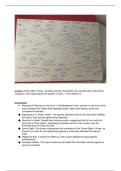
Context: Divine right of kings, Jacobean gender stereotypes, gun powder plot, King James'
suspicion of the supernatural, the garden of Eden -> the original sin
Extra points:
● Meaning of "Wounds on the front": In Shakespeare's time, wounds on the front of the
body indicated the soldier died fighting forward, rather than fleeing, which was
considered honorable.
● Significance of "God's soldier": The phrase indicates that the son died while fulfilling
his duty to God and the rightful king (Malcolm).
● Reaction to Death: Siward feels immense pride, suggesting that his son could not
have had a "fairer death," prioritizing honorable service to his country over the
emotional pain of losing his child.
● Divine Right: The phrase emphasizes the restoration of the Divine Right of Kings, as
Siward's son dies for the rightful king against a tyrant who disturbed the natural
order.
● Righteous War: It marks the battle as a holy cause (fighting for good against
evil/Macbeth).
● Jacobean Beliefs: The scene reinforces the belief that honorable sacrifice against a
tyrant is rewarded
,⚔️
Violence
● Shakespeare presents violence for the purpose of defending one’s country as
honourable and associates it with masculinity; Macbeth’s changing use of violence
however, having been manipulated by Lady Macbeth, transforms him from heroic
to treacherous.
- Macbeth from the start was not just brave but also violent - ‘like Valour’s minion’ - this
simile portrays him as a fearless warrior, yet also suggests he is dangerously
enslaved to violence, foreshadowing his transition from a noble hero to a brutal
tyrant, "Valour" is capitalised (personified) showing Macbeth physically belongs to
something which is the epitome of courage or bravery, while "minion" means a loyal
follower, servant, or favorite, Macbeth serves bravery itself
- LM encourages M to kill Duncan saying his lack of masculinity (his morals) are
getting in the way of him gaining power - "When you durst do it, then you were a
man” - LM’s different ideas of what it takes to be a man are twisted by her to make M
help her achieve power too, shows how M values the status of being a man
- M has become unfeeling and brutal - “give to th’ edge o’ th’ sword His wife, his
babes” (after witches tell him to beware of Macduff as he’s a threat to M’s power) -
brutal and cruel, this lack of empathy that Macbeth has, also shows his violence
(perhaps insults to his masculinity have got to him and he is playing into this
stereotypical manliness and becoming more violent), shows his paranoia as even the
words of the witches which he acknowledges are unreliable cause his to kill the
whole family of someone who might not even be a threat to him, delusion and
psychological instability caused by violence
- Transformation of M from loyal to uncontrollable and evil (horses eating themselves
is a grotesque and repulsive act of violence), inversion of natural order which reflects
the violence and evil nature of regicide that M has committed - “And Duncan’s horses
[…] Beauteous and swift, the minions of their race, Turned wild in nature” (and ate
each other) -> M is ‘Valour’s minion’ - whilst M was first brave and noble expelling
evil and terror from infiltrating Scotland and defending the king passionately like the
horses, he becomes wild and cannibalism is an immense act of evil much like
regicide, shows transformative effect of violence and horror of breaking Divine Right
of Kings (warning after Gunpowder plot a few years earlier
● Despite associating violence to masculinity, Shakespeare implies it is not exclusive
to men through the character of Lady Macbeth; whilst Lady Macbeth is not directly
violent, her manipulation of Macbeth in the pursuit of power and her use of violent
imagery would have been particularly horrifying to a Jacobean audience, as it goes
against the perceived natural role of women as nurturers.
- She uses this image of unimaginable brutality of killing her own child rather than
giving up on their plan to display her own unmatched commitment to violence and
regicide for the gaining of power - ‘while it was smiling in my face, Have pluck'd my
nipple from his boneless gums, And dash'd the brains out, had I so sworn as you
Have done to this’ - Lady Macbeth's hypothetical infanticide, rejection of typically
, female role in the pursuit of unfeeling violence, Through this violent imagery of killing
her child "while it was smiling" in her face, Shakespeare emphasises the highly
masculine state of lady Macbeth, lacking traditional maternal and feminine traits, as
well as her great, ruthless ambition, suggesting women can be just as brutal and
vicious as men even though LM thinks she must remove her feminine qualities if she
wants to pursue violence, encourages M to kill Duncan as he sees how committed
she is
● Through the increasingly corrosive impacts on not just Macbeth, but a wider
Scotland, Shakespeare suggests violence has a cyclical nature, presenting its
consequences is infectious and inescapable
- Cyclical / inescapable nature of violence - “I am in blood stepped in so far that should
I wade no more, returning were as tedious as go o’er” - once macbeth has committed
the initial act of violence, he has to commit more and more out of paranoia, this
mirrors his deteriorating psychological state due to his murder of Duncan and
therefore shakespeare could be trying to suggest that violence doesn't only have an
effect on its victims but it also has a great impact on its perpetrators, paranoia due to
fear of retribution due to his violent act, suffocation and entrapment in blood which is
a motif for guilt from this violence, M thinks paranoia will solve guilt as his action of
regicide will finally be worth it and he can finally be secure in his kingship
- The metaphor spoken by the soldiers, imply M, a figure of violence, is like a virus
which has infected Scotland is emphasised is the chaos, sorrow and suffering of
nature which is seen towards the end of the play - “Meet we the medicine (this is
talking about Malcolm) of the sickly weal (weal means sickly -> talking about M)” -
violence is infectious and impacts the wider environment poorly, destruction caused
by violence can potentially
- Physical damage to Scotland (said by Macduff) - “Bleed, bleed poor country!” -
personification suggests wider groups are just as vulnerable as targeted individuals
like M’s victims, Macbeth's violence has escalated to be destroying the whole country
not just individuals - repetition of bleed shows how devastating the effect is, through
this recurring motif of blood, Shakespeare presents Macbeth as extremely
bloodthirsty as it is one of his recurring thoughts, Macbeth’s violence as a physical
attack to the wellbeing of a country
⭐ Ambition
● Shakespeare uses the character of Lady Macbeth to demonstrate how manipulation
and the concealing of in pursuit of ambition has devastating effects on natural
order
- LM is telling M to conceal intentions of killing Duncan in the future - “Look like th’
innocent flower, but be the serpent under’t” - Imperative verb “look” is very
demanding showing how determined Lady Macbeth is to gain power and how


