

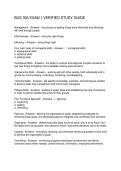
BUS 305 EXAM 1 VERIFIED STUDY GUIDE
Management - Answers - the process of getting things done effectively and efficiently,
with and through people
Effectiveness - Answers - doing the right things
Efficiency - Answers - doing things right
Four main types of managerial skills - Answers - 1. conceptual skills
2. interpersonal skills
3. technical skills
4. political skills
Conceptual Skills - Answers - the ability to analyze and diagnose complex situations to
see how things fit together and to facilitate making good decisions
Interpersonal Skills - Answers - working well with other people, both individually and in
groups by communicating, motivating, mentoring, and delegating.
Technical Skills - Answers - job specific knowledge, expertise, and techniques needed
to perform tasks (top management and mid & lower managers)
Political Skills - Answers - building a power base and establishing the right connections
in order to get the needed resources for their groups
Four Functions Approach - Answers - 1. planning
2. organizing
3. leading
4. controlling
Planning - Answers - defining the organization's goals, establishing strategies for
achieving those goals, and developing plans to integrate and coordinate work activities
Organizing - Answers - determining what tasks are to be done, who is to do them, how
the tasks are to be grouped, who reports to whom, and where decisions are to be made
Leading - Answers - motivating, directing, and otherwise influencing people to work hard
to achieve the organization's goals
Controlling - Answers - monitoring progress toward goal achievement and taking
corrective action when needed, control finances, information, employee performance
, Top Management - Answers - managers who set the overall direction of the firm,
articulating a vision, establishing priorities, and allocating time, money, and other
resources
Mid and lower managers - Answers - specialized knowledge in their required areas
Pros of flexible work arrangements
Cons of flexible work arrangements
Organizational Culture - Answers - shared values, principles, traditions, and ways of
doing things that influence the way organizational members act
How does an organization obtain its culture? - Answers - - usually reflects the vision or
mission of founders
- founders project an image of what the organization should be and what its values are
- founders can "impose their vision of employees because of a new organization's small
size
- organizational members create a shared history that binds them into a community
How employees learn culture - Answers - organizational stories, rituals, material
symbols, language
Organizational Stories - Answers - narrative tales of significant events or people
Corporate Rituals - Answers - repetitive sequences of activities that express and
reinforce important organizational values and goals
Material Symbols or Artifacts - Answers - layout of facilities, how employees dress, size
of offices, material perks provided to executives, furnishings, and so forth
Language - Answers - special acronyms; unique terms to describe equipment, key
personnel, customers, suppliers, processes, products
Affects of organizational culture on managers - Answers - - through its effect on what
employees do and how they behave
- through its effect on what managers do as they plan, lead, organize, and control
(depends on whether there is a strong or weak culture "ready-aim-fire" or "ready-fire-
aim")
Culture - Answers - perceived, descriptive, shared, unwritten rules of how we do things
here
Global Village - Answers - a boundaryless world where goods and services are
produced and marketed worldwide
Management - Answers - the process of getting things done effectively and efficiently,
with and through people
Effectiveness - Answers - doing the right things
Efficiency - Answers - doing things right
Four main types of managerial skills - Answers - 1. conceptual skills
2. interpersonal skills
3. technical skills
4. political skills
Conceptual Skills - Answers - the ability to analyze and diagnose complex situations to
see how things fit together and to facilitate making good decisions
Interpersonal Skills - Answers - working well with other people, both individually and in
groups by communicating, motivating, mentoring, and delegating.
Technical Skills - Answers - job specific knowledge, expertise, and techniques needed
to perform tasks (top management and mid & lower managers)
Political Skills - Answers - building a power base and establishing the right connections
in order to get the needed resources for their groups
Four Functions Approach - Answers - 1. planning
2. organizing
3. leading
4. controlling
Planning - Answers - defining the organization's goals, establishing strategies for
achieving those goals, and developing plans to integrate and coordinate work activities
Organizing - Answers - determining what tasks are to be done, who is to do them, how
the tasks are to be grouped, who reports to whom, and where decisions are to be made
Leading - Answers - motivating, directing, and otherwise influencing people to work hard
to achieve the organization's goals
Controlling - Answers - monitoring progress toward goal achievement and taking
corrective action when needed, control finances, information, employee performance
, Top Management - Answers - managers who set the overall direction of the firm,
articulating a vision, establishing priorities, and allocating time, money, and other
resources
Mid and lower managers - Answers - specialized knowledge in their required areas
Pros of flexible work arrangements
Cons of flexible work arrangements
Organizational Culture - Answers - shared values, principles, traditions, and ways of
doing things that influence the way organizational members act
How does an organization obtain its culture? - Answers - - usually reflects the vision or
mission of founders
- founders project an image of what the organization should be and what its values are
- founders can "impose their vision of employees because of a new organization's small
size
- organizational members create a shared history that binds them into a community
How employees learn culture - Answers - organizational stories, rituals, material
symbols, language
Organizational Stories - Answers - narrative tales of significant events or people
Corporate Rituals - Answers - repetitive sequences of activities that express and
reinforce important organizational values and goals
Material Symbols or Artifacts - Answers - layout of facilities, how employees dress, size
of offices, material perks provided to executives, furnishings, and so forth
Language - Answers - special acronyms; unique terms to describe equipment, key
personnel, customers, suppliers, processes, products
Affects of organizational culture on managers - Answers - - through its effect on what
employees do and how they behave
- through its effect on what managers do as they plan, lead, organize, and control
(depends on whether there is a strong or weak culture "ready-aim-fire" or "ready-fire-
aim")
Culture - Answers - perceived, descriptive, shared, unwritten rules of how we do things
here
Global Village - Answers - a boundaryless world where goods and services are
produced and marketed worldwide


