

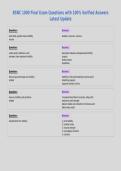
BSNC 1000 Final Exam Questions with 100% Verified Answers
Latest Update
Question: Answer:
what body systems does mobility skeletal, muscular, nervous
involve
Question: Answer:
under what conditions could bone/joint diseases (osteoporosis/arthritis)
someone have impaired mobility surgery
broken bones
disabilities
Question: Answer:
how are gas exchange and mobility mobility of ribs and breathing muscles aid in
related breathing properly
supports aerobic activity
Question: Answer:
how are mobility and perfusion increased blood flow to muscles, helps with
related endurance and strength
delivers blood and nutrients to the bones and
takes away waste
Question: Answer:
requirements for mobility 1. joint stability
2. healthy bones
3. muscle strength
4. neurological function
5. nutrition
, Question: Answer:
aging effects on mobility loss of bone mass, decreased height (can lead
to osteoporosis)
muscle atrophy (can lead to sarcopenia)
increased stiffness of joints (can lead to
osteoarthritis)
Question: Answer:
cell types in bones osteoblast, osteoclast, osteocyte, osteogenic
cell (stem cells)
Question: Answer:
extracellular matrix osteoid (organic)- collagen and calcium-binding
proteins, it is the intercellular matrix
inorganic - minerals (calcium, Mg, carbonate,
phosphate) and water
Question: Answer:
bone remodelling ongoing replacement of old bone tissue by new
bone tissue
maintain and repair
adaptation to stress (weightlifting)
mineral regulation
Question: Answer:
which part of the bone does Trabelcullar surface of spongy bone
remodelling occur
Question: Answer:
4 steps of bone remodelling 1. resorption - osteoclasts attach to bone
surface andremove bone matrix
2. reversal - transitional period bt resorption and
formation
3. formation - osteoblasts secrete osteoid
4. mineralization - osteoblasts deposit minerals
in the formed organic osteoid matrix
Latest Update
Question: Answer:
what body systems does mobility skeletal, muscular, nervous
involve
Question: Answer:
under what conditions could bone/joint diseases (osteoporosis/arthritis)
someone have impaired mobility surgery
broken bones
disabilities
Question: Answer:
how are gas exchange and mobility mobility of ribs and breathing muscles aid in
related breathing properly
supports aerobic activity
Question: Answer:
how are mobility and perfusion increased blood flow to muscles, helps with
related endurance and strength
delivers blood and nutrients to the bones and
takes away waste
Question: Answer:
requirements for mobility 1. joint stability
2. healthy bones
3. muscle strength
4. neurological function
5. nutrition
, Question: Answer:
aging effects on mobility loss of bone mass, decreased height (can lead
to osteoporosis)
muscle atrophy (can lead to sarcopenia)
increased stiffness of joints (can lead to
osteoarthritis)
Question: Answer:
cell types in bones osteoblast, osteoclast, osteocyte, osteogenic
cell (stem cells)
Question: Answer:
extracellular matrix osteoid (organic)- collagen and calcium-binding
proteins, it is the intercellular matrix
inorganic - minerals (calcium, Mg, carbonate,
phosphate) and water
Question: Answer:
bone remodelling ongoing replacement of old bone tissue by new
bone tissue
maintain and repair
adaptation to stress (weightlifting)
mineral regulation
Question: Answer:
which part of the bone does Trabelcullar surface of spongy bone
remodelling occur
Question: Answer:
4 steps of bone remodelling 1. resorption - osteoclasts attach to bone
surface andremove bone matrix
2. reversal - transitional period bt resorption and
formation
3. formation - osteoblasts secrete osteoid
4. mineralization - osteoblasts deposit minerals
in the formed organic osteoid matrix


